TL;DR
The right warehouse management system (WMS) depends on your business type, order volume, sales channels, SKU complexity and number of warehouses. Enterprise WMS platforms like Manhattan Associates, SAP EWM, Oracle, Infios, Infor, Tecsys and Microsoft Dynamics 365 suit large, automation-heavy distribution networks. E-commerce and logistics-focused tools like Vinculum, Shipsy and Unicommerce suit small to mid-scale sellers with simpler catalogues. Increff WMS, rated 4.7/5 on Gartner Peer Insights, suits mid to large enterprises and 3PLs across 17+ industries, from retail and consumer goods to electronics, pharma and manufacturing, that need to handle high scale, fast fulfillment and complex SKU catalogues across multiple warehouses without fulfillment failures.
Run peak-season volumes without a single fulfillment failure
Choosing the best warehouse management system has become a crowded decision. The global WMS market is estimated at USD 4.0 to 4.8 billion in 2026, and forecasts put it at USD 16.0 billion by 2033. More vendors means more choice, and more ways to buy the wrong system. At Increff, we see the same pattern with growing brands: the WMS works well on a normal Tuesday, then buckles on sale day. Orders stall, inventory goes out of sync, and cancellations pile up exactly when demand is highest.
This guide flips the usual approach. It starts with your business type, then shows which WMS fits it best.
What Should Decide Which WMS You Choose?
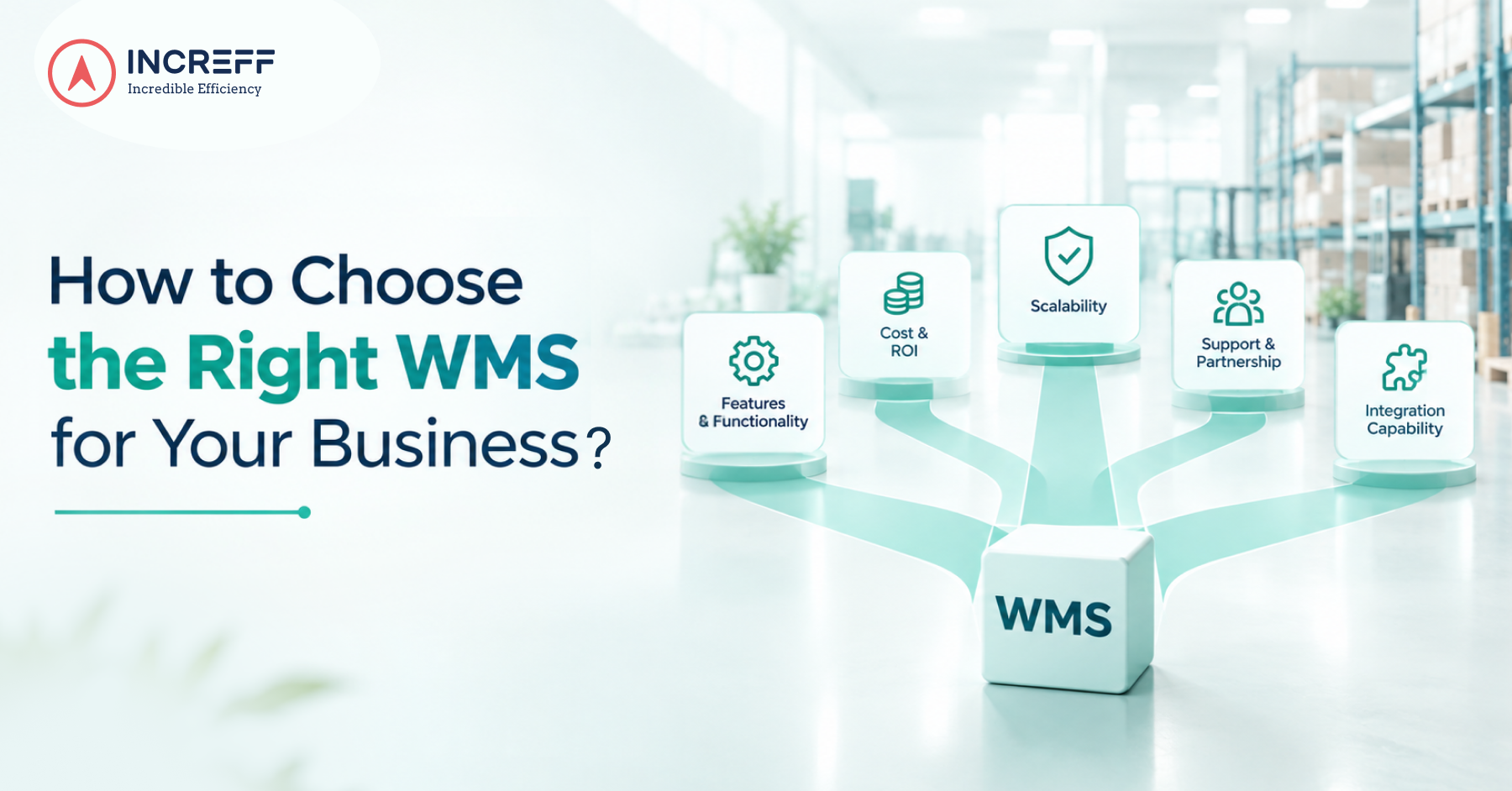
Features matter less than fit. Before comparing vendors, define where your business sits on four dimensions.
| Dimension |
Lower complexity |
Higher complexity |
| Order volume |
Under 1,000 orders a day |
10,000+ orders a day, with sale-day spikes |
| Channels |
Single channel (own site or one marketplace) |
Website, marketplaces, stores, B2B and quick commerce |
| SKU profile |
Few SKUs, no variants |
Thousands of SKUs across variants, batches or serial numbers |
| Warehouse setup |
One site, manual picking |
Multi-site or multi-country, automation, 3PL or client-specific rules |
Your position on this grid narrows the shortlist faster than any feature checklist.
Which Business Types Need Which Kind of WMS?
| Business type |
What it needs most |
WMS category that fits |
| Early-stage D2C brand |
Fast setup, low cost, Shopify integration |
E-commerce WMS |
| Marketplace-led e-commerce seller |
Channel integrations, order routing, simple catalogue |
E-commerce WMS |
| Mid to large omnichannel brand or retailer |
Unified inventory, real-time sync, peak-day reliability |
Scalable multi-industry WMS |
| High-SKU, multi-category business (fashion, beauty, electronics, pharma, consumer goods) |
Item-level accuracy, batch or serial tracking, high returns, B2B and B2C from one site |
Scalable multi-industry WMS |
| 3PL provider |
Multi-client inventory, fast client onboarding |
Scalable multi-industry or 3PL-focused WMS |
| Global manufacturer with heavy automation |
Automation orchestration, labour management, deep ERP ties |
Tier-1 enterprise WMS |
Which WMS Platform Is Right for You?
Use this table to match each platform to your business. Ratings are from Gartner Peer Insights as of October 2026.
| WMS |
Gartner Rating |
Depth vs Breadth |
Business Scale |
Industry & Complexity |
Inventory Accuracy & Auditing |
| Increff WMS |
★ 4.7 / 5 |
Depth: high-volume execution with enterprise-grade precision |
Mid to large-scale enterprises and 3PLs |
17+ industries including fashion, beauty, electronics, pharma, consumer goods, automotive and manufacturing, with complex SKU catalogues |
99.9% bin-level accuracy with item-level serialization and audit trails |
| Unicommerce |
Not shown |
Breadth over depth: covers many e-commerce use cases but lacks the high-volume capacity enterprise operations demand |
Small to mid-scale businesses |
D2C and e-commerce brands with simpler fulfillment and catalogue complexity |
Warehouse-level accuracy with standard fulfillment audits |
| Infios (formerly Körber) |
★ 4.6 / 5 |
Breadth with depth: modular WMS plus warehouse control and automation software, configured site by site |
Mid to large enterprises; 5,000+ customers across 70 countries |
Retail, 3PL, manufacturing and pharma distribution with custom workflows |
Configurable counting and control; accuracy depends on how each site is implemented |
| Vinculum (Vin WMS) |
★ 4.6 / 5 |
Breadth across B2B warehousing and B2C e-commerce fulfillment |
Small to mid-scale sellers, brands and dark-store networks |
Multichannel online retail and quick commerce |
Multi-location, barcode-based SKU tracking with real-time monitoring |
| Oracle Fusion Cloud WM |
★ 4.5 / 5 |
Breadth: a warehouse module inside the wider Oracle Fusion Cloud SCM suite |
Mid to large enterprises already standardised on Oracle |
Distribution and manufacturing consolidating applications under Oracle Cloud |
Cycle counting and LPN-level control, with stock shared across Oracle supply, finance and order records |
| Shipsy WMS |
★ 4.5 / 5 |
Breadth across logistics: warehousing sits alongside transportation and last-mile modules |
Mid-market to enterprise logistics-led operations |
3PL, courier and distribution businesses where transport is the core workflow |
SKU-level tracking with standard counting and audit reporting |
| Tecsys Elite WMS |
★ 4.5 / 5 |
Depth for regulated, high-cost-of-failure distribution |
Mid to large healthcare networks, hospital systems and pharma distributors |
Healthcare, hospital logistics and pharmaceutical distribution; narrower adoption in retail and e-commerce |
DSCSA-ready serialization with lot and expiry traceability for regulated goods |
| Infor WMS |
★ 4.5 / 5 |
Depth for industrial distribution, with embedded labour management and 3D warehouse visualisation |
Mid to large enterprises and contract logistics providers |
Manufacturing, wholesale distribution and 3PL, including multi-client sites in one warehouse |
Accuracy tied to configuration and ERP integration |
| Manhattan Associates |
★ 4.4 / 5 |
Depth: advanced execution with a warehouse execution system built into the WMS |
Large global enterprises running automated distribution centres |
High-volume retail, grocery and manufacturing distribution; implementations typically run over several months |
Strong location, slotting and automation control from inbound through outbound |
| Microsoft Dynamics 365 SCM |
★ 4.3 / 5 |
Breadth: advanced warehousing inside a wider ERP rather than a standalone WMS |
Mid to large enterprises already running Dynamics 365 |
Manufacturers and distributors on Microsoft; a warehouse-only mode covers sites on other ERPs |
Inventory governed by ERP records, with waves, location directives and mobile-app counting |
| SAP EWM |
★ 4.2 / 5 |
Depth within the SAP ecosystem, run embedded in or decentralised |
Large, process-heavy enterprises already standardised on SAP |
Manufacturing, chemicals, pharma and wholesale, with material flow control for automation; configuration-heavy to implement |
Stock governed through SAP finance and supply chain records, with physical inventory and audit processes |
Which Signals Say You've Outgrown Your Current WMS?
- Inventory counts in the WMS rarely match physical stock.
- Sale events cause missed SLAs, oversells and order cancellations.
- Adding a new channel or warehouse takes months of IT work.
- Pickers rely on paper lists or workarounds for exceptions.
- Every change request goes back to the vendor as a paid project.
How Does Increff Handle Scale, Speed and Complexity Without Fulfillment Failures?
Mid to large enterprises face a specific problem. E-commerce WMS tools work until volume, SKU depth or warehouse count grows, and then they break at peak. Enterprise suites can handle the load, but they take months to implement. Increff WMS is built for the scale, speed and complexity these businesses actually run on, without fulfillment failures, across 17+ industries from fashion and beauty to electronics, pharma, automotive and manufacturing.
| What it handles |
How Increff delivers it |
| Scale |
Peak sale-day surges with zero downtime and 99.5% SLA adherence across B2B and B2C orders |
| Speed |
Inventory sync in under 10 seconds, go-lives in days, and staff onboarding in under 30 minutes |
| Complexity |
99.9% bin-level accuracy with item-level serialization across large SKU catalogues, multiple warehouses and multiple countries |
| Connectivity |
1,300+ plug-and-play integrations across ERPs, marketplaces, POS and logistics partners |
| Full warehouse coverage |
Receiving, putaway, picking, packing, invoicing, dispatch, cross-docking and returns in one system |
| Dispute-proof fulfillment |
Video proof at dispatch and returns for faster refunds and claim resolution |
These capabilities show up in results.
Increff Helped GlobalBees Achieve 99.9% Inventory Accuracy with a Cloud-Based WMS and OMS
Conclusion
The best WMS is the one that matches how your business actually runs. That means your volume, your channels, your SKU depth and how quickly you need to be live. Enterprise suites earn their place in very large networks, and e-commerce tools work well while operations stay simple. Mid to large enterprises, in any industry, need a system that holds up when scale, speed and complexity peak together, and that is when fulfillment failures cost the most.
See how Increff keeps fulfillment running even during peak volume surge
Frequently Asked Questions
Q: What is the best WMS for a small business?
A: For single-channel businesses with low order volumes, a lightweight e-commerce WMS with ready marketplace integrations is usually enough. Once you add stores, B2B orders or multiple warehouses, look for a system that runs all channels from one inventory pool with real-time sync.
Q: What is the best WMS for mid to large enterprises?
A: Mid to large enterprises need a WMS that handles high order volumes, fast fulfillment and complex SKU catalogues across multiple warehouses without breaking at peak. Increff WMS is built for this across 17+ industries, with zero downtime during sale-day surges, 99.5% SLA adherence, 99.9% bin-level accuracy and a 4.7/5 rating on Gartner Peer Insights.
Q: Is Increff a good Unicommerce alternative?
A: It is for mid to large businesses. Unicommerce suits small to mid-scale e-commerce sellers with simpler catalogues. Increff is built for complex SKU catalogues, multi-warehouse operations and high-volume peaks, with inventory sync in under 10 seconds.
Q: How long does a WMS implementation take?
A: Enterprise WMS projects from vendors like SAP and Manhattan can take several months. Increff has deployed a 1M sq. ft. warehouse in under a week, and warehouse staff can be onboarded in under 30 minutes.
Q: Which WMS works for businesses with complex, high-SKU catalogues?
A: Look for item-level serialization, bin-level accuracy and support for variants, batches and serial numbers. Increff WMS handles this across 17+ industries, including fashion, beauty, electronics, pharma and consumer goods, while general-purpose WMS platforms often need customisation to match.
Q: Should a 3PL choose a different WMS than a brand?
A: Yes, in most cases. 3PLs need multi-client inventory separation, client-specific rules and quick onboarding. Increff helped a UK 3PL lift warehouse productivity by 20% on a single, rapidly deployed system.