


.webp)
.webp)




.webp)











Allocation & Replenishment for E-commerce and Offline Retail

allocation


allocation

centre replenishment







Increase Sales While Reducing Excess Inventory
- True ROS and Store-StyleRank™
- Intelligent Replacements & Options Increment
- Assortment & Size Mix Optimization
- Configurable Business Rules & Guardrails
- Easy Integration and Rapid Deployment
- Granular Analytics & Reporting
- Darkstore/DC Replenishment
True ROS and Store-StyleRank™

- True Rate of Sale Precision: Calculates True Rate of Sale (ROS) for every store-style-SKU by considering only healthy, in-stock sales days, removing the noise of stockouts, liquidation periods, and broken sizes.
- Advanced Ranking Algorithm: Creates unique rankings for every store–style combination, factoring in recency, seasonality, sales velocity, and revenue potential through Store-StyleRank™
- Intelligent Allocation System: Prioritizes merchandise allocation and replenishment to the highest ROI store-style-SKU combinations, ensuring the right depth at the right store at the right time.
- Local Trend Detection: Identifies local top-sellers and emerging winners accurately to minimize sales loss.
Intelligent Replacements & Options Increment
- Smart Replacement System: Suggests the closest style replacements instantly from similar attribute groups when a bestseller is out of stock, preventing lost sales from unavailability.
- Automatic Options Increment: Tailors the assortment at each store by identifying gaps and sending additional options accordingly with the support of retail allocation software.
- Historical Pattern Adaptation: Enables rapid new style merchandise allocation (even for styles with no historical data) using attribute group performance as a proxy for demand.
- Customer Experience Enhancement: Maintains merchandise variety and freshness for shoppers, boosting conversion rates and customer experience.
Assortment & Size Mix Optimization
- Localized Demand Intelligence: Adapts store assortments to local demand by analyzing sales data and shopper demographics.
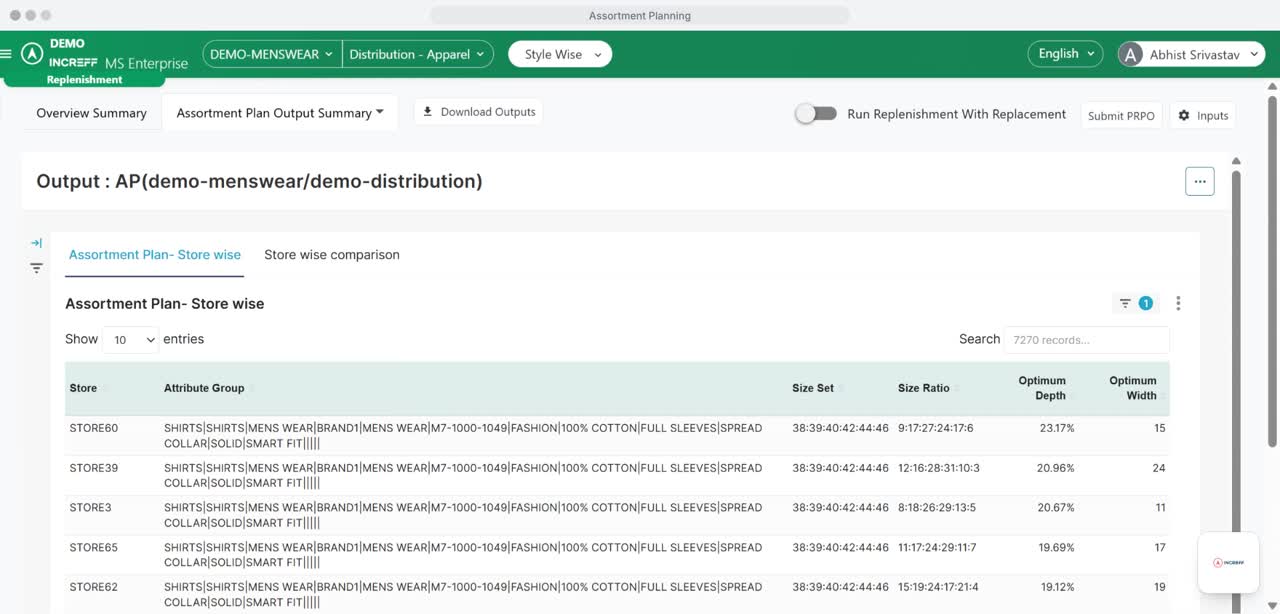
- Dynamic Size Profile Optimization: Optimizes size distribution dynamically to ensure every location carries accurate size mix through precise inventory allocation and reduces stockouts.
- Seasonal Assortment Management: Updates product variety and size mix continuously based on seasonality, trends, and real-time performance.
- Performance-Based Inventory Control: Removes underperforming SKUs and replenishes winning options to maximize sales and minimize excess inventory with smart merchandise replenishment solution.
Configurable Business Rules & Guardrails
- Customizable Control Framework: Allows teams to set custom merchandise allocation, replenishment, and assortment parameters for every store or channel, as part of a flexible retail allocation software suite.
- Inventory Threshold Management: Enforces minimum and maximum stock thresholds to prevent over- or under-stocking at each location.
- Policy Compliance Automation: Applies automated checks and validations to ensure business policy compliance throughout inventory movement.
- Exception-Based Monitoring: Monitors sales, stock, and allocations to flag exceptions and trigger corrective actions as needed.
Easy Integration and Rapid Deployment
- Operational Continuity: Enables fast onboarding of new stores, channels, or products without disrupting ongoing operations, a hallmark of agile allocation and merchandise replenishment solutions.
- Intuitive User Experience: Provides intuitive, browser-based interfaces and built-in training support, reducing learning curves and making teams productive from day one.
- Integrations: Integrates with existing ERP, POS, and e-commerce systems, eliminating manual uploads and ensuring smooth data flow.
- Streamlined Implementation: Enables rapid onboarding and automation of allocation, merchandise replenishment and store transfer outputs with minimal IT intervention.
Granular Analytics & Reporting
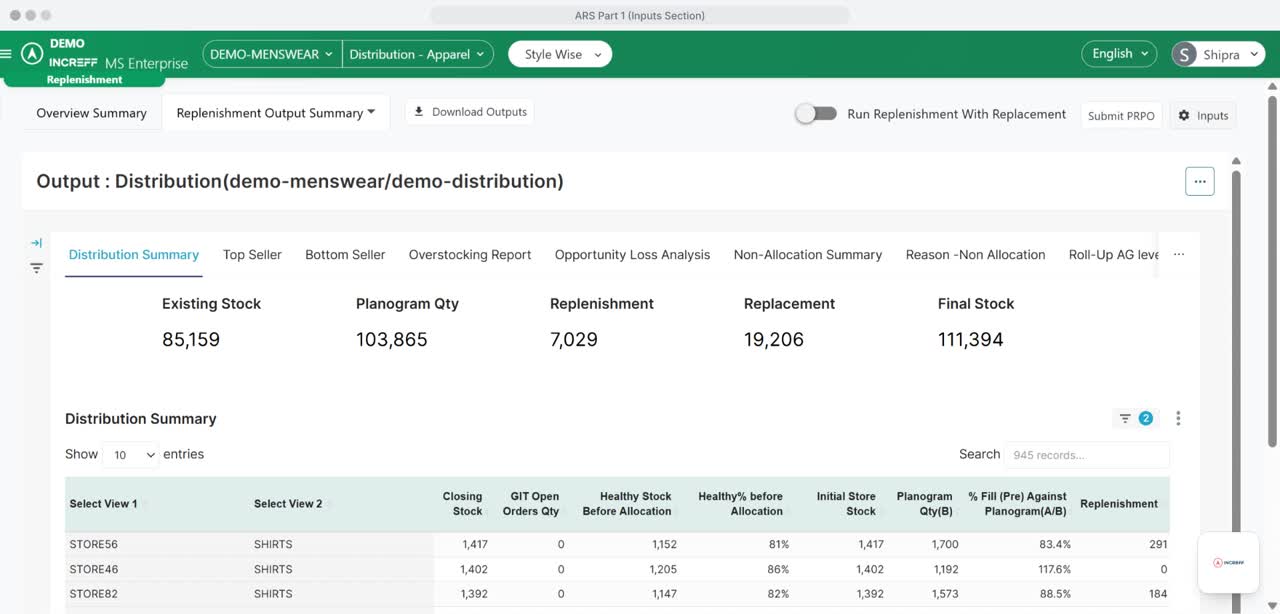
- Granular Analytics: Delivers actionable insights at the most granular level, including store, SKU, and attribute dimensions.
- Performance Monitoring: Provides customizable dashboards and reports for daily performance- track sales, stock cover, sell-through, stockouts, and discounts across any hierarchy.
- Trend Analysis: Enables comparison of trends over time, such as sell-through rates, revenue, and size availability, so merchandisers can spot gaps and take corrective action quickly.
- Topseller identification: Visualizes top sellers, dead styles, and inventory health, helping identify opportunities for replenishment, pullback, or markdown optimization instantly.
- Role-Based Reporting: Creates customised reports and dashboards so every planner and CXO can access tailored reports, filters, and metrics for their roles leveraging all aspects of merchandise allocation software.

Darkstore/DC Replenishment
- Delivery Optimization: Reduces last-mile delivery costs and enables faster customer delivery through optimized inventory positioning.
- Pincode-level Demand Patterns: Optimizes inventory distribution across multiple darkstores and distribution centers based on pincode-level demand patterns.
- Automated Stock Flow: Automates replenishment from central warehouses to darkstores and regional DCs using daily sales data and DC/Darkstore/Regional warehouse stock capacity thresholds.
- Inventory Cover Management: Maintains optimal inventory cover at darkstores/DCs with frequent replenishment cycles to optimize space and reduce carrying costs.
Inventory Planning
- Allocation and Replenishment
- Inter Store Transfers
- Markdown Optimization
- KPI Watchtower
Allocation and Replenishment

Inter Store Transfers

Markdown Optimization

KPI Watchtower

Frequently Asked Questions
What is allocation and replenishment in retail?
Allocation and replenishment in retail refers to the process of distributing inventory across stores, warehouses, and fulfillment centers based on demand patterns and sales performance. Allocation determines how new inventory is initially distributed across locations, while replenishment ensures that stores and fulfillment channels are restocked as products begin to sell.
Retail allocation and replenishment software automates these decisions by analyzing real-time sales data, inventory levels, and demand signals to ensure the right products are available in the right locations.
How does allocation and replenishment software improve retail inventory performance?
Allocation and replenishment software improves inventory performance by using data-driven algorithms to distribute inventory across stores and channels based on demand signals. The system continuously monitors sales velocity, stock levels, and product performance to ensure that high-demand locations receive inventory faster.
This helps retailers increase product availability, reduce stockouts, improve full-price sell-through, and minimize excess inventory across their store network.
What is True Rate of Sale (ROS) in retail inventory planning?
True Rate of Sale (ROS) is a demand metric used in retail inventory planning to measure how quickly products sell when they are actually available for purchase. Unlike traditional sales metrics, True ROS only considers days when the product was fully in stock and available to customers.
By excluding periods affected by stockouts, liquidation events, or broken size assortments, True ROS provides a more accurate view of real customer demand and helps retailers make better allocation and replenishment decisions.
What is the difference between allocation and replenishment?
Allocation and replenishment are related but distinct retail inventory processes.
Allocation refers to the initial distribution of inventory across stores or fulfillment locations when new products arrive from suppliers or warehouses. Replenishment refers to the ongoing process of restocking stores or fulfillment centers as products sell and inventory levels decline.
Together, allocation and replenishment ensure that inventory flows efficiently across the retail network to maintain product availability.
How do inter-store transfers help optimize inventory?
Inter-store transfers allow retailers to move inventory from stores with excess stock to locations where products are selling faster. This helps balance inventory across the store network and prevents lost sales caused by stockouts.
Retail allocation systems analyze store-level demand signals to identify when inventory should be transferred between locations, helping retailers maximize sell-through and reduce excess inventory.
How does allocation software help fashion and apparel retailers?
Fashion and apparel retailers face challenges such as size imbalances, regional demand differences, and short product lifecycles. Allocation software helps by optimizing size curves, adjusting assortments based on local demand patterns, and continuously reallocating inventory to high-performing stores.
This improves size availability, increases full-price sell-through, and reduces markdown risk for seasonal products.
Can allocation and replenishment software support omnichannel retail?
Yes, modern allocation and replenishment platforms support omnichannel retail by managing inventory distribution across stores, e-commerce fulfillment centers, dark stores, and distribution centers.
By analyzing demand across multiple sales channels, the system ensures that inventory is positioned in locations where it can fulfill both in-store purchases and online orders efficiently.
How does automated replenishment reduce stockouts?
Automated replenishment systems monitor inventory levels and sales velocity in real time. When inventory drops below predefined thresholds or demand increases, the system automatically triggers replenishment orders or inventory transfers.
This ensures that top-selling products are restocked quickly and helps retailers maintain consistent product availability across stores and fulfillment channels.
What industries benefit most from allocation and replenishment software?
Allocation and replenishment software is widely used in industries where inventory distribution across multiple locations is critical. These include:
- fashion and apparel retail
- footwear and accessories
- sporting goods
- department stores
- consumer electronics retail
- omnichannel retail operations
These industries benefit from improved inventory productivity, faster replenishment cycles, and better demand-driven assortment planning.
What metrics improve with allocation and replenishment optimization?
Retailers typically see improvements in several key inventory performance metrics after implementing allocation and replenishment systems, including:
- higher product availability
- improved full-price sell-through
- reduced stockouts
- better inventory turnover
- improved size availability in stores
- reduced excess inventory and markdowns
These improvements lead to higher revenue and better overall inventory productivity.