


TL;DR
Better demand forecasts mean fewer stockouts, less excess inventory, and smarter inventory decisions. The right demand forecasting software helps retailers predict what will sell, where, and when by combining sales, inventory, seasonality, promotions, and other demand signals. Increff’s True Demand Forecasting also accounts for stockouts, broken sizes, and liquidation noise to create a more realistic view of underlying demand. These forecasts can then drive buying, allocation, replenishment, and inventory planning, helping retailers improve availability while keeping inventory under control.
What is retail demand forecasting software?
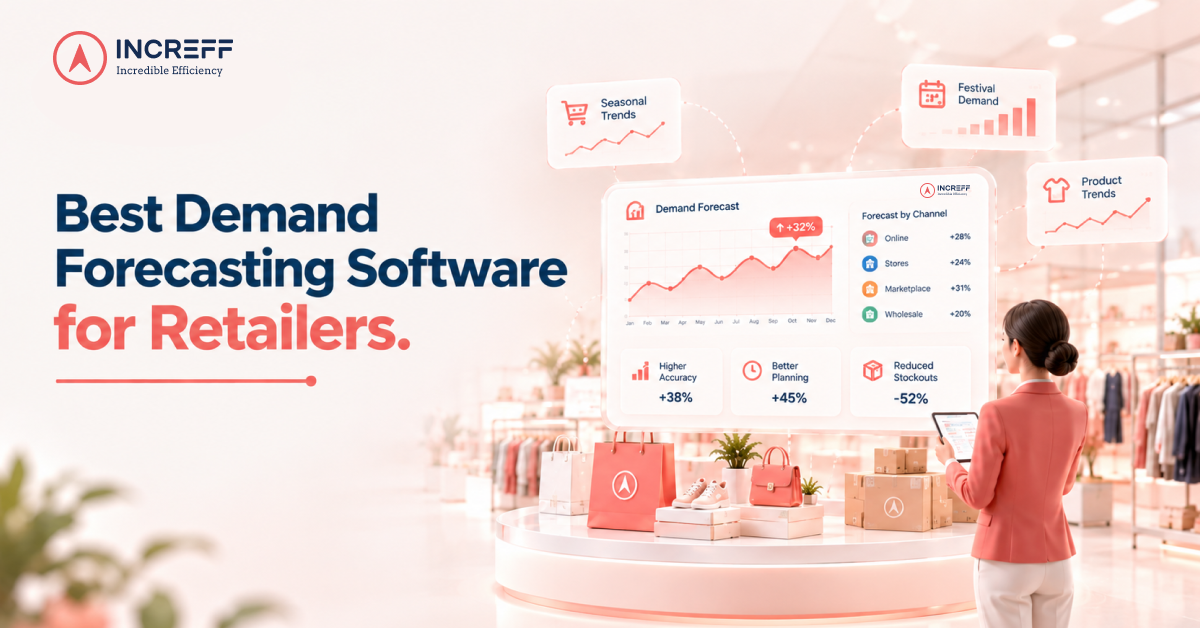
Retail demand forecasting software uses historical sales, inventory, promotions, seasonality, product and location data, and increasingly AI-driven analytics to estimate future demand.
Instead of relying on static averages or manual spreadsheets, modern forecasting platforms can generate predictions at granular levels such as:
- SKU
- Store
- Channel
- Region
- Time period
The forecast can then feed downstream decisions such as buying, inventory planning, allocation, and replenishment.
For example, if a retailer sees that a particular SKU consistently sells faster in one city during a seasonal period, the system can account for that demand pattern instead of applying the same forecast across every store.
The strongest platforms also account for demand distortions. Stockouts, broken sizes, promotions, and liquidation sales can make historical sales look different from actual customer demand.
Which are the best demand forecasting software for retailers?
What features should retailers look for in demand forecasting software?
A forecasting platform should improve decisions, not simply produce another dashboard. Key capabilities include:
- AI-powered forecasting: Uses machine learning and multiple demand signals to improve forecast quality.
- SKU-level predictions: Forecasts demand at the level where buying, allocation, and replenishment decisions actually happen.
- Promotion planning: Accounts for promotional uplift instead of treating promotional sales as normal demand.
- Inventory optimization: Connects expected demand with stock levels, service targets, and inventory investment.
- Automated replenishment: Converts demand forecasts into timely reorder recommendations.
- ERP and POS integrations: Brings sales, inventory, product, and transaction data into the planning workflow.
- Exception-based planning: Helps planners focus on unusual demand patterns instead of manually reviewing every SKU.
- Forecast explainability: Shows why demand changed so planners can validate and act on the output.
How should retailers choose the right demand forecasting software?
Start with the business problem rather than the feature list.
Consider these six factors:
- Business size and complexity: A 20-store retailer may not need the same planning infrastructure as a global retailer.
- Assortment complexity: Fashion and lifestyle brands need to account for sizes, colors, attributes, newness, seasonality, and short product lifecycles.
- Data quality: Forecasting cannot compensate for unreliable SKU, sales, inventory, or master data.
- Planning workflows: Check whether forecasts connect to buying, allocation, replenishment, and inventory decisions.
- Implementation effort: Evaluate integration requirements, user adoption, configuration, and time to value.
- Measurable ROI: Define success through metrics such as forecast accuracy, stockout rate, inventory turns, full-price sell-through, availability, and markdown reduction.
The best software is therefore not necessarily the platform with the most sophisticated AI. It is the one that fits the retailer's data, operating model, and decision-making process.
How does Increff help retailers turn demand forecasts into better inventory decisions?
A forecast is only useful when it changes what a retailer does next.
Increff connects True Demand Forecasting with merchandise financial planning, buying, allocation, and replenishment. Its forecasting approach cleans historical demand signals by accounting for stockouts, broken sizes, and liquidation noise, helping planners work with a more realistic view of underlying demand.
That forecast can then support decisions such as:
- How much inventory should be bought?
- How much stock should each store receive?
- Which stores need replenishment?
- Where is inventory likely to become excess?
- How should inventory plans change as actual sales come in?
This creates a more connected planning workflow, where demand forecasts inform inventory decisions rather than remaining isolated in a planning report.
Conclusion
The best demand forecasting software for retailers should improve the entire decision chain from demand prediction to inventory action. Before choosing, test each platform against your own SKU, store, channel, promotion, and inventory data. The real measure of a forecasting system is not how impressive the forecast looks. It is whether it helps you put the right inventory in the right place at the right time.
Frequently Asked Questions
Q: What data does retail demand forecasting software need?
A: Most platforms use historical sales, inventory, product, store, channel, promotion, and seasonal data. More advanced systems can also incorporate external demand signals.
Q: Can demand forecasting software reduce stockouts?
A: Yes. Better forecasts help retailers anticipate demand and position inventory more effectively. The impact is strongest when forecasting is connected to allocation and replenishment.
Q: Is AI necessary for retail demand forecasting?
A: AI is not the only approach, but modern AI and machine learning can process more demand variables and identify patterns that are difficult to capture through manual forecasting.
Q: How accurate should a retail demand forecast be?
A: There is no single accuracy benchmark for every retailer. Accuracy should be measured by product category, forecast horizon, store or channel, and demand volatility, alongside business outcomes such as availability and inventory efficiency.
Q: Can demand forecasting software integrate with ERP and POS systems?
A: Yes. Integration with ERP, POS, inventory, ecommerce, and other retail systems is important because forecast quality depends heavily on the quality and timeliness of the underlying data.
Q: How does demand forecasting improve inventory planning?
A: It provides a forward-looking estimate of demand that can guide buying, stock targets, allocation, replenishment, and inventory investment decisions instead of relying only on historical sales.