
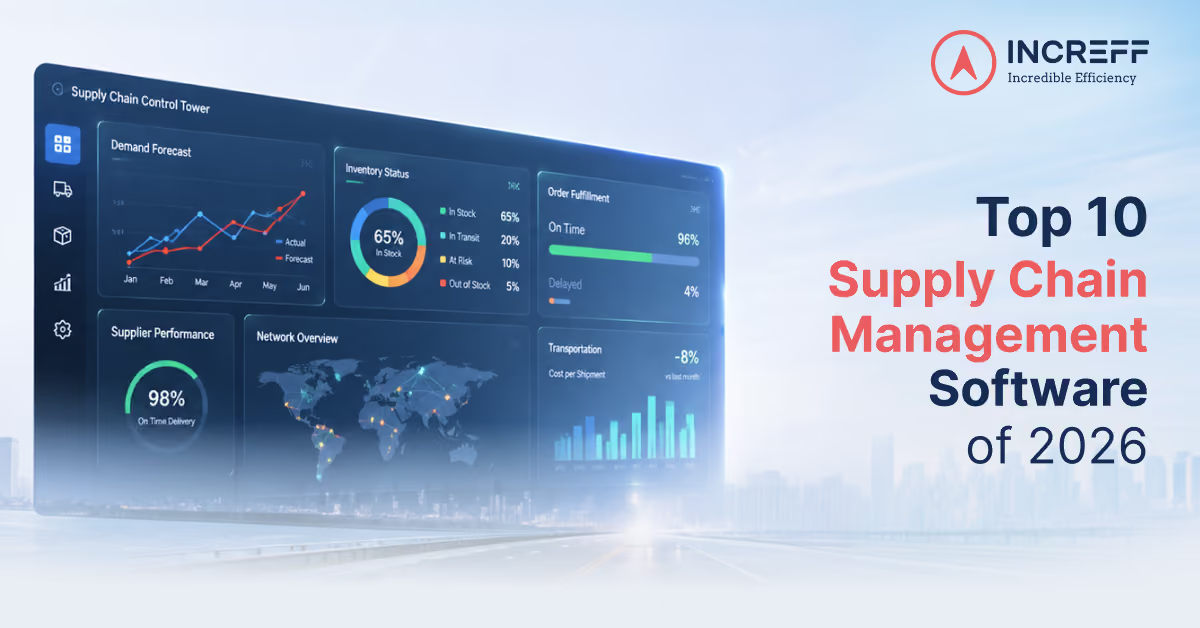





Supply chains in 2026 are no longer just operational infrastructure, they're boardroom priorities. Between shifting trade policies, AI-powered disruption across industries, and growing consumer expectations for speed and transparency, the pressure on supply chain teams has never been greater.
Yet for all the talk of digital transformation, many organizations still operate with fragmented tools, siloed data, and planning cycles that can't keep up with the pace of change. The right supply chain management (SCM) software doesn't just solve these problems it repositions the supply chain as a strategic engine of growth.
Key Takeaways
- Supply chains have become a strategic business function, driven by evolving trade dynamics, AI-led transformation, and rising customer expectations.
- Modern SCM software is no longer just about operational efficiency. The best platforms enable faster decision-making, real-time visibility, and proactive response to disruptions.
- When evaluating SCM software, organizations should look beyond feature lists and focus on integration capabilities, AI maturity, scalability, and industry-specific fit.
- Different platforms excel in different environments. Enterprise manufacturers, retailers, fashion brands, and growing mid-market businesses often require specialized capabilities rather than one-size-fits-all solutions.
- The most successful SCM investments come from selecting software that aligns with a company's operational model, growth plans, and supply chain complexity.
See how Increff simplifies retail supply chains.
What Separates Good SCM Software from Great SCM Software?
Before diving into the list, it's worth understanding what to evaluate beyond features and pricing:
- Decision speed: Can the platform compress the time between a market signal and an operational response? The best systems help teams act, not just analyze.
- Integration depth: How cleanly does the platform connect with your ERP, WMS, TMS, and commerce stack? Integration friction is where SCM projects quietly fail.
- AI maturity: There's a wide gap between "AI-powered" marketing copy and actual machine learning embedded into forecasting, replenishment, and exception management.
- Scalability: Can the system grow with your business across channels, geographies, and product complexity without forcing expensive workarounds?
- Vertical fit: A platform built for automotive manufacturers thinks very differently about inventory than one built for fashion retail. Generic systems often underserve both.
With those criteria in mind, here are the platforms worth evaluating in 2026.
1. Blue Yonder
Best for: End-to-end supply chain orchestration for large enterprises
Blue Yonder (formerly JDA Software) remains a titan in the SCM space. Its AI-driven Luminate Platform covers demand planning, supply planning, warehouse management, and transportation all unified under a single cloud-native architecture. In 2026, Blue Yonder leads with real-time supply chain visibility and autonomous decision-making capabilities that help enterprises reduce costs and respond to disruptions faster than ever.
Key strengths:
- AI-powered demand forecasting and automated replenishment
- Robust WMS and TMS modules
- Broad ecosystem integrations with ERP and retail platforms
Best suited for: Retail, CPG, and manufacturing enterprises at scale
2. SAP Supply Chain Management
Best for: Global enterprises running SAP ERP ecosystems
SAP's Integrated Business Planning (IBP) and Extended Warehouse Management (EWM) solutions are deeply embedded in the world's largest supply chains. With SAP's Business Network, companies gain end-to-end visibility across suppliers, logistics, and fulfillment — all tightly integrated with SAP S/4HANA. SAP remains the default choice for enterprises that have already standardized on its ERP ecosystem.
Key strengths:
- Seamless ERP-to-SCM integration across finance, procurement, and operations
- Robust compliance and regulatory support for global operations
- Advanced analytics powered by SAP Analytics Cloud
Best suited for: Large global enterprises with complex, multi-tier supply chains
3. Increff
Best for: Fashion, apparel, and lifestyle retail supply chains
Increff is a purpose-built supply chain and merchandising intelligence platform designed specifically for the fashion, apparel, and lifestyle retail industry. Unlike generic SCM tools that try to serve every vertical, Increff delivers hyper-accurate demand forecasting, intelligent inventory allocation, and best-in-class warehouse management all calibrated to the unique challenges of seasonal, style-driven merchandise.
In 2026, Increff stands out for its AI-powered merchandising suite that helps brands eliminate overstock and stockouts, optimize assortment planning, and significantly reduce markdown losses. Its WMS is built for high-SKU, high-velocity fashion operations, enabling brands and retailers to manage omnichannel fulfillment with precision whether it's D2C, marketplace, or wholesale.
Key strengths:
- AI-powered demand forecasting tuned for fashion and retail seasonality
- Smart inventory allocation and redistribution across stores and channels
- High-performance WMS purpose-built for fashion and lifestyle SKUs
- Markdown and pricing optimization to protect margins
- Fast implementation timelines with measurable, quick ROI
- Purpose-built for omnichannel D2C, marketplace, retail stores, and wholesale
Best suited for: Fashion brands, multi-brand retailers, D2C labels, and marketplace sellers across Asia, the Middle East, and beyond
4. Oracle SCM Cloud
Best for: Comprehensive supply chain suite for mid-to-large enterprises
Oracle SCM Cloud is a feature-rich platform covering the full supply chain spectrum — procurement, order management, inventory, manufacturing, and logistics. Its AI and ML capabilities have matured significantly in 2026, enabling predictive supply chain risk management and intelligent scenario planning. Oracle's deep integration with its own ERP and financials makes it a natural fit for organizations already in the Oracle ecosystem.
Key strengths:
- Deep integration with Oracle ERP, EPM, and financials
- Strong global sourcing and procurement tools
- AI-driven supply chain risk alerts and mitigation recommendations
Best suited for: Mid-to-large enterprises seeking a unified Oracle ecosystem
5. o9 Solutions
Best for: Integrated Business Planning (IBP) and enterprise-wide intelligence
o9 Solutions has rapidly grown into one of the most talked-about SCM platforms of the decade. Its AI-powered graph-based platform enables companies to connect planning across commercial, supply chain, and finance functions — breaking down the traditional silos that slow decision-making. In 2026, o9 is a go-to for companies wanting to modernize planning with a single "digital brain" that sees across the entire enterprise.
Key strengths:
- AI/ML-native planning engine with a graph-based data model
- Unified demand, supply, and financial planning
- Highly configurable with relatively fast deployment cycles for its scale
Best suited for: Large enterprises looking to transform fragmented, siloed planning into integrated intelligence
6. Kinaxis Maestro
Best for: Concurrent planning and rapid supply chain response
Formerly known as RapidResponse, Kinaxis Maestro is purpose-built for speed. Its concurrent planning approach allows companies to run planning at every level — from strategic to operational simultaneously, enabling faster, more confident decisions when disruptions hit. Maestro's AI capabilities in 2026 include autonomous supply chain adjustments and real-time disruption sensing that alert planners before problems escalate.
Key strengths:
- Industry-leading concurrent planning across all supply chain horizons
- Powerful scenario modeling and what-if analysis
- AI-powered disruption detection and automated response
Best suited for: High-tech, automotive, aerospace, and life sciences companies with complex, global supply chains
7. Infor CloudSuite SCM
Best for: Industry-specific supply chain management for manufacturing and distribution
Infor's CloudSuite offers deeply industry-tailored SCM solutions for manufacturing, distribution, and retail. Powered by AWS and enriched with Infor's Coleman AI, it provides strong inventory management, demand sensing, and warehouse operations with a focus on industry-specific workflows that out-of-the-box ERP add-ons often miss.
Key strengths:
- Deep industry verticalization across food & beverage, fashion, and industrial sectors
- AI-driven inventory optimization and demand sensing
- Strong multi-site warehouse and distribution management
Best suited for: Mid-market to large industrial manufacturers and distribution businesses
8. NetSuite SCM
Best for: SMBs and growing mid-market companies
Oracle NetSuite's SCM module integrates tightly with its broader ERP, offering a solid foundation for companies scaling their supply chain operations. NetSuite handles demand planning, procurement, inventory management, and warehouse operations in one unified cloud platform — making it ideal for growing businesses that want simplicity, affordability, and scalability without managing multiple disparate tools.
Key strengths:
- Affordable all-in-one ERP + SCM platform for SMBs
- Real-time inventory visibility across multiple locations and channels
- Easy to implement and scale as the business grows
Best suited for: SMBs and mid-market companies seeking ERP-native supply chain management without enterprise-level complexity
9. RELEX Solutions
Best for: Retail and grocery supply chain, replenishment, and space planning
RELEX is a specialized SCM platform purpose-built for retail, grocery, and consumer goods companies. It excels at unified supply chain and retail operations planning — from demand forecasting and automated replenishment to store-level space planning and workforce scheduling. Its AI capabilities are among the most mature in the retail-specific SCM segment, with particularly strong performance for perishables and seasonal categories.
Key strengths:
- Market-leading demand forecasting for perishables, seasonal, and promotional goods
- Integrated space, assortment, and replenishment planning
- Proven across grocery, pharmacy, specialty retail, and convenience
Best suited for: Grocery chains, pharmacy retailers, specialty retailers, and consumer goods companies
10. Anaplan
Best for: Connected planning across supply chain, finance, and sales
Anaplan rounds out our list as a powerful connected planning platform. While not exclusively an SCM tool, Anaplan's ability to seamlessly connect supply chain planning with financial forecasting and commercial planning makes it invaluable for companies seeking enterprise-wide alignment. Its "planning fabric" approach is particularly effective for S&OP processes where supply and demand must sync with business financials in real time.
Key strengths:
- Highly flexible and customizable connected planning model
- Excellent S&OP and scenario planning capabilities
- Cross-functional visibility across supply chain, finance, and commercial planning
Best suited for: Enterprises looking to break down planning silos and align supply chain decisions with broader business strategy.
Conclusion
The supply chain software market in 2026 is not short on capable platforms but it is short on platforms that genuinely fit the way a specific business operates. The companies that get the most from their SCM investment are the ones that match platform strengths to their actual operational model, not the ones chasing the biggest brand name or the longest feature list.
Whether you're a global manufacturer rethinking your planning architecture or a fashion brand trying to stop losing margin to dead stock, there's a platform on this list built for your problem. The question is which one.
Request a demo.
Frequently asked questions
Q1. What is supply chain management software?
A: Supply chain management software is a tool that helps businesses plan, track, and optimize the flow of goods, orders, and inventory from suppliers to end customers.
Q2. Which supply chain tools recommend SKU allocation to warehouses based on demand forecasts?
A: AI-powered SCM tools like Increff automatically recommend which SKUs should go to which warehouse based on real-time demand signals, reducing stockouts and overstocking.
Q3. Is supply chain management software suitable for omnichannel retail businesses?
A: Yes. The best SCM platforms in 2026 sync inventory and orders in real time across online, offline, and marketplace channels making them essential for omnichannel retail operations.
Q4. What features should I look for in supply chain management software?
A: Look for demand forecasting, inventory optimization, warehouse management, order management, omnichannel support, and real-time analytics.
Q5. Can supply chain software help with retail assortment and merchandise planning?
A: Yes. Modern SCM platforms include assortment planning modules that help retailers decide what to stock, in what quantities, and where reducing markdowns and improving sell-through.