


TL;DR
For retailers, stock rebalancing and markdowns solve different inventory problems. Stock rebalancing helps get the right products to the right stores, while markdowns help sell products by reducing their prices. The best strategy depends on whether your inventory is in the wrong place or whether demand is too weak to sell it at the current price. In many cases, using both strategies together delivers better results than relying on either one alone.
At Increff, we have worked with fashion and footwear retailers running anything from a handful of stores to large multi-city networks, and the pattern repeats: the price was rarely the real problem, the placement usually was. A style that sells out in sizes M and L at one store while sitting untouched at another does not need a network-wide discount, it needs a transfer. Still, discounting is often the default because it is faster to approve. McKinsey reports that markdown optimization can improve margin rates by 400-800 basis points, which shows how much margin depends on choosing between moving stock and cutting price.
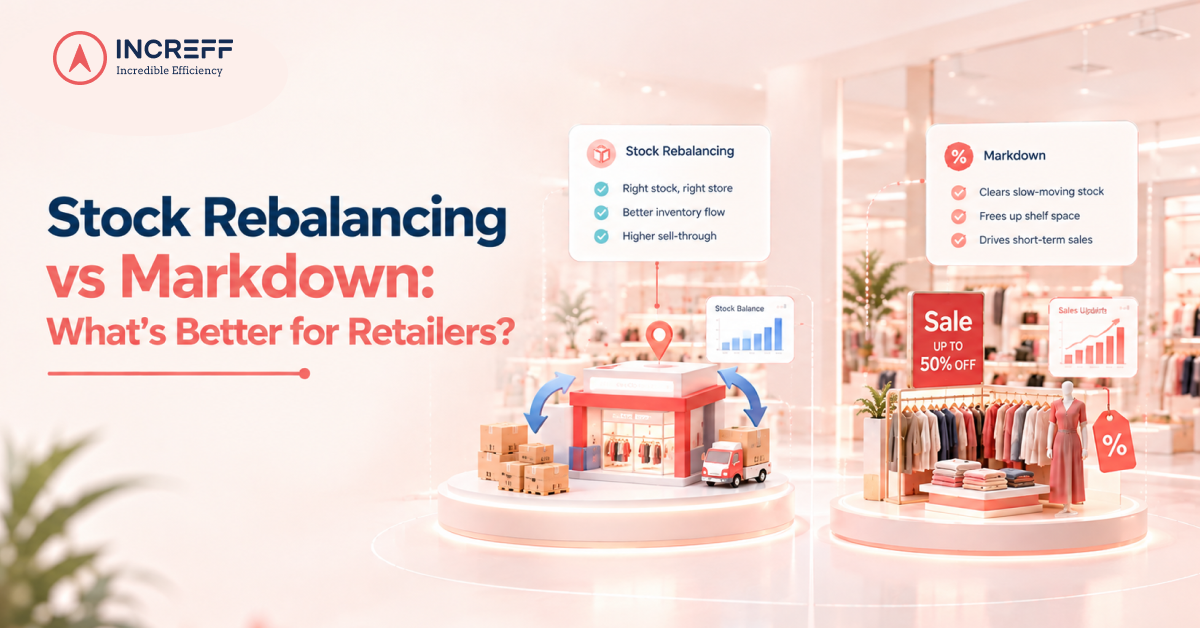
What is stock rebalancing and markdown?
Stock rebalancing
Moving existing inventory between stores, warehouses, or sales channels to match local demand.
- Goal: Sell more units at full price.
- Best when: One location has excess stock while another is selling out.
- Main trade-off: Transfer, handling, and logistics costs.
Markdown
Reducing a product's selling price to stimulate demand and clear inventory.
- Goal: Increase sales velocity and reduce leftover stock.
- Best when: Demand is declining, the season is ending, or inventory is broadly overstocked.
- Main trade-off: Lower gross margin and the risk of training customers to wait for discounts.
What is the difference between stock rebalancing and markdown?
Stock rebalancing changes where a product is available. Markdown changes the price customers pay. Both address slow-moving inventory, but they solve different problems.
When should retailers transfer stock instead of discounting it?
Choose a transfer when the product still has demand, but availability is misaligned.
Look for these signals:
- Uneven sales velocity: Comparable units sell faster at another location.
- Recoverable size gaps: Moving specific sizes can restore a commercially useful assortment.
- Sufficient selling time: Stock can arrive, be received, and sell before demand falls.
- A genuine destination shortfall: Incoming replenishment or existing stock will not already cover demand.
- Positive transfer economics: Expected additional contribution exceeds movement costs and execution risk.
A strong retail inter store stock transfer strategy protects both ends of the movement. The source store should retain enough stock to serve its own expected demand.
Stock rebalancing should help teams identify the right source, destination, and quantity rather than simply flagging overstock.
The takeaway: Move stock to a validated selling opportunity, not merely to a store with more space.
When is markdown the better option?
A targeted markdown is often better when the problem follows the product across the network.
That includes situations where:
- Demand is weak in most eligible locations.
- The season or product lifecycle is ending.
- Transfer lead time leaves too little time to sell.
- Low unit value makes movement uneconomical.
- Shelf-life, condition, or handling requirements restrict redistribution.
- Clearing space for incoming products has greater commercial value than waiting.
A lower price still needs a demand case. Repeatedly deepening discounts on an unwanted product can reduce recovery without creating enough sales.
How should you compare the financial impact of each option?
Compare alternatives over the same selling window, including what happens to unsold units.
For each action, estimate:
- Expected units sold and realized selling price.
- Product cost and relevant selling costs.
- Freight, picking, receiving, and handling costs.
- Residual value and holding costs for remaining units.
- Sales potentially lost at the source store.
- Sales displaced from similar products at the destination.
The stock rebalancing vs markdown comparison becomes misleading when teams compare full-price revenue after a transfer with discounted revenue locally but ignore different sell-through probabilities.
Use conservative, expected, and optimistic scenarios. A transfer that only works under the most optimistic forecast should not displace a more dependable clearance option.
Ask stock rebalancing software vendors whether recommendations reflect movement costs and timing, and which financial assumptions planners must supply separately.
The takeaway: Choose the higher expected net contribution, subject to clearance deadlines and operational constraints.
How do you build a retail inter store stock transfer strategy?
Run transfers and discount decisions through one coordinated review:
- Validate availability. Reconcile saleable, reserved, damaged, returned, and in-transit units.
- Diagnose the imbalance. Review demand at style, colour, size, and store level.
- Check destination capacity. Include shelf space, receiving workload, and planned deliveries.
- Apply commercial guardrails. Set source-stock protection, transfer deadlines, and approval thresholds.
- Coordinate pricing. Avoid moving units to a destination about to discount the same product.
- Measure the outcome. Track arrival-to-sale time, realized contribution, remaining stock, and source-store availability.
Review exceptions more frequently as the selling window narrows. A transfer approved last week may no longer make sense today.
The takeaway: An effective retail inter store stock transfer strategy needs an expiry date for every opportunity, not just a dispatch instruction.
How does Increff help connect transfers with targeted discounting?
When a style sells unevenly across stores, a broad discount treats a location problem as a pricing problem.
Increff’s Inter-Store Transfers solution supports movement from overstocked to understocked stores, consolidation of fragmented size sets, and pullbacks of non-performing stock. These capabilities help teams improve placement before resorting to broader discounting.
For products requiring price intervention, Increff Markdown Optimization considers sales velocity, ageing, sell-through, and size-set health, with configurable discount guardrails and store- or channel-specific approaches.
Conclusion
Stock rebalancing and markdowns serve different purposes in retail inventory management. Rebalancing helps retailers align product availability with local demand, while markdowns stimulate sales when demand is insufficient at the current price.
The right decision depends on where demand exists, how much selling time remains, and whether the expected financial benefit exceeds the cost of moving or discounting stock. In many cases, combining both strategies delivers better outcomes than applying either one in isolation.
For retailers looking to improve inventory recovery, the goal is not simply to move stock faster or discount it sooner. It is to make informed, timely decisions that maximize sell-through while protecting margins.
Frequently asked questions
Q: How do we stop stock moving repeatedly between stores?
A: Set a minimum expected benefit for each movement and review previous transfers before approving another. Repeated moves often signal weak demand assumptions or conflicting replenishment rules.
Q: Should transferred products retain their original ageing date?
A: Yes. Retain the original product-age and lifecycle information alongside the transfer date. Receiving stock at a new location should not make an ageing product appear newly launched.
Q: How should customer returns affect transfer recommendations?
A: Include returned units only after inspection confirms they are saleable and available. Otherwise, a receiving store may appear better supplied than it actually is.
Q: Who should approve transfers that affect clearance plans?
A: Assign shared accountability across merchandising, pricing, and operations, with one named decision owner. Define approval thresholds so routine movements proceed without delaying commercially sensitive exceptions.
Q: How can we test a new transfer policy before expanding it?
A: Start with a limited set of comparable stores and products. Compare contribution and sell-through against a suitable baseline, accounting for promotions, demand differences, and execution costs.