
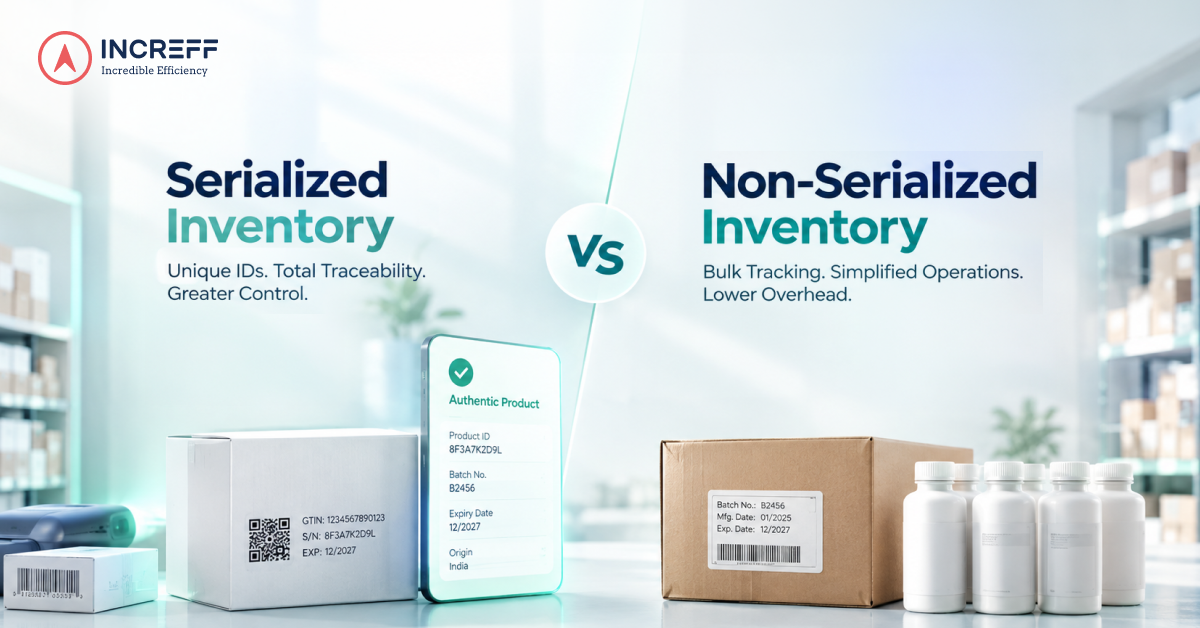





TL;DR
Serialization buys you unit-level traceability. Bulk tracking buys you speed at receiving. Which one you need depends on your industry, price point, channel mix, fraud exposure and scale, and it often differs line to line inside the same warehouse. Increff WMS runs both, as a configuration, on one platform: one task engine, one receiving process, one set of dashboards. Serialize what needs it, keep the rest in bulk, and change that call as you grow.
At Increff, we've worked with 700+ brands across fashion, beauty, footwear, and jewellery, and the serialization question comes up in almost every warehouse conversation. A luxury jewellery brand needs to know which exact piece shipped to which customer. A bulk apparel wholesaler moving box-in, box-out consignments needs speed, not unit-level identity. According to Rockwell Automation, 83% of supply chain professionals consider product traceability and serialization very important to their company's competitiveness. But traceability adds labour and time at receiving. The right call depends on the client, not a platform limitation. That's the gap Increff WMS closes.
What's the Difference Between Serialized and Non-Serialized Inventory?
Neither model is universally better. The decision variables usually pull in opposite directions, and the right answer changes client to client.
Why Do Some Brands Need Serialization and Others Don't?
This is the question we get asked most. There is no universal answer, because the signals usually pull in opposite directions. The practical way to decide is to sort them into three groups.
Serialization as a non-negotiable
Serialization as a good to have
Non-serialization as the efficient path
How Increff WMS Supports Both Models
In most WMS platforms, serialization is a separate module or a second system. In Increff WMS, it is a setting you turn on for the stock that needs it. That works because every part of the system below it can be configured.
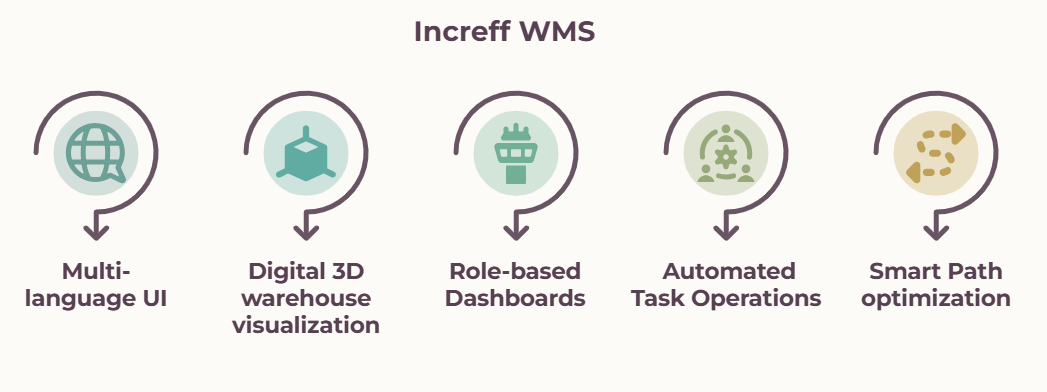
- Multi-language UI
The platform isn't locked into one language or one set of terminology. Clients can set their preferred language and even customize nomenclature to match how their own teams and region refer to warehouse concepts (for instance, what one client calls a "bin" another might call a "location," or terms may differ between a US and a European operation). This means the software adapts to the client's operational vocabulary and language preference, rather than forcing the client to adapt to the software's. - Digital 3D warehouse visualization
Instead of asking clients to design their layout from scratch inside the software, the system takes the 2D layout drawing they already have (the kind almost every warehouse maintains) and converts it into a 3D model. The vision extends to overlaying pick/putaway movement on top of that 3D model, so a warehouse manager can visually spot where the layout design is causing inefficient picker travel, catching layout mistakes before they become an operational cost. - Configurable, role-based Control Tower
Rather than a fixed set of dashboards, the system gives every role (CEO, COO, CFO, supply chain head, warehouse head, supervisor) access to a large, extensible library of pre-built charts, and lets each person assemble their own dashboard from that library. This means the platform adapts to how each layer of the client's organization actually wants to consume data, without requiring custom dashboard development per client. - Task-based operator ecosystem
Every warehouse operator works from a task queue on their device rather than being verbally instructed. Picking, replenishment, and cycle-count work all flow through this same framework, and operators get push notifications the moment a new task is assigned. The system is also smart about task creation: for example, if a picker can't find an item and marks it "not found," the system automatically creates a secondary verification task for a different picker to confirm, with no manual intervention needed. This reduces supervisor overhead and keeps the floor moving without someone manually re-assigning work all day. - Pick-path and travel-distance optimization
The system reduces unnecessary picker movement in two ways. First, it can be aware of zoning (cross-zone travel) so that picks are ideally clustered rather than sending a picker back and forth across the warehouse. Second, it leverages the fact that a handheld scanning device is already being tracked everywhere it moves, so picker location and movement can be inferred passively, without requiring an extra dedicated location-scan step just to know where someone is. This is designed to extend further into full route optimization over time. For clients, the pitch is straightforward: less walking per order, more picks per hour, without adding process steps for the picker.
How Does This Come Together for a Brand?
In practice, this means:
- A brand can serialize its high-value or marketplace-facing lines while keeping bulk B2B consignments on standard SKU-level tracking, all within one warehouse and one system.
- Traceability starts at the gate, with the same GRN process configured differently depending on whether the SKU is serialized.
- The same task engine, putaway logic, replenishment rules, and dashboards run underneath both models, so operators and supervisors aren't managing two mentally separate operations.
Take a closer look at how the Increff Warehouse Management System handles configurable receiving, task management, and multi-model inventory in one platform.
The Bottom Line
Increff WMS was built to support both models natively, so logistics and operations leaders can make the call based on what their business actually needs, and change that call as the business grows.
If you're weighing serialization for part of your catalogue, or running two disconnected systems today to handle it, it's worth seeing what a single configurable platform looks like in practice.
Talk to Increff About Your Warehouse Setup
Frequently Asked Questions
Q: Can one warehouse run serialized and non-serialized inventory at the same time?
A: Yes. Increff WMS supports both models on a single platform, configurable per client, site, or SKU range. A brand can serialize its premium or marketplace-facing lines while keeping bulk B2B stock on standard SKU-level tracking, without running two separate systems.
Q: Does serialization slow down warehouse operations?
A: It adds labour at the receiving (GRN) stage, since each unit needs to be scanned and registered individually. In exchange, it typically reduces labour and error at putaway, picking, packing, and audit, because every unit's location and status is known precisely. Whether that trade-off is worth it depends on labour cost, scale, and price point.
Q: How do I know if my brand actually needs serialization?
A: Score your business against the key variables: regulated industry status, price point, sales channel mix, fraud or counterfeit exposure, warranty liability, and recall risk. A single strong driver, like a regulatory requirement or high fraud exposure, can justify serialization even if other factors point the other way.
Q: Is serialization only relevant for high-value or luxury goods?
A: No. Price point is one factor, not the deciding one. Regulated industries, marketplace-heavy fulfilment, fraud exposure, and specific business risks like territory leakage or recall requirements can all justify serialization regardless of unit price.
Q: What if my business scales up significantly, will serialization become a bottleneck?
A: It can. Very high transaction volume is one of the scenarios where serialization at the receiving stage becomes a throughput constraint. This is one of the reasons a configurable system matters: you can revisit the decision as scale changes instead of being locked into your original setup.
Q: Does switching to a system that supports both models mean re-implementing our WMS?
A: No. Increff WMS is designed so serialized and non-serialized inventory run on the same underlying task engine, receiving process, and dashboards. Adding serialization for a specific product line doesn't require a separate implementation.
Q: We use warehouse robotics, do we still need serialization?
A: Usually less so. Robotics already delivers deterministic movement and location accuracy, which reduces the operational case for serialization. It may still be worth adding for compliance, fraud, or brand-specific reasons even in a highly automated warehouse.
Q: If we run non-serialized inventory everywhere else, do we still need serialization for returns?
A: Usually, yes. Verifying a returned unit's condition and matching it back to the original sale is hard to do reliably at the batch level. Most brands that are non-serialized for inbound and storage still apply unit-level tracking specifically at the returns stage.