





TL;DR
Ship from store turns physical locations into local fulfillment hubs. Retailers need a store management system that can handle store fulfillment operations at scale, real time inventory visibility to stop overselling, and distributed order management (OMS) that routes each order to the right location. Item serialization software adds tracking accuracy without RFID-level cost. Get these pieces right and it becomes a genuine driver of omnichannel fulfillment, not just a cost center.
From Store Shelf to Customer Door
By 2022, 57% of retailers had already built ship from store into their fulfillment strategy, and that share has only grown since. Turning every location into a mini distribution center sounds simple: pick, pack, and ship from wherever stock sits closest to the customer. In practice, it exposes every gap in a store's systems, from real time inventory visibility to how orders get routed in the first place. If you're weighing this fulfillment model for your own store network, here's where to start.
Understanding Ship from Store
It's a fulfillment model where online orders are shipped directly from physical retail locations instead of a central distribution center. Each store becomes a small fulfillment node, sitting closer to the customer than a warehouse ever could, a core piece of omnichannel fulfillment for any multi-location retailer. The model only works if the store can behave like a warehouse when it needs to.
Why retailers are moving now
A few numbers explain the shift:
- Forrester Research has found that combining in-store and online inventory can lift online revenue by 10 to 30%, simply by making more stock sellable.
- A UK consumer study found 73% of shoppers prefer their order to ship from the closest store, largely to cut delivery distance and environmental impact.
- USPS data shows that during the pandemic, over a third of stores took on fulfillment responsibilities almost overnight, a shift that stuck once retailers saw the cost and speed benefits.
Together, these numbers point to the same conclusion: idle store inventory is a liability, and this shift is how retailers turn it into a fulfillment asset.
Strategic Store-Level Steps for Smooth Implementation
- Building the right store management system
Order routing and inventory sync both depend on the store management suite underneath them. At minimum, it needs to support:
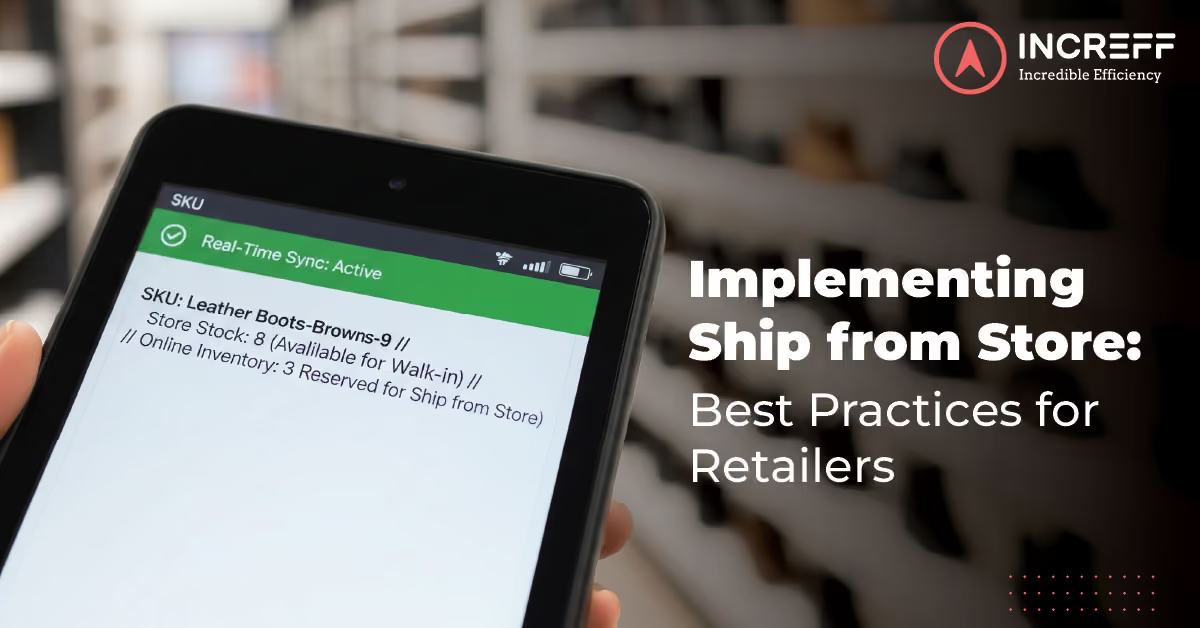
- Real time inventory visibility across every channel, so a sale on the floor updates what's available online within seconds.
- Direct e-commerce integration, with order tracking that store staff can see without switching tools.
- Automated order allocation, based on proximity, current stock, and shipping cost.
Increff's store management system handles this by connecting directly to store POS systems and routing orders with minimal manual input from store teams. It's built to run store fulfillment operations without adding headcount at every location.
- Real time inventory visibility is the foundation
None of the above works without accurate, current stock data. Two things make the biggest difference here:
- Serialization instead of RFID. Unique barcodes per item, rather than RFID tags, give granular tracking without the hardware cost. Increff's item serialization software is built for exactly this piece-level accuracy at a fraction of RFID's price.
- Predictive stock forecasting. Knowing demand ahead of time lets stores plan for fulfillment rather than react to stockouts.
Together, item serialization software and demand forecasting are what keep stock counts trustworthy at the shelf level. Get real time inventory visibility wrong and every other piece of the model breaks orders, get promised against stock that isn't actually there, and stores end up canceling orders they should never have accepted.
- Routing orders: why distributed order management matters
Deciding which one actually ships it is the job of distributed order management. A capable OMS weighs proximity, stock levels, and shipping cost in real time, then assigns the order automatically with no manual triage required.
Increff's OMS was built for exactly this kind of distributed order management, syncing inventory across channels in under 10 seconds so orders route to a location that can actually fulfill them. Retailers running distributed order management will see fewer canceled orders and shorter delivery windows, because the system is picking the best node every time instead of defaulting to the same warehouse.
- Getting store staff ready
Store fulfillment operations live or die on staff buy-in. A few things help:
- Hands-on training on the order tools staff will actually use day to day, not just a one-time walkthrough.
- Clear role separation between staff handling in-store sales and staff handling online dispatch, so nothing falls through the cracks.
- Incentives tied to fulfillment accuracy and speed, not just sales targets.
Staff who understand why store fulfillment operations matter and who benefit from doing them well adapt faster than teams handed a new process with no context.
- Order allocation and logistics
Beyond the store management suite itself, two more pieces round out the rollout:
- Order allocation logic that uses geolocation to assign orders to the nearest capable store, balancing stock levels against shipping cost and delivery speed. Review the allocation rules monthly. What worked at launch often needs adjusting once volume grows.
- Logistics partnerships for last-mile delivery, with real-time tracking built into the customer's order status and enough capacity to handle peak season without falling over.
Neither of these is optional. A well-run store management suite that hands off to unreliable last-mile logistics still produces late deliveries and frustrated customers.
Common implementation problems and how to avoid them
Most rollouts run into the same handful of issues:
- Inventory accuracy drifts without regular audits; item serialization software closes that gap without a full RFID rollout.
- Operational complexity spikes without the right systems doing the routing work. This is where a proper store management suite earns its cost.
- Order volume outpaces staffing if nobody's watching the numbers. Track volume by store and adjust before it becomes a bottleneck.
Conclusion
A few shifts are worth planning around:
- Same-day and quick-commerce expectations are pushing store networks toward becoming rapid-delivery nodes, particularly in dense urban markets.
- Omnichannel fulfillment models BOPIS, local store shipping, and micro-fulfillment are converging into a single store-level strategy rather than staying separate initiatives.
- In-store technology, from digital pick lists to handheld scanners, is becoming standard rather than a differentiator.
- Route optimization and carbon-aware delivery choices are turning into a competitive factor, not just a sustainability talking point.
Retailers building omnichannel fulfillment into their store network now are the ones positioned to handle whatever comes next, whether that's same-day delivery expectations or a shift in how customers want their orders routed.
Ship from store rewards retailers who treat it as an operating model, not a feature to switch on. Get the systems, staffing, and item serialization software in place first, and the delivery speed and cost gains follow.
Retailers that get the fundamentals right, systems, staff, and logistics, in that order are the ones seeing results and making it worth the effort.
Frequently asked questions
Q: Is ship-from-store worth it for a mid-size fashion retailer?
A: Absolutely, when done right, it is one of the highest-ROI fulfilment investments for a mid-size retailer. By converting stores into fulfillment nodes, you reduce last-mile delivery distances, improve delivery speed, and unlock inventory that would otherwise sit idle and get marked down. Increff's ship-from-store solution makes this operationally feasible even for lean store teams, with guided pick-pack-ship workflows, automated carrier label generation, and real-time inventory deduction.
Q: How do I improve warehouse accuracy and reduce picking errors as my brand scales?
A: Warehouse accuracy degrades at scale when processes rely on manual checks and paper-based workflows. The fix lies in system-directed operations barcode or RFID-based scanning at every touch point, directed putaway, and pick verification. Increff's WMS enforces scan-based workflows that eliminate mispicks at the source, while its quality control gates catch errors before shipment, keeping accuracy high even as order volumes grow.
Q: How does an OMS route orders across warehouses and stores?
A: An OMS applies configurable routing logic proximity to customer, available stock, fulfilment cost, and SLA to select the best node for every order. Increff's OMS evaluates all eligible fulfillment nodes in real time, routes each order to the optimal source, and manages the end-to-end lifecycle from allocation to dispatch, ensuring consistent SLA performance across a distributed fulfillment network.
Q: How does BOPIS software coordinate stores, inventory and customers?
A: Buy Online, Pick Up In Store (BOPIS) requires tight coordination between the e-commerce layer, inventory system, and store operations. Increff's BOPIS capability confirms real-time stock availability at the chosen store at the point of purchase, triggers an instant pick task for store staff, and sends automated customer notifications at each stage from order confirmation to ready-for-pickup creating a seamless experience on both sides of the counter.
Q: Can an OMS route orders for same-day delivery?
A: Yes, but it requires the OMS to evaluate fulfillment nodes in real time with SLA windows as a primary routing parameter. Increff's OMS supports same-day delivery routing by identifying the nearest stocked node within the delivery radius, integrating with local carrier or quick-commerce partners, and triggering dispatch workflows that meet tight cut-off times.
Q: How can a 3PL manage multiple clients in one WMS?
A: Multi-client WMS architecture uses logical partitioning to keep each client's inventory, workflows, and reporting completely separate within a shared physical facility. Increff's WMS supports multi-client operations with client-specific SKU masters, billing rules, SLA configurations, and reporting dashboards allowing 3PLs to run differentiated operations for each brand without infrastructure duplication.
Q: How does a WMS exchange shipment data with a TMS?
A: A WMS and TMS integrate via APIs or EDI to hand off shipment data at the point of dispatch. Once the WMS completes the pick-pack and generates shipment details weight, dimensions, destination, carrier preference it pushes this to the TMS, which handles carrier selection, rate shopping, label generation, and tracking. Increff's WMS is built for seamless integration with leading TMS and carrier platforms, ensuring accurate, real-time data flow that eliminates manual handoffs and dispatch delays.