





TL;DR
When a retailer over-commits to the wrong assortment depth, miscalibrates size ratios, or misaligns inventory allocation across store clusters, the resulting overstock has no viable exit but the clearance rack. This post examines the structural reasons behind that failure pattern and explores how modern assortment planning software enables retailers to intervene at the point of decision before a single discount is applied.
Stop Markdowns Before They Start
At Increff, we've watched merchandise planning teams run the same analysis every season: sales missed plans, inventory piled up in the wrong stores, and the only lever left was a discount.
McKinsey estimates that 30 to 40 percent of apparel inventory in the US ends up sold at a discount, and the National Retail Federation puts total markdown losses across US retail above $300 billion a year. That's the downstream cost of buying and allocating inventory that never matched real, store-level demand.
Why Markdowns Happen in the First Place
Markdowns don't just happen at the end of a season. They're the compounded result of decisions made weeks or months earlier:
- Over-buying on low-demand SKUs
- Poor assortment depth too many sizes of slow-sellers, too few of fast-movers
- Misaligned merchandise planning across channels (online vs. offline)
- No visibility into real-time sell-through rates
The root cause is a disconnect between what was planned and what the market demanded.
What Is Assortment Planning?
Assortment planning is the process of determining which products to stock, where to stock them, how much inventory each location needs, and when to introduce them during the season. When done well, it ensures you're carrying the right inventory not too much, not too little.
A well-executed assortment plan considers:
- Historical sales data by category, SKU, and store cluster
- Demand forecasting adjusted for seasonality and trends
- Merchandise depth and width balancing breadth of choice vs. inventory risk
- Channel-level planning what sells online may differ from what sells in-store
When assortment planning is data-driven, you naturally buy closer to demand which means less leftover inventory to markdown.
The Link Between Assortment Planning Software and Markdown Reduction
Modern assortment planning software doesn't just tell you what to buy, it tells you how much, when, and where to allocate it. Here's how it directly reduces the need for markdown pricing:
1. Buy Smarter, Not More
Assortment planning tools analyze historical sell-through rates, return rates, and margin contribution by SKU. Instead of relying on gut feel or manual spreadsheets, buyers can make precise purchasing decisions that minimize overstock from the start.
2. Cluster Stores for Localized Assortments
Not every store has the same customer. Retail assortment planning software clusters stores by customer profile, geography, and sales patterns ensuring each location gets an assortment suited to its demand. This reduces low-sell-through situations that trigger markdown cycles.
3. Optimize Inventory Depth
Over-ordering depth (too many units per SKU) is a top driver of end-of-season markdowns. Planning software flags when depth exceeds projected sell-through, allowing buyers to course-correct before orders are placed.
4. In-Season Rebalancing
The best tools don't stop at pre-season. With inventory markdown pricing model capabilities built in, they continuously monitor sell-through velocity and recommend:
- Inter-store transfers to move slow-sellers to high-demand locations
- Early price promotions before full markdowns become necessary
- Replenishment signals to avoid stockouts on winning SKUs
5. Automated Markdown Pricing: When You Do Need It
Despite the best planning, some markdowns are inevitable. A Markdown pricing tool takes the guesswork out of when and how much to mark down. Instead of blanket end-of-season discounts, it:
- Calculates optimal markdown timing based on inventory aging and remaining sell-through window
- Recommends tiered markdown depths (e.g., 20% → 30% → 40%) to maximize revenue recovery
- Prevents margin cannibalization on items still selling well
This is the difference between reactive markdown pricing and a proactive clearance and markdown pricing strategy.
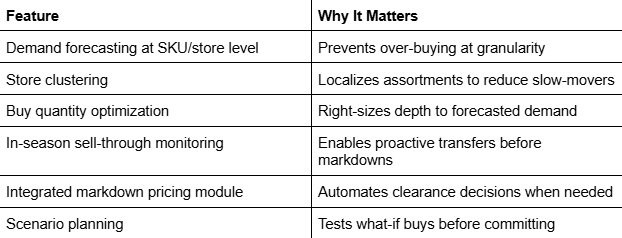
Key Features to Look for in Assortment Planning Software
When evaluating assortment planning software for markdown reduction, prioritize these capabilities:
Real-World Impact: What the Numbers Say
Retailers who implement intelligent assortment planning and retail markdown pricing strategies consistently report:
- 87% Topseller availability with smart inventory allocation
- 71% Improvement in rate of sale (ROS)
- 13% Full price sell-through improvement
- Higher gross margins driven by fewer clearance units
- Leaner inventory with fewer dollars tied up in slow-moving stock
The key is treating assortment planning and markdown pricing not as separate functions, but as two sides of the same inventory optimization coin.
How Increff Helps Retailers Reduce Markdowns
Increff's assortment planning software is purpose-built for brands that want to move from reactive markdowns to proactive inventory optimization. With Increff, brands can:
- Plan and buy quantities at a granular SKU store level using data-backed forecasts
- Optimize assortment depth and width to match localized demand signals
- Monitor in-season performance and rebalance inventory across nodes
- Automate markdown recommendations to protect margins while clearing aging stock
The result: fewer markdowns, higher sell-throughs, and stronger gross margins season after season.
Conclusion
Markdowns are not inevitable. They are, in large part, the result of planning decisions that can be improved with the right data and tools. By investing in assortment planning software that integrates demand forecasting, inventory optimization, and automated markdown pricing, retailers can fundamentally change the economics of their business.
The goal isn't to eliminate markdowns entirely, it's to make them a deliberate, strategic choice rather than a last-resort reaction.
Frequently asked questions
Q: How can retailers manage in-season markdowns without destroying margin?
A: The secret is timing markdowns based on sell-through velocity rather than gut feel or fixed calendar dates. Increff's markdown optimization tools analyse real-time sales pace, weeks-of-cover, and price elasticity to recommend the right discount depth at the right time protecting margin by avoiding premature blanket discounts and clearing aged stock before it becomes a write-off.
Q: Why do fashion retailers end up with overstock and stockouts at the same time?
A: This happens when buying and allocation decisions are made at a category or brand level rather than at the SKU-store level. Poor size ratios, inaccurate demand forecasts, and uneven inventory distribution leave some stores buried in slow-sellers while bestsellers stock out elsewhere. Increff addresses this with SKU-level demand sensing and intelligent allocation, ensuring the right product reaches the right store in the right quantity.
Q: How do I stop over-buying and under-buying stock before a retail season starts?
A: Pre-season buying accuracy depends on granular, data-driven open-to-buy planning. Increff's assortment and buying tools factor in historical sell-throughs, size curves, channel mix, and trend signals to generate SKU-level buy recommendations, reducing both the excess that leads to markdowns and the gaps that lead to lost sales.
Q: How can retailers rebalance excess inventory between stores?
A: Inter-store transfers (IST) are one of the most margin-friendly levers in retail. Increff's stock rebalancing engine identifies stores sitting on slow-moving or overstocked SKUs and matches them with stores experiencing demand for the same product triggering automated transfer recommendations that improve sell-through without resorting to discounts.
Q: How should retailers plan assortments for stores without sales history?
A: For new stores, retailers can use demand proxies, regional demographic profiles, catchment area data, cluster benchmarks, and comparable store performance. Increff's store clustering capability groups stores by demand patterns and customer behaviour, allowing planners to mirror the assortment of a proven cluster peer rather than starting from scratch.
Q: Can software create store clusters using demand and customer behaviour?
A: Yes. Increff's clustering module uses machine learning to group stores based on multiple dimensions, sales velocity, size preferences, price sensitivity, product category mix, and regional demand patterns. These clusters enable smarter, differentiated assortment and replenishment plans rather than a one-size-fits-all approach across the store network.
Q: Which software recommends markdown timing and discount depth?
A: Increff's markdown optimization solution is purpose-built for this. It continuously monitors sell-through rates, weeks-of-cover, and seasonality curves to trigger markdown recommendations at the optimal moment and calculates the minimum discount needed to hit clearance targets, ensuring retailers protect margin while moving aged inventory efficiently.