





TL;DR
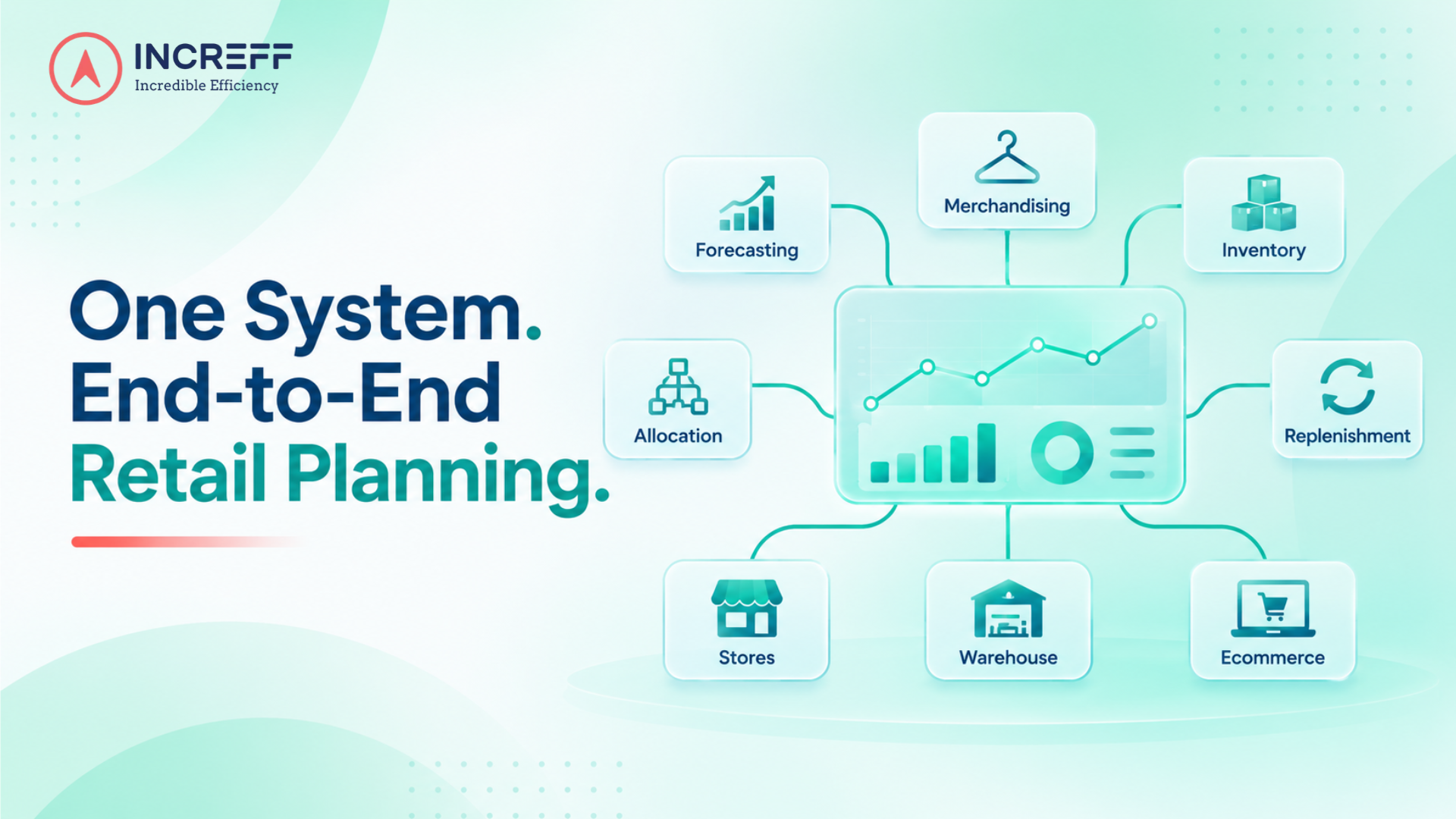
Most retail plans break at the handoffs. Financial targets, open to buy planning, assortment and store stock sit in separate files, so every change gets rebuilt by hand. A connected retail planning platform links each stage so one change flows through the whole cycle, and AI flags risk before a plan goes for approval.
Schedule a Personalized Planning Demo
IHL Group puts global inventory distortion, the combined cost of out-of-stocks and overstocks, at $1.73 trillion a year, about 6.5% of worldwide retail sales. It also finds that fewer than one in four retailers have rolled out AI or ML where it matters most. With tariff uncertainty adding pressure on inventory positioning, a slow planning cycle now costs margin directly.
At Increff, which works with 700+ brands across 34+ countries, we see the same root cause again and again: stages that work in isolation. Here is how the retail planning process should connect, and what AI planning software changes.
Seven Stages of Retail Planning
1. Demand Forecasting: Understand What Customers Actually Want
Historical sales do not always reflect true demand. A style may appear to be selling slowly because its popular sizes were unavailable. Similarly, clearance discounts can inflate sales and make demand look stronger than it really is.
Increff’s demand forecasting solution accounts for distortions such as stockouts, broken size sets, and clearance activity. Its True ROS™ approach considers genuinely available selling days, while product attributes can help estimate demand where a style has limited sales history.
2. Assortment Planning: Build the Right Range for Each Store
A best-selling style in one store may not perform equally well in another. Store location, customer preferences, seasonality, and size demand all influence the right assortment.
Increff’s Assortment Planning uses store-level demand insights to help retailers plan assortment width, how many styles to carry and depth how much to buy. It also considers product attributes and demand-corrected size curves, helping teams build ranges around the needs of individual stores rather than relying only on broad averages.
3. Buying and Inventory Planning: Turn Demand into the Right Quantities
Once the assortment is defined, retailers need to decide how much inventory to commit. Buying too much ties up working capital; buying too little can lead to missed sales.
Increff’s Inventory Planning connects assortment decisions with buying by considering expected sales, projected closing inventory, and the available product range. Buying decisions can also be evaluated against open-to-buy budgets and margin goals.
For core and bestseller styles, Increff can calculate reorder quantities using factors such as demand, cover days, lead times, and safety stock.
4. Pricing and Markdown Optimization: Protect Sales and Margins
Even a well-planned assortment needs attention as the season progresses. Some styles outperform expectations; others sell more slowly or develop broken size runs.
Increff’s Markdown Optimization connects inventory performance with markdown decisions, helping retailers manage stock through the season rather than waiting until the end to react. Markdown recommendations can consider factors such as rate of sale, sell-through, aging, and available sizes.
5. Allocation and Replenishment: Put Inventory Where It Is Needed
Having enough stock across the business does not guarantee that the right products are available in the right stores.
Increff’s Allocation and Replenishment helps retailers use demand and inventory information to guide allocation where available stock should go and replenishment when and how much stock to send. Inventory planning also includes inter-store and warehouse transfers, helping teams respond when stock is unevenly distributed.
For a fashion retailer, this could mean directing more units of a fast-selling size to a high-demand store while reviewing excess stock in slower locations.
6. Financial Planning: Align Merchandise Decisions with Business Goals
A demand-led plan also needs to work financially. Retailers must balance sales opportunities with revenue targets, margins, purchasing budgets, and inventory investment.
Increff’s financial planning capabilities help teams align merchandise targets and open-to-buy budgets across levels of the business, from channels to stores. These financial guardrails give buyers and planners a clearer context for assortment and purchasing decisions.
7. Performance Monitoring: Learn and Adjust Through the Season
Retail planning does not end when a purchase order is placed. Sales, sell-through, stock availability, and inventory movement reveal whether the plan is working.
Increff’s KPI Watchtower helps teams use these signals to identify opportunities for action such as reordering a bestseller, reviewing an imbalance, or adjusting a markdown. Those learnings can also inform the next assortment and buying cycle.
The Business Impact of Connected Retail Planning
By connecting decisions across the planning cycle, retailers can work toward:
- Better availability: Place and replenish products in line with local demand.
- Lower excess inventory: Make more informed buying and inventory decisions.
- Stronger full-price sell-through: Support the right assortment and stock placement earlier in the season.
- Better margin management: Use inventory performance to inform markdown decisions.
- More productive working capital: Align purchases with demand and financial targets.
- Faster planning decisions: Reduce the effort spent reconciling disconnected data and spreadsheets.
Conclusion
Retail planning is not a series of isolated forecasts, spreadsheets, and purchase orders. It is a continuous set of decisions about what customers want, what the business should buy, where inventory should go, and how it should be managed through the season.
Increff helps connect those decisions from demand forecasting and assortment planning to buying, allocation, replenishment, and markdowns. The result is a planning process built around a clearer view of demand and the actions needed to respond to it.
Frequently asked questions
Q: Which merchandising software combines planning, allocation and replenishment?
A: Look for a connected retail planning platform that links each stage, so one change flows through the whole cycle instead of being rebuilt by hand. Increff connects demand forecasting and assortment planning to buying, allocation, replenishment and markdowns. It also includes financial planning for budgets and KPI Watchtower for tracking performance through the season. Most plans break at the handoffs, where financial targets, open-to-buy, assortment and store stock sit in separate files.
Q: Which systems help retailers plan assortments store-wise based on local demand patterns?
A: Increff’s Assortment Planning uses store-level demand insights to plan assortment width, meaning how many styles to carry, and depth, meaning how much to buy. It also considers product attributes and demand-corrected size curves, so ranges are built around the needs of individual stores rather than broad averages. Store location, customer preferences, seasonality and size demand all shape the right range, because a best-selling style in one store may not perform equally well in another.
Q: How can retailers forecast demand for newly launched products?
A: Use forecasting that doesn’t depend only on recorded sales history. Increff’s demand forecasting solution accounts for distortions such as stockouts, broken size sets and clearance activity. Its True ROS™ approach considers genuinely available selling days, and product attributes help estimate demand where a style has limited sales history.
Q: What software helps with merchandise financial planning and open-to-buy (OTB)?
A: Increff’s financial planning capabilities help teams align merchandise targets and open-to-buy budgets across levels of the business, from channels to stores. These financial guardrails give buyers and planners clearer context for assortment and purchasing decisions. Its Inventory Planning then connects assortment decisions with buying by considering expected sales, projected closing inventory and the available range. Buying decisions can be evaluated against open-to-buy budgets and margin goals.
Q: What systems can reduce dependency on Excel for planning and allocation in retail?
A: A connected retail planning platform replaces the spreadsheets in which financial targets, open-to-buy, assortment and store stock are kept separately and every change is rebuilt by hand. Because each stage is linked, one change flows through the whole cycle. Teams spend less time consolidating reports and reconciling disconnected data before acting, and performance signals surface decisions for review.
Q: How does AI improve merchandise planning and buying decisions?
A: AI planning software flags risk before a plan goes for approval, so problems are caught at the handoffs where most retail plans break. Increff’s KPI Watchtower uses sales, sell-through, stock availability and inventory movement to surface actions such as reordering a bestseller, reviewing an imbalance or adjusting a markdown. IHL Group finds that fewer than one in four retailers have rolled out AI or ML where it matters most, and puts global inventory distortion at $1.73 trillion a year, about 6.5% of worldwide retail sales.