
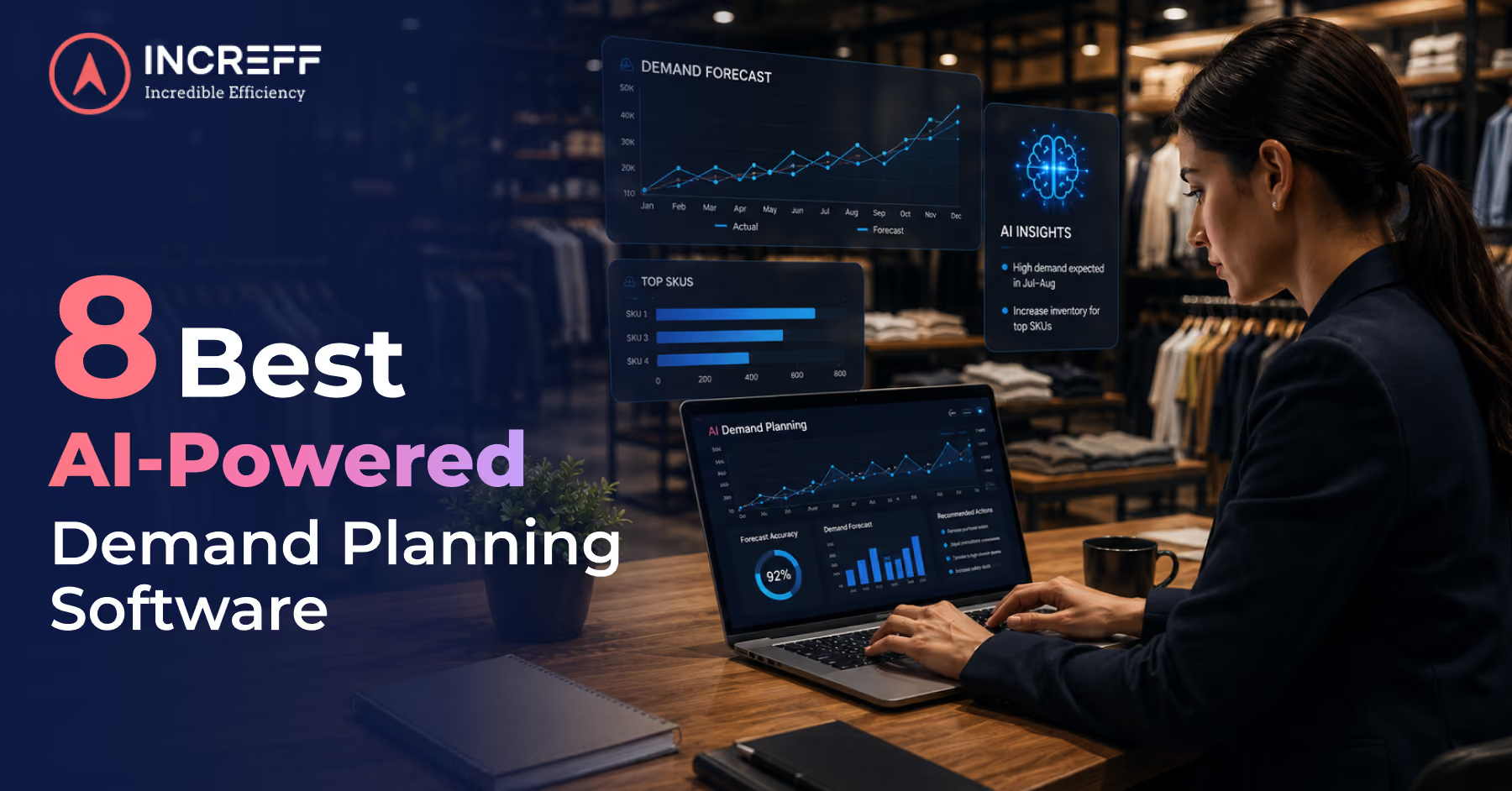




Supply chain demand planning software has moved far beyond spreadsheets and gut instinct. The best AI-powered platforms predict demand with far greater accuracy, reduce stockouts, cut excess inventory and help you respond faster to market shifts. Below are the 8 best options for 2026, who each one suits, and how to choose between them.
What Is AI-Powered Demand Planning Software?
AI-powered demand planning software uses machine learning, statistical modeling, and real-time data to forecast demand across products, channels, and geographies. Unlike traditional tools, these platforms continuously learn from new data accounting for seasonality, promotions, market trends, and supply chain disruptions to generate more accurate, actionable plans.
The 8 Best AI-Powered Supply Chain Demand Planning Software in 2026
1. Blue Yonder
Blue Yonder (formerly JDA Software) is one of the most established names in AI-powered supply chain and demand planning. Its platform leverages machine learning to generate probabilistic demand forecasts, automatically adjusting for variables like promotions, weather, and market signals.
Key features:
- AI-driven demand sensing and shaping
- Integrated merchandise financial planning and replenishment
- End-to-end supply chain visibility
- Luminate Platform with real-time data orchestration
Ideal for: Retail, CPG, manufacturing, and logistics companies with high SKU complexity and global distribution.
2. o9 Solutions
o9 Solutions' Digital Brain platform connects demand planning with supply, finance, and commercial planning on a single unified graph model. It's known for its speed, flexibility, and powerful scenario modeling capabilities.
Key features:
- AI/ML-based demand forecasting with causal drivers
- Integrated business planning (S&OP/IBP)
- Generative AI agents for complex, cross-functional planning
- Real-time scenario modeling and what-if analysis
Ideal for: Mid-to-large enterprises in retail, consumer goods, high-tech, and industrial sectors seeking tightly integrated planning.
3. Anaplan
Anaplan's connected planning platform brings together demand forecasting, financial planning, and supply chain modeling in a flexible, cloud-native environment. Its Polaris calculation engine enables large-scale, multi-dimensional planning in real time.
Key features:
- AI-assisted demand forecasting and consensus planning
- Flexible modeling for revenue, operations, and supply
- Real-time collaboration across planning teams
- Integration with ERP, CRM, and data warehouses
Ideal for: Enterprises that need demand planning tightly connected to financial budgeting and workforce planning.
4. Increff
Increff's AI-powered merchandising software helps fashion, apparel, and retail businesses make smarter inventory decisions from demand forecasting and open-to-buy planning to store-level allocation and replenishment. Unlike large enterprise suites, Increff is purpose-built for retail, making it fast to deploy and intuitive to use.
Key features:
- AI-driven demand forecasting at SKU and store level
- Open-to-Buy (OTB) and merchandise financial planning (MFP)
- Smart allocation and replenishment with inter-store transfers
- Dynamic markdown and inventory optimization
- WSSI (Weekly Sales, Stock & Intake) planning
Ideal for: Retail, fashion, D2C, and omnichannel brands looking for a specialized, high-accuracy demand and inventory planning solution without the complexity of an enterprise-wide platform.
5. RELEX Solutions
RELEX Solutions is a unified supply chain and retail planning platform with particularly strong capabilities in demand forecasting for fresh products, short shelf-life categories, and promotional planning. It's consistently recognized as a Leader in the Gartner Magic Quadrant for Supply Chain Planning.
Key features:
- Machine learning demand forecasting including fresh/perishable items
- Promotion and markdown planning
- Automated replenishment and space planning
- Store-level inventory optimization
Ideal for: Grocery chains, FMCG companies, hardline retailers, and specialty retailers dealing with high variability and perishability.
6. SAP IBP (Integrated Business Planning)
SAP IBP is the cloud-based evolution of SAP's supply chain planning suite, combining demand sensing, supply planning, inventory optimization, and sales & operations planning (S&OP) in one platform. It's deeply integrated with SAP S/4HANA, making it the natural choice for companies already running SAP.
Key features:
- AI-powered demand sensing and statistical forecasting
- Sales & operations planning (S&OP) and IBP
- Inventory optimization with multi-echelon support
- Native integration with SAP S/4HANA and SAP Analytics Cloud
Ideal for: Large enterprises with existing SAP infrastructure that need tightly integrated, enterprise-wide planning.
7. Oracle Demand Management (Oracle SCM Cloud)
Oracle's Demand Management Cloud, part of the Oracle Supply Chain & Manufacturing (SCM) suite, uses AI and machine learning to improve forecast accuracy, detect demand signals, and enable collaborative planning across the supply chain.
Key features:
- Statistical and ML-based demand forecasting
- Demand sensing and consensus planning
- Integration with Oracle ERP and inventory management
- Scenario planning and exception management
Ideal for: Enterprises using Oracle ERP seeking a unified, natively integrated planning solution.
8. Kinaxis
Kinaxis Rapid Response is known for its unique concurrent planning approach — instead of running sequential planning cycles, it continuously reconciles demand, supply, and inventory in real time. This makes it especially powerful for manufacturers and companies with highly complex, global supply chains.
Key features:
- AI-powered demand planning and sensing
- Concurrent planning across demand, supply, inventory, and capacity
- Rapid scenario modeling and exception-based management
- Real-time visibility across multi-tier supply networks
Ideal for: Automotive, aerospace, high-tech, and industrial manufacturers with complex, multi-echelon supply chains.
How to Choose the Right Demand Planning Software
Do you need supply planning or retail merchandise planning? Supply chain suites such as Kinaxis, SAP IBP and o9 connect demand to supply and S&OP. Retail-first tools such as Increff and RELEX connect demand to buying, allocation and replenishment.
- What industry are you in? Retail and fashion brands benefit from purpose-built tools like Increff or RELEX; manufacturers may prefer Kinaxis or SAP IBP.
- What's your current ERP? SAP users naturally gravitate to SAP IBP; Oracle users to Oracle SCM Cloud.
- How complex is your supply chain? For global, multi-tier complexity, o9, Blue Yonder, or Kinaxis are strong fits.
- Do you need cross-functional planning? Anaplan and o9 excel at connecting demand with finance and commercial planning.
- What's your team size and implementation capacity? Smaller teams may find Increff or RELEX faster to deploy than large enterprise platforms.
Conclusion
AI-powered demand planning is no longer a luxury, it's a competitive necessity. Whether you're a fast-growing retail brand optimizing SKU-level inventory with Increff, a global manufacturer running concurrent planning on Kinaxis, or a CPG company aligning demand and supply through o9 or Blue Yonder, there's a platform designed for your needs.
The best software is the one that fits your industry, integrates with your existing stack, and empowers your team to plan faster and smarter. Use this guide as a starting point and dig deeper into the platforms that match your priorities.
Request a demo.
Frequently Asked Questions
Q: What is supply chain demand planning software?
A: Supply chain demand planning software forecasts customer demand and turns that forecast into plans for inventory, purchasing and replenishment. The platforms above range from enterprise suites that link demand to supply and S&OP (Blue Yonder, o9, SAP IBP, Kinaxis) to retail-specific tools that link demand to buying, allocation and replenishment (Increff, RELEX).
Q: What is AI-powered demand planning software?
A: AI-powered demand planning software uses machine learning, statistical models, and real-time data to predict future product demand across channels, locations, and time periods. It automatically accounts for seasonality, promotions, market trends, and supply chain disruptions — generating more accurate forecasts than traditional spreadsheet or rule-based tools.
Q: How is AI demand planning different from traditional demand planning?
A: Traditional demand planning relies on historical averages and manual adjustments. AI-powered platforms continuously learn from new data, incorporate external signals (weather, trends, promotions), and generate probabilistic forecasts at a granular SKU and store level — significantly improving accuracy and reducing both overstock and stockouts.
Q: Which AI demand planning software is best for retail and fashion brands?
A: Increff and RELEX Solutions are among the strongest choices for retail and fashion brands. Increff is purpose-built for retail with AI-driven SKU-level forecasting, open-to-buy planning, smart allocation, and markdown optimization — making it ideal for fashion, D2C, and omnichannel brands. RELEX is particularly strong for grocery and FMCG categories with perishable inventory.
Q: What is the best demand planning software for large enterprises?
A: For large enterprises, Blue Yonder, o9 Solutions, SAP IBP, and Kinaxis are leading choices. SAP IBP is ideal for companies already running SAP S/4HANA. Kinaxis excels for manufacturers with complex, multi-tier global supply chains. o9 is suited for enterprises needing tightly integrated cross-functional planning (demand + finance + supply).
Q: How accurate is AI demand forecasting?
A: Accuracy varies by platform, industry and data quality. Before you shortlist, ask each vendor to show forecast accuracy measured on your own SKU-level history.