





TL;DR
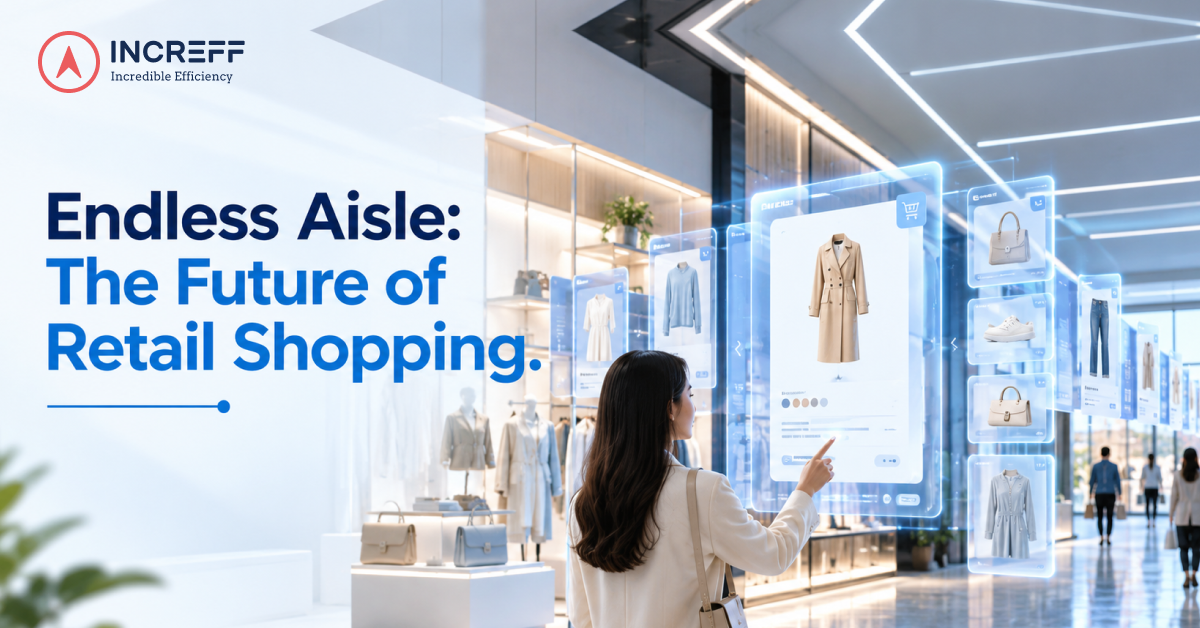
Endless aisle lets shoppers buy products unavailable locally by sourcing them from another store, warehouse, or online catalog. Effective endless aisle solutions connect network inventory, product discovery, checkout, routing, payment, and fulfillment.
Turn local stockouts into completed sales
A shopper finds the right style but not the right size. The unit may exist elsewhere in the network, yet the store cannot complete the sale.
Endless aisle retail technology closes that gap by exposing the wider catalog, confirming availability, taking payment, and arranging pickup or delivery. Endless aisle in retail stores lets every location sell beyond what it physically carries.
What is an endless aisle in retail?
An endless aisle is an omnichannel capability that allows customers in a physical store to browse and order products that are out of stock locally or not normally carried at that location. The order is fulfilled from another store, warehouse, dark store, or ecommerce node.
The experience can run through mobile POS, a kiosk, or a shopper's smartphone. Every model requires accurate inventory, pricing, promise dates, and fulfillment.
Unlike BOPIS, where a customer orders online and collects an item from a store, an endless aisle begins with demand inside the store and extends the available assortment beyond its walls.
Why do retailers need endless aisle solutions?
Local stockouts may be distribution problems, not network shortages. Without visibility and remote ordering, the store still loses the sale.
Strong endless aisle solutions help retailers:
- Recover sales: Complete purchases instead of turning shoppers away.
- Expand assortment: Sell the full catalog without adding shelf space.
- Use stock better: Source units from across the network.
- Support associates: Unify discovery, payment, and fulfillment.
- Improve convenience: Offer pickup or delivery with a clear promise date.
- Capture demand: Use searches and orders to improve local assortments.
Endless aisle in retail stores turns distributed stock into one sellable pool.
How does endless aisle retail technology work?
A connected workflow usually follows six steps:
- A customer or associate searches the retailer's complete product catalog.
- The system checks sellable inventory across stores, warehouses, and other nodes.
- It displays available variants, live prices, promotions, and fulfillment options.
- The shopper chooses home delivery or pickup and completes payment.
- An order management system routes the order to the best eligible node.
- Store or warehouse staff pick, pack, dispatch, and update the order status.
The quality of endless aisle retail technology depends on the inventory, order, payment, and fulfillment services behind the interface.
What features should the best endless aisle software provide?
The best endless aisle software should support the entire transaction rather than stopping at product discovery. Evaluate these capabilities:
- Live availability: Show sellable stock, not stale or reserved units.
- Catalog search: Filter by style, colour, size, and location.
- Unified carts: Combine local and remotely fulfilled products.
- Flexible fulfillment: Support delivery, pickup, stores, and warehouses.
- Routing: Select nodes using availability, distance, cost, and SLA.
- Consistent pricing: Apply valid prices, coupons, tax, and promotions.
- Simple workflows: Minimize switching between staff applications.
- Analytics: Track recovered sales, cancellations, and fulfillment.
Top Platforms for Endless Aisle Solutions
1. Increff
Increff lets shoppers buy out-of-stock or off-location products on mobile in the store. It combines SKU-level network availability, live pricing, promotions, node selection, payments, and inventory and order sync in under ten seconds. It is one of the best endless aisle software options for multi-location brands seeking granular visibility without dedicated kiosks or RFID.
2. Salesforce
Salesforce positions endless aisles around a connected, customer-focused retail experience. Its published guidance emphasizes mobile compatibility, personalization, product recommendations, configurable interfaces, system integration, real-time data, and flexible fulfillment. It is one of the best endless aisle software options for retailers that want to connect assisted selling with CRM and customer engagement.
3. Cloudshelf
Cloudshelf layers on existing ecommerce systems such as Shopify, Salesforce Commerce Cloud, and Magento. It combines customer-facing endless aisle, AI buyer guides, kiosks, digital signage, real-time store stock, and integrated payments. Cloudshelf may suit retailers seeking fast deployment on existing interactive screens rather than replacing their POS or OMS.
4. Fynd Store OS
Fynd Store OS gives associates access to inventory across stores and warehouses, cross-store fulfillment, mixed-cart checkout, product information, recommendations, and delivery choices. Fynd says the capability can sit over an existing POS or ERP and run on common phones and tablets. It is relevant for retailers seeking a store-led omnichannel layer.
5. NewStore
NewStore combines mobile POS, inventory, fulfillment, clienteling, and endless aisle. Associates can search the catalog, view remote stock, capture customer data, and use mixed carts. It suits global brands modernizing the complete store stack.
6. Manhattan Active Omni
Manhattan Active Point of Sale lets associates search global inventory by style, colour, and size, then add available products to a unified cart for pickup or delivery. It suits large networks requiring enterprise POS, order management, inventory, and fulfillment.
7. Shopify POS
Shopify connects ecommerce, POS, catalog, inventory, customer, and order data. Associates can ship unavailable products to customers during an in-person sale. It can be among the best endless aisle software choices for retailers already using Shopify.
How should retailers select and test endless aisle retail technology?
Ask each vendor to demonstrate:
- A locally unavailable size sourced from another location.
- A mixed cart containing store stock and a remote item.
- A unit becoming unavailable between search and payment.
- Routing when the nearest store is overloaded or closed.
- Split fulfillment, cancellation, return, and refund handling.
- Pricing and promotion consistency across channels.
- Associate workflows during peak store traffic.
Measure conversion, recovered revenue, cancellations, promise accuracy, fulfillment cost, processing time, and adoption. The best endless aisle software should increase sales without inventory errors or unreliable promises.
Conclusion
For brands prioritizing rapid inventory visibility, mobile access, flexible sourcing, and store-level execution, Increff deserves close evaluation. The right platform should turn a local stockout into a convenient purchase while keeping inventory, payment, and fulfillment accurate behind the scenes.
Frequently asked questions
Q: Does an endless aisle require a kiosk?
A: No. Retailers can use associate devices, POS terminals, kiosks, or customer smartphones, depending on the service model.
Q: Can an endless aisle work without RFID?
A: Yes, if the retailer has reliable SKU-level inventory data and scan-based workflows. RFID can improve store accuracy, but it is not the only way to support network availability.
Q: How is endless aisle different from BOPIS?
A: Endless aisle captures demand in the store for an item unavailable there and sources it remotely. BOPIS begins with an online order that the customer later collects from a store.
Q: Which retailers benefit most from the endless aisle?
A: Multi-location brands with limited shelf space, broad catalogs, variant-heavy products, or uneven stock benefit most.
Q: How should retailers measure success?
A: Track recovered sales, search-to-order conversion, average order value, cancellations, fulfillment cost, promise accuracy, returns, and associate adoption. Compare results with stores or periods that use the current process.