


At a glance: Footwear carries more SKU complexity than almost any other retail category. Every style multiplies across sizes, colors, genders and regions. Lead times are long, and one broken size set can strand everything else in the style. Increff plans and moves footwear inventory at size level, across stores, warehouses and marketplaces. Size sets stay complete. Bestsellers stay where they sell. Aging stock clears before it needs a deep discount.
Ask three people in a footwear business what the inventory problem is and you get three answers. The store manager says the bestseller is out of stock. The planner says the warehouse is full of size 6s nobody wants. The CFO says the margin left through markdowns nobody planned.
They are all describing the same thing. Stock decisions get made on last month's data, at style level, after the selling window has already moved.
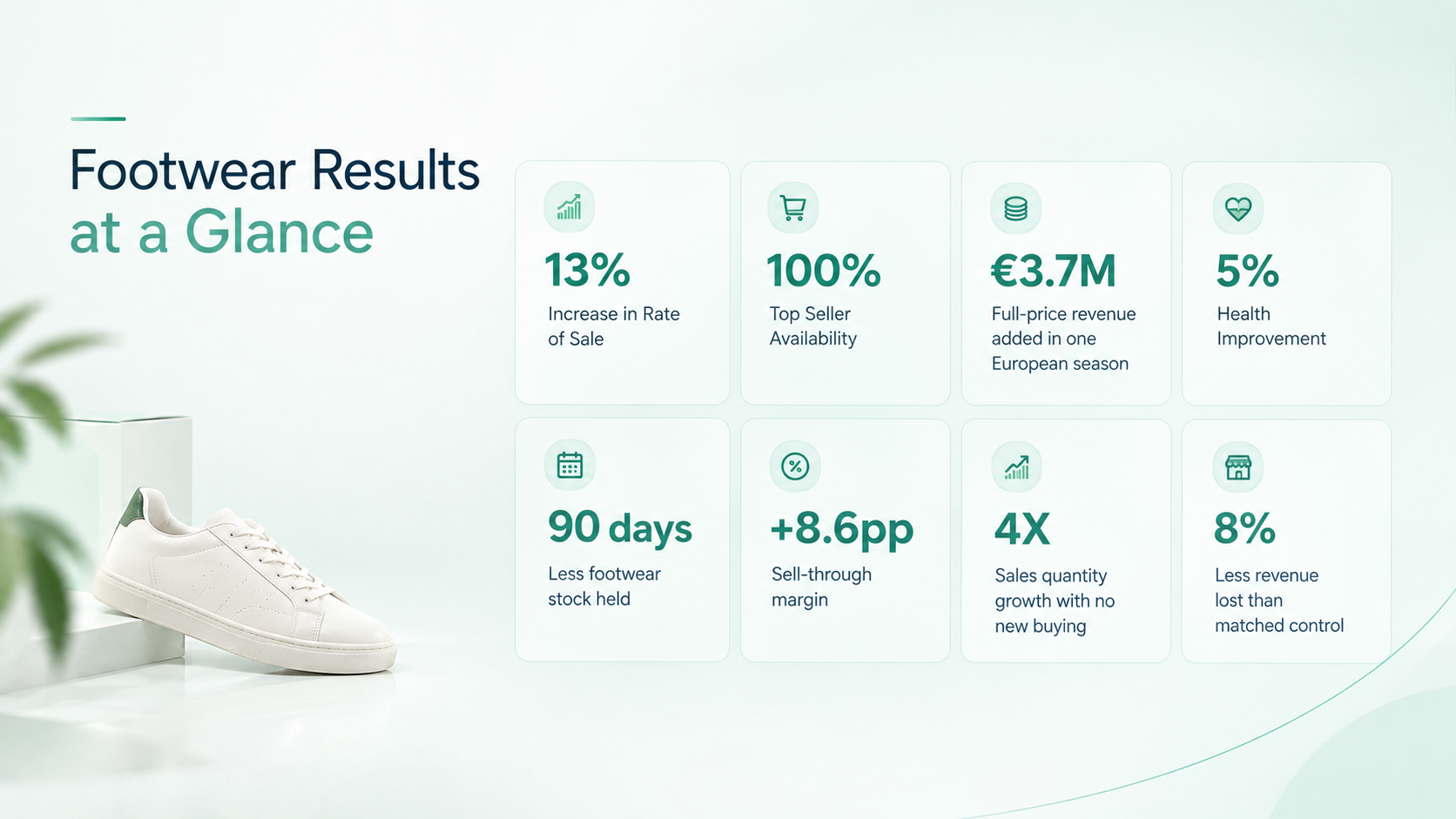
Footwear Results at a Glance
Each figure below is the strongest measured result from a live footwear engagement. The sections that follow show where every one of them came from.
Six footwear and sportswear brands, nine programs. Every section below follows the same shape. What was going wrong, what Increff changed, and what moved. Brand names are withheld, and each section names its source.
Automated Replenishment
More stock is not the same as the right stock
For: A footwear and outdoor brand
The challenge
- Plenty of inventory was the problem. Shelves were full of stock that was not moving, while the styles customers actually wanted kept running out.
- Replenishment was a manual, periodic review. The gap between what was selling and what was on the shelf kept widening.
What Increff did
- Automated replenishment read sell-through at style, size and store level and raised recommendations daily, without waiting for a planner to notice a gap.
- Manual review went away. Continuous, demand-driven replenishment took its place.
Results
Size-Wise Distribution
The style was right. The size wasn't.
For: A leading sportswear brand, across its factory outlet network
The challenge
- Stores kept getting the wrong size mix. Stockouts on the popular sizes, and excess of the same style sitting in sizes nobody wanted.
- Allocation ran off style-level totals, which hid a size-level demand gap underneath a number that looked fine on the surface.
What Increff did
- A size-wise model allocated stock at size level inside each style, instead of spreading a style total across stores and hoping the sizes worked out.
- Planograms were rebuilt around size, so the sizes that sell fastest got the shelf visibility to match.
Results
Allocation
A mature network still had money left on the table
For: A sportswear major, across its European full-price network
The challenge
- This network was already performing well. That is what made the remaining gap interesting, because better allocation was the only lever left to pull.
- An earlier review had flagged stock sitting in stores where it was not selling. The open question was whether fixing that would hold across a full season.
What Increff did
- Replenishment and allocation ran across the full-price network, measured like for like against the prior year.
- True rate of sale and size availability signals held days of holding near target, instead of letting it drift once the program settled.
Results
End-of-Season Sale Planning
A sale window does not forgive a slow decision
For: A leading sportswear major, in its India business
The challenge
- The end-of-season window is short. A few days of misallocation and the whole clearance underperforms.
- Store category mix was not built around actual selling speed, so revenue leaked across the network before the sale even started.
What Increff did
- A forward rate-of-sale analysis drove replenishment down to store, category, gender and attribute rather than broad strokes.
- Top sellers stayed in stock through the window, and category mix inside each store was recalibrated to what was really selling there.
Results
Inter-Store Transfer
The stock you need might already be sitting a few stores away
For: An international athletic brand, across its India store network
The challenge
- Some stores held size runs that had stopped selling locally, while stores a few kilometres away were short of the same sizes.
- Style health across the network was low, with a lot of stock sitting outside any healthy sell-through band and doing nothing.
What Increff did
- Transfer recommendations moved stock from where it was stuck to where it would sell, with no new buying involved.
- Only around 40% of the eligible network was live in this phase, so the numbers below reflect a partial rollout.
Results
The brand made an internal video on mastering inter-store transfers.
Markdown Optimization
Discounting was a guess. Now it's a calculation.
For: An athletic brand, across its factory outlet network
The challenge
- Markdowns went out unevenly across categories and store clusters, which diluted whatever impact they were meant to have.
- Pricing ran on spreadsheets, so nobody could react quickly when demand shifted or a competitor moved.
What Increff did
- Discount depth was set from actual price elasticity, SKU by SKU, instead of a blanket percentage applied everywhere.
- Automated triggers fired pricing moves off live sell-through and rate of sale, with room for a planner to override.
Results
That margin held through a period when store traffic fell around 25%.
Inter Store Transfer
Proof beats a projection every time
For: A footwear brand, across a 30-store controlled pilot in two regions
The challenge
- A market-wide slowdown was pulling revenue down across the network, and stock was not positioned to fight back.
- The brand did not want a forecast. It wanted to see, side by side, whether regrouping stock beat doing nothing.
What Increff did
- A controlled pilot ran across 30 stores, matched against 30 control stores in two regions.
- Transfer and regrouping logic moved stock from underperforming stores to the ones with real demand, inside the pilot group only.
Results
Size-Wise Distribution
The style was right. The size wasn't.
For: A leading sportswear brand, across its factory outlet network
The challenge
- Stores kept getting the wrong size mix. Stockouts on the popular sizes, and excess of the same style sitting in sizes nobody wanted.
- Allocation ran off style-level totals, which hid a size-level demand gap underneath a number that looked fine on the surface.
What Increff did
- A size-wise model allocated stock at size level inside each style, instead of spreading a style total across stores and hoping the sizes worked out.
- Planograms were rebuilt around size, so the sizes that sell fastest got the shelf visibility to match.
Results
Conclusion
We observed improvements in full-price stores and outlets across six brands in Europe and India. Purchasing better inventory did not result in these improvements. They originated from the daily accuracy of which sizes were assigned to which retailers. Planning at the size and shop level is necessary for footwear, not at the style level. Although outcomes differ, the trend is constant: planners concentrate on exceptions rather than restoring perspectives, availability increases as stock declines, and margins hold as discounts decrease.
Frequently Asked Questions
How can we reduce stockouts without carrying more inventory?
By replenishing on live sell-through at size and store level instead of on a fixed review cycle. One brand cut stockouts from 13% to 5% across 264 stores within 105 days while carrying 18% less store stock, and footwear days of holding fell from 314 to 224.
Which tools give size-level replenishment suggestions for each store?
Increff generates replenishment and allocation at size level within each style, using each store's own size demand rather than one network-wide size ratio. In one factory outlet network this lifted top-seller availability from 67% to 100% and cut excess inventory from 40% to 19%.
How do we decide which stores should receive new stock first?
Allocation ranks stores on true rate of sale and size availability rather than on last season's totals, so new stock lands where it will sell through at full price. On one European full-price network this added €3.7M in like-for-like revenue and 204,801 units, with rate of sale up 11%.
Can inter-store transfer replace buying more inventory?
Often, yes. Most brands already hold the sizes they are short of, just in the wrong stores. One brand grew sales quantity 4X and lifted style health from 9% to 52% by moving existing stock alone, with no new purchase orders raised.
Does markdown automation protect margin or just clear stock faster?
It protects margin when discount depth is set from price elasticity per SKU rather than as a blanket percentage. One outlet network improved sell-through margin from 46.1% to 54.7% while cutting markdown depth from 52% to 45%, worth around €259K, and held that margin through a 25% fall in store traffic.
We already run an ERP. Why add a merchandising system?
An ERP records what stock you hold and where it sits. It does not decide which size belongs in which store this week. That decision is where the results on this page come from, which is why brands running mature ERP stacks still found 4% like-for-like revenue and 90 days of holding left on the table.
How quickly do results show, and can we prove it before a full rollout?
Yes. One brand ran a controlled pilot of 30 stores against 30 matched control stores, where pilot stores lost around 8% less revenue through a market-wide slowdown and availability rose 13%. A 264-store rollout delivered its stockout result in 105 days, and another brand's markdown program showed incremental sales within 12 days.
Want to see these numbers on your own footwear inventory? Book a demo and we will run the same analysis on your stores, your sizes and your sell-through.