
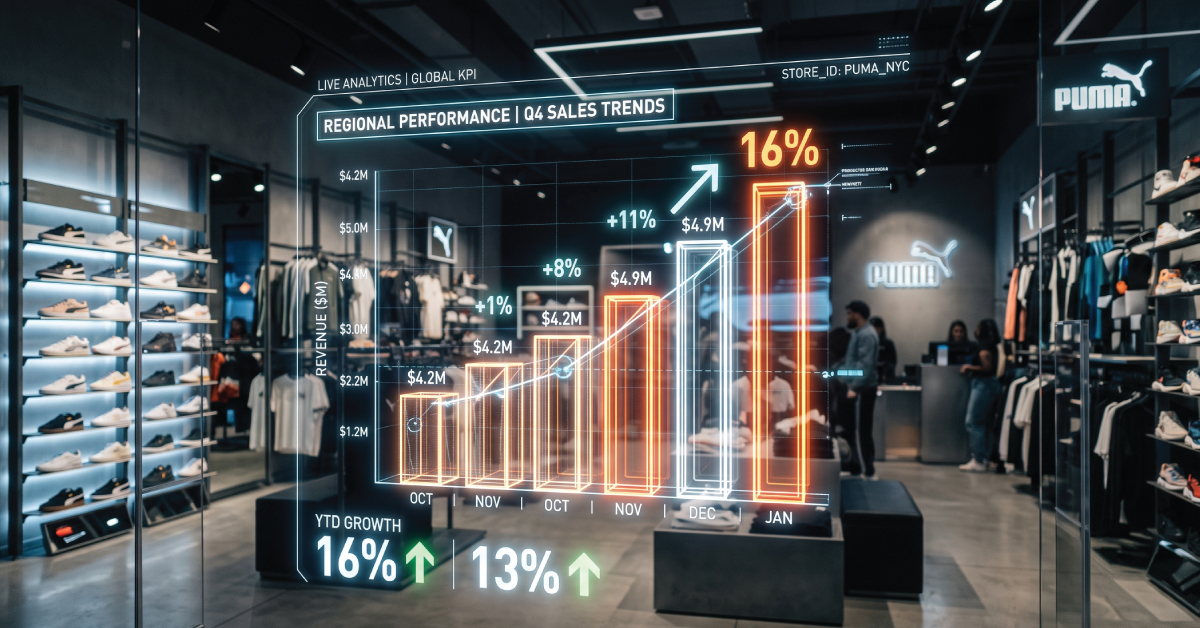


📌 At a glance: Puma India improved overall store health by 5%, grew Revenue per Day by 8%, and lifted Rate of Sale (ROS) by 13% across all categories during EOSS by using Increff's Merchandising Software and EOSS Forward ROS analysis to guide replenishment and allocation across its active stores.
What Is This Case Study About?
This case study shows how Puma India used Increff’s Merchandising Solution and EOSS Forward ROS analysis to optimize its category mix and store replenishment during one of retail’s most crucial selling periods, the End of Season Sale. Puma swapped manual, experience-based allocation with replenishment recommendations based on real sales data to boost shelf health, top seller availability and revenue across every category. Its best-performing store saw revenue grow by 16%.
Client Overview
- Industry: Global Sportswear Retail
- Retail Format: Full-price and factory outlet stores across India (Footwear, Apparel, Accessories)
- Focus Area: EOSS replenishment optimization, category mix, and store-level allocation
- Key Challenge: Misaligned inventory allocation during EOSS leading to poor shelf health, top seller gaps, and weaker revenue per day
- Objective: Use its own sales data to optimize category mix and store performance for EOSS replenishment and allocation
Challenges Faced: When EOSS Allocation Leaves Revenue on the Table
EOSS is a short, quick-moving window in which decisions taken over days about replenishment can make or break the entire season-end clearance. By the start of the analysis period, most of Puma’s problems boiled down to inventory being allocated to the wrong places:
- Shelf health gaps across categories: Accessory stores were contributing at only 88%, Footwear at 78%, and Apparel at 89%, leaving real revenue unrealized on the floor.
- Top seller stockouts during peak selling: With top sellers benchmarked at 1.5x category average revenue, any gap in availability meant lost revenue on the highest-value styles.
- No demand-weighted category mix: Store capacity wasn't set based on how fast items were actually selling, so stores held the wrong depth of inventory during the EOSS window.
- Flat ROS despite active selling season: Without replenishment aligned to what was actually selling, stores were holding slow-moving stock instead of restocking what customers were buying.
- Discounts dragging down ASP: Revenue was growing slower than it could, as stores leaned on discounts rather than letting the right inventory sell at full price.
Increff’s EOSS Forward and ROS-Driven Allocation for Peak Season
Increff ran a full EOSS Forward ROS analysis and built replenishment recommendations using sales data, store capacity norms, and category-level demand across all active stores. This is part of Increff’s Merchandising Suite which also helps during in season replenishment.
👉 Ready to sell more at full price, like Puma? Explore Increff's Allocation & Replenishment software →
Demand-Signal-Based Store Replenishment
- Analyzed past sales data from 09-06-2024 to 18-08-2024 to identify optimum category mix at each store
- Replenishment recommendations built at the store × category × gender × attribute level, not just at SKU or style level
- Only styles with at least 14 days of shelf life left were included, so near-end-of-life inventory didn't distort the recommendations
Top Seller Prioritization
- Styles generating revenue greater than 1.5x the category average were tagged as top sellers and prioritized in replenishment
- This ensured that the highest-velocity, highest-value styles remained available throughout the EOSS window
DOH-Calibrated Allocation
- A 45-day Days of Holding (DOH) cover was used as the replenishment target, balancing availability against overstock risk during a time-bound sale period
- Store capacity set per ROS increment, ensuring allocation scaled to each store's actual selling velocity, not its physical size
Category Mix Correction
- Recommendations recalibrated the Footwear, Apparel, and Accessories split within each store to reflect where demand was actually concentrated
- This shifted Footwear's revenue contribution from 60% to 61% and improved Accessories health by 11pp
Results: Every Category Improved, Every Key Metric Up
"Higher revenue growth (16%) compared to sales quantity growth (4%) indicates improved ASP (12%) and better inventory management."
Key Outcomes Summary
- Overall store health improved by 5% across all active stores; Accessories saw the largest gain at +11pp (88% → 97%)
- Revenue per day grew 8%, with Footwear leading at +9%, driven by better-aligned inventory levels
- Rate of Sale improved 13% overall, with Footwear delivering the strongest gain at +19% ROS
- Top seller availability improved 2% overall; Select City Mall posted the highest store-level jump at +4%
- Like-for-Like revenue grew 16% YoY on only 4% more units sold, meaning the quality of inventory, not volume, drove growth
- ASP increased 12% YoY, reflecting the shift from discount-led clearance to full-price selling of the right stock
- Elante Mall 2 (top store) delivered +16% revenue, +17% inventory per day, +15% ROS, and +6% health score
Ready to Maximize Your Next EOSS Window?
If your EOSS replenishment is still running on last season's allocation logic, Increff's Forward ROS analysis can align your inventory to live demand, and turn your sale window into a stronger revenue period.
👉 Book a demo with Increff and see what data-driven EOSS allocation looks like for your network.
Why Increff for EOSS Replenishment and Allocation?
Increff is built for brands that need to maximize every day of a time-bound selling window:
- Store × category × gender × attribute level recommendations: granular enough to account for the actual demand mix within each store, not just brand-wide averages
- Live ROS-driven allocation: replenishment calibrated to what's selling now, not what sold last season
- Top seller protection built in: highest-velocity styles are always prioritized so peak-season availability never falls short
- DOH-calibrated depth: stock cover aligned to the sale window duration, preventing both overstock and sellout
- Category mix correction: automatically recalibrates Footwear, Apparel, and Accessories splits within stores to match where demand is actually concentrated
- Measurable L2L impact: every recommendation tied to before/after metrics so the uplift is visible and attributable
Frequently Asked Questions (FAQ)
What is EOSS Forward ROS, and why does it matter?
EOSS Forward ROS is an allocation methodology that uses past Rate of Sale data to project what inventory each store needs during the End of Season Sale period. By matching replenishment to how fast items are actually selling, rather than to historical norms or manual forecasts, it makes sure the right styles and quantities are in the right stores before the peak selling window closes.
How is store capacity calculated in Increff's EOSS recommendations?
Store capacity is set using a store × category × gender × attribute base stock, calibrated to actual Rate of Sale. This means each store's replenishment target reflects its own selling velocity, not a generic depth norm.
Why did Revenue grow 4x faster than Units Sold in the L2L analysis?
Because when inventory was better matched to demand, more of it sold at full price or at a smaller discount. When the right styles are on the shelf, especially top sellers, customers buy what they want at the listed price instead of waiting for deeper markdowns. The 12% ASP improvement is a direct result of this dynamic.
How quickly can EOSS recommendations be actioned?
Increff's EOSS Forward ROS recommendations are generated from a defined analysis window and can be actioned as replenishment or transfer instructions for all active stores simultaneously. The turnaround from analysis to recommendation is quick, so teams can act on it before EOSS begins.
Which categories benefit most from EOSS Forward ROS?
All three categories showed improvement in this engagement, but Accessories saw the largest health gain (+11pp) and Footwear the strongest ROS improvement (+19%). Categories with historically uneven allocation tend to benefit most, because replenishing to real demand fixes the depth imbalances that manual planning tends to miss.