
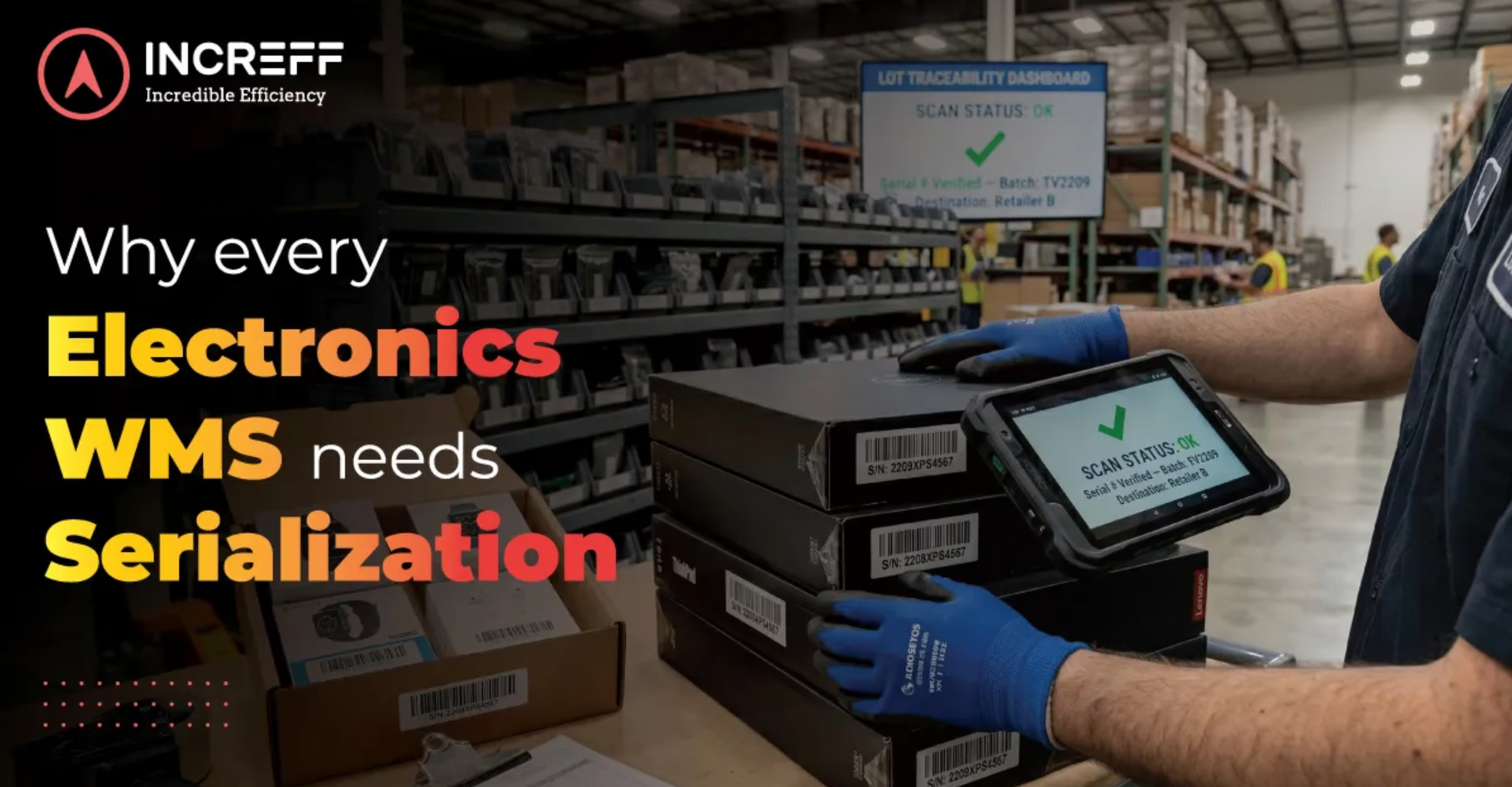





At a glance:The problem the blog talks about is that Electronics brands face 15-20% revenue loss due to inventory blindness and SKU-level tracking errors. Implementation of Serial-Level Warehouse Management Software (WMS) for individual unit traceability can significantly help overcome this issue with which retail brands can achieve 99.2%+ picking accuracy, instant warranty/recall resolution, and automated regulatory compliance.
What is the Real World Impact of Serialisation in the Electronics Industry
We've been solving warehouse complexity for 15+ years. At Increff, we've helped 700+ global brands—from scaling D2C founders to enterprise operations leaders—fix the exact same problem: inventory blindness. Here's what we've learned works.
The Problem: Why Generic Warehouse Management System (WMS) Systems Fall Short for Electronic Goods. Here's the conversation we have constantly with ops founders and supply chain leaders:
"How many iPhone 13 Pros do you have in stock?"
"50 units."
"And how many are actually in new condition with active warranty?"
Long pause.
"Uh... we'd have to check?"
That gap is the problem.
When you're running on SKU-level warehouse management software, your sales team sees "50 available" and starts selling. Your warehouse team has no idea which specific units to pick. Some are dented. A few are open-box. One's flagged for warranty disputes. But the system doesn't know any of that.
Result?
- Marketplace listings oversell because the software doesn't distinguish between new and damaged units
- Warehouse staff grab the wrong inventory without condition or warranty guidance
- Customer service drowns in warranty disputes because nobody tracked which unit went to which customer
- Logistics accidentally ships items that should've been quarantined for recalls
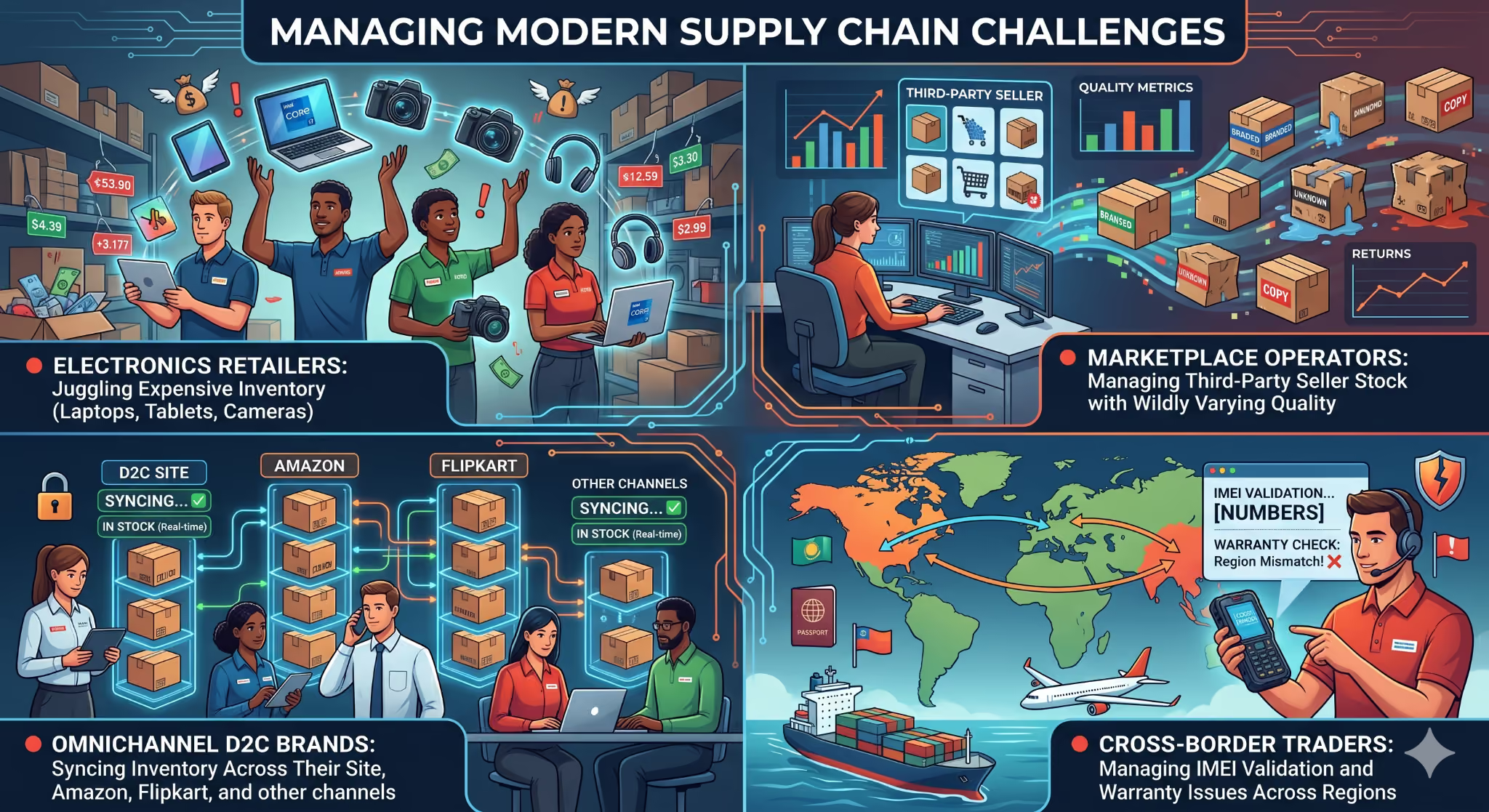
According to Gartner's Magic Quadrant for Warehouse Management Systems, serial-level tracking is now table-stakes for modern WMS platforms—but adoption gaps remain significant among mid-market brands. This hits hard across electronics:
What Is Serial-Level Inventory Tracking?
Serial-level tracking is literally tracking each individual unit instead of lumping them together. So instead of your warehouse management system saying "50 iPhone 13 Pros available," it knows the serial ID, the quantity, the condition, what you have and where you have.
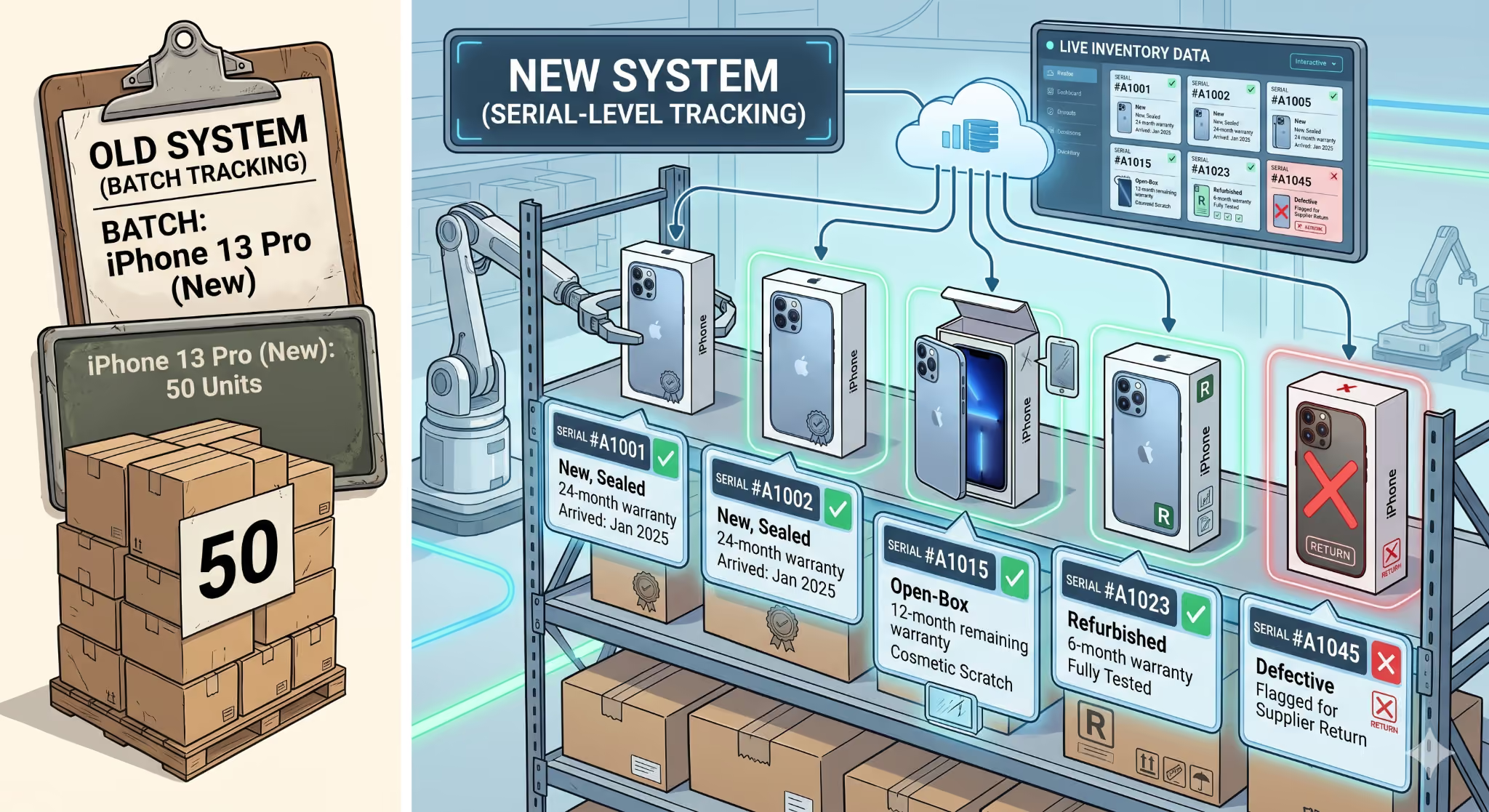
Here's what gets tracked at the serial level:
When integrated into modern warehouse management systems, everything changes. Instead of reacting to customer complaints and warranty disputes, you're preventing them before they happen.
How Does it Affect Costs for an Electronic Warehouse?
Let's talk money. This isn't just an operational nuisance—it's bleeding your margins dry.
1. Overselling & Lost Revenue (15-20%)
Your marketplace listing says "50 available." Your sales team closes 20 orders for new condition units with 24-month warranties. But your warehouse finds only 8 units actually in that condition. The rest? Damaged, open returns, refurbished, warranty issues. For marketplace and ecommerce managers, this tanks your seller metrics. Your return rate spikes. Your cancellation rate climbs. Amazon's algorithm stops recommending your listings.
2. Customer Returns & Warranty Chaos (8-12%)
Customer receives a phone. Serial number doesn't match their expectation. Calls your support team. Someone spends 2+ hours investigating whether the warranty is actually valid. Sometimes it is. Sometimes you accidentally shipped refurbished stock to someone who ordered "new.". For electronics, this happens constantly. Every investigation costs time and money. Research from APICS (now ASCM), the gold-standard certification body for supply chain management, shows that untracked warranty claims consume an average of 2.3 hours per claim in administrative overhead alone.
3. Deadstock & Obsolescence (5-10%)
You've got inventory sitting on shelves you forgot about. Slow movers. Damaged units. Items nearing warranty expiry. At year-end, you write it all off as unsellable. Studies and Statistics quantified this hidden cost: mid-market distributors write off an average of 5-10% of inventory annually due to lack of visibility. For a brand managing $10M in annual inventory? That's potentially $500K just gone.
4. Compliance & Legal Risk (Unpredictable)
A batch of phones gets recalled due to battery defects. You shipped 200 units from that batch before the recall notice came through. Without serial-level tracking, you have no idea which customers got which units. According to ISO 28003 (Supply Chain Security and Compliance Framework), organizations without traceability mechanisms face exponentially higher legal liability and remediation costs. For enterprise ops leaders and cross-border operators, compliance management is non-negotiable.
5. Operational Overhead (3-5% of payroll)
Your warehouse team manually counts bins to figure out what's actually there. Your customer service team spends hours investigating warranty disputes. Your finance team runs monthly reconciliations explaining why the system says $2.4M in inventory but you can only find $2.1M physically.
How Serial-Level Tracking Works in Modern WMS Platforms
Let's walk through what happens when you implement serial-level tracking in a modern warehouse management software.
Inbound: Capture Serials at Receipt- :A shipment arrives from your supplier. Instead of just logging "50 units received," your warehouse management system captures the serial number on each box. Modern WMS software pulls this data straight from supplier APIs, BOMs, or digital invoices—no manual data entry needed. Each serial gets linked to: condition (new/open-box/refurbished), warranty expiry, batch code, procurement cost. All automatic. All searchable.Non-technical warehouse staff don't need to understand any of this. They just scan barcodes. The system does the heavy lifting.
Putaway: Intelligent Bin Assignment- Here's where it gets smart. Your warehouse management software doesn't just say "put these in rack 5." It makes intelligent decisions:
✓ Fast-moving inventory → Put it near packing station (faster picking)
✓ Slow movers → Deeper in warehouse (lower foot traffic)
✓ Warranty expiring in 30 days → Flag for immediate sale or clearance
✓ Damaged units → Quarantine zone
✓ Recalled batch → Locked bin, no picking allowed
For warehouse managers coordinating complex operations, this transforms the entire bin strategy. You're not guessing anymore. The system does the math.
Picking & Packing: Zero Mistakes- Order comes in. Customer bought "new condition, 24-month warranty." Your WMS software recommends specific serials that match exactly. Not "new condition might be here," but "pick serial A1001, it's new, warranty valid until Jan 2027." Picker scans the serial. System confirms it matches. Result? 99.2%+ pick accuracy. (Compare that to 95-97% with SKU-only systems where staff are guessing.) Even non-technical warehouse staff execute flawlessly because the system tells them exactly what to do.
Fulfillment: Perfect Traceability- Serial numbers travel with the order. Shipping label, invoice, warranty documentation—all pre-filled with the exact serial shipped. For cross-border operators? Instant compliance verification. For marketplace managers? Zero disputes about authenticity or condition.
Post-Sale: Instant Problem Resolution- Customer calls: "My phone won't charge." Your team pulls the order. Sees serial A1234, batch B5678, warranty valid until Dec 2025. Knows instantly whether to troubleshoot or replace.No investigation. No customer frustration. Done in 3 minutes.
8 Must-Have Features in Electronics WMS Platforms
Not all warehouse management systems are created equal. Here's what you actually need:
1️⃣ Serial-Number Capture & Lookup
Can your WMS software auto-capture serials from supplier data, or are you manually entering thousands? Look for platforms with supplier API integration, mobile barcode scanning, and searchable serial history. Warehouse managers should find any unit's complete history in seconds—no IT background needed.
2️⃣ Multi-Condition Tracking
Your system needs to track new, open-box, refurbished, damaged, and defective as completely separate pools. Not just different SKUs—actually different at the serial level. New condition sells for $800. Refurbished sells for $500. Damaged might sell for $200 or liquidate. Your WMS has to enforce these rules at picking time.
3️⃣ Batch/Lot Management
Group units by purchase order or manufacturing batch. Track defect rates. Enable instant quarantine when a batch is recalled. For cross-border operators managing multiple sourcing regions, this is critical for quality control.
4️⃣ Warranty Tracking & Alerts
Auto-flag units expiring in 30, 60, 90 days. Prevent selling expired-warranty stock. Calculate warranty coverage for pricing. For heads of ecommerce, warranty tracking is a trust signal. It prevents warranty disputes that tank seller ratings.
5️⃣ IMEI Blacklist Integration
For mobile devices especially, your WMS should check serials against telecom blacklists. Block shipment of stolen/blacklisted devices. Per IEEE's IMEI Management & Telecom Compliance Standards, this is a regulatory requirement in most jurisdictions and a critical security gate.For enterprise ops leaders, this is the security layer that prevents regulatory violations.
6️⃣ Condition-Based Bin Assignment
Your warehouse management software automatically assigns storage based on condition, expiry, and velocity (how fast it sells). Results? Faster picking (less walking), better inventory freshness (FIFO enforcement), fewer handling errors.
7️⃣ Multi-Channel Integration
Sync serial availability across your website, Amazon, Flipkart, Shopify, B2B wholesale—everywhere you sell. Prevents overselling. Tracks which channel each unit was sold to (important for warranty/recall tracking). For marketplace managers, this solves the overselling problem that tanks seller ratings.
8️⃣ Compliance & Recall Management
Instant quarantine of recalled batches. Reports showing which customers received recalled units. Audit trails for regulatory compliance. According to Government of India's E-Waste Management Rules 2016 and similar regional frameworks, companies managing electronics must maintain complete traceability records. For enterprise ops leaders and cross-border operators, compliance management is non-negotiable.
Implementation Roadmap: 12 Weeks to Perfect Accuracy
Implementing serial-level tracking doesn't require blowing up your operation. Here's the realistic timeline:

Serial-Tracking vs. SKU-Only Systems: Side-by-Side Comparison
Real Case Study: How An Electronics Retailer Achieved 9.1% Higher ASP with Increff Warehouse Management System (WMS)
A leading electronics retailer in the GCC and MENA region unlocked a ~9.1% potential increase in Average Selling Price (ASP), identified ~22% revenue loss from stock-outs, and improved inventory mix using Increff’s data-driven assortment optimisation framework across 20 stores.
👉 Read the full case study
Your Next Step Forward
You know the problem. You know the cost. You know it's fixable. Here's what actually works:
Option 1: Quick Assessment (30 minutes) ✓
Audit your current inventory. Pick 2-3 high-value SKUs. Count them physically. Compare to your system. If discrepancy >5%, serial-level warehouse management software is urgent.
Option 2: Build Your Business Case (1 hour) ✓
Do the math on your hidden costs. What's your overselling loss (2-3% of revenue)? Warranty dispute handling? Returns rate? Deadstock? Add it up. You're probably looking at $500K+ annually.
Option 3: Schedule a Demo (1 hour) ✓
See how it actually works. Live walkthrough of inbound, putaway, picking, fulfillment. How warranty alerts prevent overselling. Multi-channel sync. Timeline and cost for your specific situation.
👉 Explore Increff's Warehouse Management Software
FAQ: Your Biggest Questions Answered
Q1: Isn't serial-level tracking only for luxury brands?
Not even close. Sure, luxury watch brands care about authentication. But refurbished electronics retailers? They need serials desperately. Marketplace aggregators managing sketchy third-party inventory? Essential. Even a $2M distributor saving 2-3% revenue through serial tracking in warehouse management software justifies the investment.
Q2: Which WMS platforms let non-technical warehouse staff learn the system quickly?
Look for these features: mobile-first interface, barcode scanning instead of menus, visual workflow guidance (icons + simple language), built-in help tooltips, zero command memorization required. Increff's warehouse management system is built specifically for non-technical teams. No IT backgrounds needed.
Q3: What features should I look for in WMS software for e-commerce vs. manufacturing?
For e-commerce (marketplace + D2C):
✓ Multi-channel integration
✓ Rapid fulfillment workflows
✓ Customer-facing visibility
✓ Return management
✓ Condition-based picking (new vs. refurbished)
For manufacturing:
✓ BOM management
✓ Component-level tracking
✓ WIP inventory
✓ Serial tracking for finished goods
If you're blending both (like electronics retailers do), you need a WMS software that handles both paradigms.
Q4: Do I need to train my entire warehouse team?
Yes, but it's fast. According to CBRE's Logistics Warehouse Technology Benchmark Report 2024, modern WMS platforms designed with non-technical users in mind can be learned in 3-5 days on average. Your team isn't learning a new system—they're learning a new picking workflow. For non-technical warehouse staff, the best systems require zero training on concepts. Just: "Scan this barcode, pick the unit the system shows, scan it again."
Q5: How can I optimize my warehousing solutions for better efficiency?
Implement serial-level inventory tracking with condition-based bin assignment (new items near packing, slow movers deeper) and multi-channel sync to prevent overselling. This reduces picking time from 45-60 seconds to 30-40 seconds per unit and improves inventory accuracy from 8-12% discrepancy to <1%, directly boosting operational efficiency by 35%.