
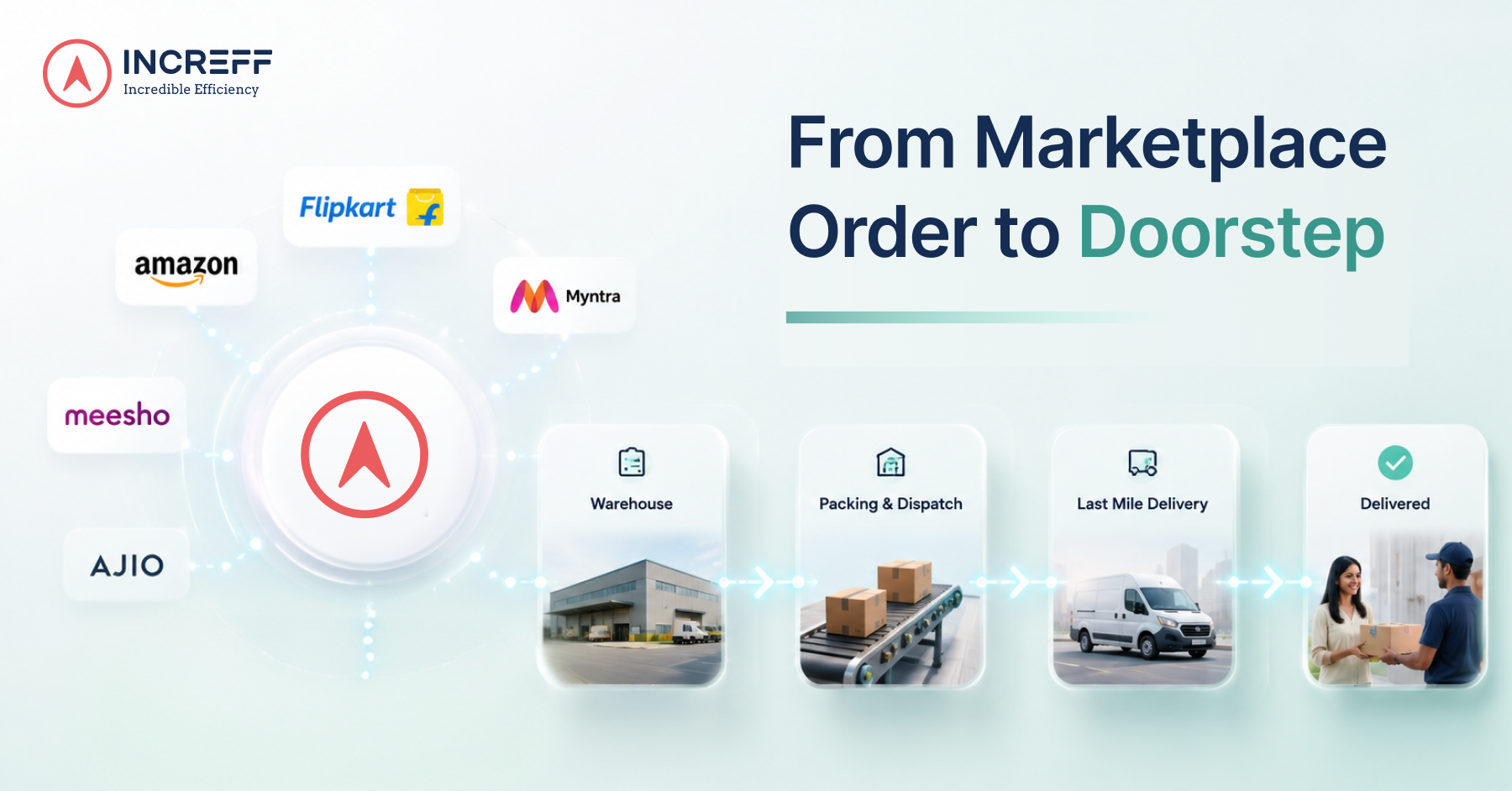





TL;DR:
Every new marketplace a retailer plugs into adds another way for stock counts to lie, orders to double-book, and customers to wait. An order management system that syncs inventory in real time turns marketplace sprawl into a single, sellable pool instead of a dozen disconnected ledgers.
1,300+ integrations. Zero excuses for overselling
Multichannel e-commerce sales are on track to hit $892.4 billion in 2026, up 15% year over year, and most of that growth is landing on marketplaces retailers don't fully control. Flipkart, Myntra, Amazon, Ajio: each one wants its own feed, its own SLA clock, its own return rules.
At Increff, we've watched brands onboard a fourth or fifth marketplace and then quietly start overselling on all of them, not because demand out ran supply, but because no single order management system was tracking the truth across channels. McKinsey has found that B2B buyers alone now interact across 10% or more channels during a single purchase journey, roughly double what it was a few years ago, a pattern showing up just as fast on the consumer side.
Why Marketplace Integration Is No Longer Optional
Selling on multiple marketplaces used to be a growth strategy. The brands gaining ground in 2026 aren't the ones with the most marketplace listings, they're the ones whose backend can actually keep up.
Without integration, every new marketplace you add creates a new operational surface to manage manually: a separate feed to update, a separate order queue to monitor, a separate return process to reconcile. The work scales with the channel count. Margins don't.
Integration collapses that complexity. Instead of five separate systems talking past each other, you get one layer that connects them so inventory, orders, and fulfillment data move automatically across channels without anyone manually pushing information from one platform to another.
For brands with ambitions to grow beyond two or three channels, integration isn't a nice-to-have. It's the infrastructure that determines whether growth creates leverage or just creates more work.
How Integration Completely Transforms Order Fulfillment
Centralized Order Management
Every order whether it comes in through Amazon, Flipkart, Myntra, or your own D2C site lands in one place. There's no switching between marketplace seller portals, no risk of missing an order because someone forgot to check a tab, and no delay between when a sale happens and when fulfillment begins.
Centralization also means your team works from a single queue with consistent logic applied to every order, regardless of where it originated. Priority rules, SLA windows, and routing preferences are set once and applied everywhere instead of being configured differently in each marketplace's native interface and inevitably falling out of sync.
Real-Time Inventory Syncing
When a sale happens on one channel, inventory updates across every other connected channel in seconds not the next morning, not at the next batch refresh. The stock count a marketplace sees is the stock count that actually exists.
This matters most during high-velocity moments: a flash sale on Myntra, a trending product moment on Amazon, a campaign driving D2C traffic simultaneously. Without real-time sync, these are exactly the conditions that produce overselling. With it, every channel is drawing from the same live number, and the first channel to sell a unit is the only one that gets to sell it.
Automated Order Routing
Once an order is placed, integration handles the decision of where it should be fulfilled from based on which warehouse or dark store has the stock, which location is closest to the customer, and which node can meet the marketplace's SLA window.
That decision, which takes a human several minutes of dashboard-checking to make well, happens in milliseconds. For brands with multiple fulfilment locations, this means faster shipping, lower last-mile costs, and SLA adherence that doesn't depend on who's on shift. For brands using third-party logistics partners, orders route directly to the right 3PL without a manual handoff in between.
Seamless Tracking Updates
The moment a shipping label is generated, the tracking number pushes back automatically to the marketplace and to the customer. No manual entry, no delay between dispatch and notification, no customer service tickets asking "where's my order?" because the update didn't make it back to the platform in time.
This matters for SLA compliance as much as it matters for customer experience. Marketplaces that track fulfillment performance look at how quickly tracking is confirmed, not just whether the order shipped. Automated tracking updates keep those metrics clean without anyone having to remember to post them.
What Breaks First When Marketplaces Multiply
Three things tend to fail in a predictable order.
- Inventory visibility goes first. A single SKU sitting in one warehouse gets allocated to four marketplaces at once because nothing is telling each channel what the others just sold. The result is oversold stock.
- Order routing goes second. Without central supply chain order management, someone has to manually decide which warehouse, dark store, or vendor ships a given order, a decision that should take milliseconds but instead takes forever. Retailers running this manually report shipping delays that have nothing to do with actual stock availability and everything to do with decision latency.
- Return visibility goes third. Marketplace returns often show up without warning, no advance notification, mismatched SKUs, delayed sync from the platform. Teams without a unified order management end up reconciling refunds against orders they can barely locate, which is how margin is quietly lost out of an otherwise healthy order fulfillment.
How Increff Approaches Marketplace Integration
Increff’s order management system exposes 100% of inventory across every connected channel with no buffer stock held back, which means a brand selling on Amazon, Flipkart, Myntra, and its own D2C site is drawing from one real pool instead of five, and that alone removes the guesswork that causes overselling. Orders sync across systems in under 10 seconds, so a sale on one marketplace updates availability everywhere else before the next shopper hits buy.
For brands selling vendor-managed stock, orders route straight to the vendor to ship without the retailer ever holding that inventory, which matters for long-tail SKUs and fast regional expansion. On the store side, every physical location can double as a shipping node, turning stores into extra dispatch capacity during marketplace demand spikes instead of dead stock sitting on a shelf. Returns route back through the same order management, with forward and reverse shipment tracking and QC grading built in, so refund and restock decisions don't stall waiting on marketplace notifications that may never arrive.
The result is a supply chain order management setup where marketplace growth doesn't multiply operational risk 1,300-plus existing marketplace, ERP, and logistics integrations mean a new channel is a configuration step, not a six-month project, and SLA adherence stays above 99% even as order volume climbs.
Conclusion
Marketplace integration isn't really about plugging in another sales channel. It's about whether the systems behind that channel can be trusted to tell the truth about stock, orders, and returns without a human double-checking every number. Retailers who get this right treat their OMS as the backbone of growth, not a maintenance line item. The ones who don't end up managing five marketplaces the way they'd manage one, badly, five times over. If marketplace sprawl is already outpacing what your team can track by hand, it's worth seeing what connected order fulfillment actually looks like before the next channel launch adds to the pile.
Talk to Increff about fixing this before your next marketplace launch
Frequently Asked Questions
Q: Which inventory platforms make it easy to onboard new marketplaces quickly?
A: Platforms with pre-built marketplace connectors like Increff OMS can onboard a new channel in days rather than months. The key differentiator is the size of the existing integration library; Increff connects with 1,300+ marketplaces, ERPs, and logistics partners, so adding a new channel is a configuration step, not a development project.
Q: Which tools support same-day inventory sync to avoid order cancellations on marketplaces?
A: Tools that sync in near real time rather than on batch schedules. Increff OMS updates stock across all connected channels in under 10 seconds from the point of sale, which means a purchase on one marketplace adjusts availability everywhere else before the next order lands.
Q: Which software can handle marketplace-specific SLAs while allocating orders to warehouses?
A: An OMS with rule-based routing logic that factors in SLA deadlines alongside stock availability and proximity. Increff's order routing engine automatically assigns orders to the fulfillment node best positioned to meet each marketplace's SLA without manual intervention.
Q: What platforms can sync stock in real time across Amazon, Flipkart, Myntra, and my own D2C site?
A: Increff OMS maintains a single inventory pool shared across all connected channels Amazon, Flipkart, Myntra, D2C, and physical stores with no buffer stock held back per channel. Every sale, regardless of where it happens, updates the shared count in under 10 seconds.
Q: Which platforms are best for managing marketplace flash sales with accurate stock?
A: Platforms that expose 100% of available inventory rather than holding safety stock in reserve. During flash sales, Increff's real-time sync ensures stock counts are accurate at the moment of purchase, reducing oversell risk even during sharp demand spikes..
Q: Which platforms support real-time inventory visibility for brand, marketplace, and distributor stock in India?
A: Increff OMS provides a unified view across brand-owned stock, marketplace-held inventory, and vendor-managed goods with distributor-to-consumer routing supported natively, so brands don't need to hold stock to fulfil orders on vendor-managed SKUs.
Q: Which tools are best for reconciling inventory discrepancies across ERP, WMS, and marketplaces?
A: Tools that create a single source of truth rather than requiring periodic reconciliation. Increff's architecture keeps inventory state consistent across ERP, WMS, and marketplace channels in real time, so discrepancies are caught at the transaction level rather than surfacing in a weekly audit.