





TL;DR
Increff solves retail inventory fragmentation by combining warehouses, stores, vendors, and sales channels into a single connected pool. By replacing isolated channel buffers with 5–10 second real-time syncs, item-level WMS tracking, and intelligent order routing, Increff eliminates oversells, cuts fulfillment costs, and unlocks invisible stock (like store and vendor inventory) to boost overall sell-through across D2C, marketplaces, and wholesale.
IHL Group sizes global inventory distort the combined cost of out-of-stocks and overstocks at $1.7 trillion in 2026, or 6.2% of retail sales, with empty shelves alone accounting for $690.9 billion. And the root cause is usually the record, not the stock: a 2026 Journal of Business Logistics study found 65% of retail inventory records were inaccurate, off by roughly 35% of the units actually on the shelf. This is where supply chain inventory management software becomes critical. It tracks, allocates, and syncs stock across every node in a retail network, including warehouses, stores, vendors, 3PLs, and sales channels, from one live record. It replaces isolated channel-wise pools with a single source of truth for what exists, where it sits, and what it is already committed to.
Why do retailers lose control of inventory across the supply chain?
Control breaks when inventory lives in multiple systems that update on different clocks. Each handoff inbound to putaway, warehouse to store, channel reservation to dispatch adds lag. By the time batch syncs reconcile, the brand has already oversold, held back sellable stock, or shipped from the wrong location.
The recurring failure points:
- Channel-wise buffers. Teams reserve 10–20% per channel as insurance against oversells, which quietly suppresses sell-through everywhere.
- Store stock is treated as invisible. Units that could serve nearby online demand never enter the fulfillment pool.
- Returns in limbo. Stock sits unclassified for days instead of going back to saleable.
- Fixed-warehouse routing. Every order ships from the same node regardless of distance, cost, or SLA.
- Manual reconciliation. Teams trust the spreadsheet over the system, so the system never becomes trustworthy.
How does Increff create a single view of inventory?
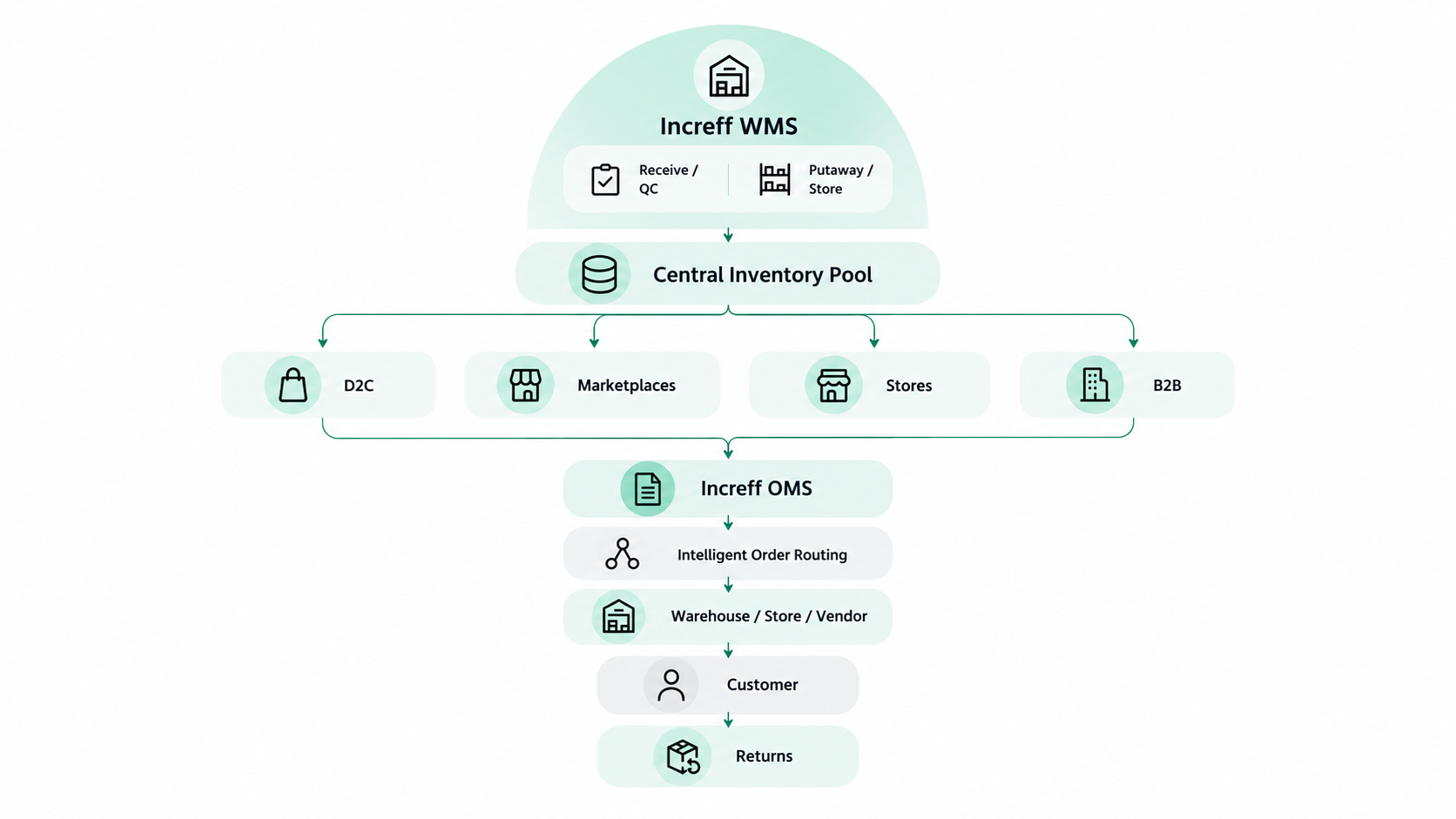
Increff's OMS acts as the central inventory and order layer. It tracks stock across every warehouse, store, and fulfillment node, then exposes that combined availability to all relevant sales channels instead of maintaining separate pools per channel.
Take a brand holding 500 units in a Bengaluru warehouse, 100 in Mumbai, and 30 in a retail store. Traditionally, each of those is a separate pool with its own allocation rules, and a chunk of each is held back as safety. With Increff, all 630 units sit in one connected pool visible to marketplaces, D2C, B2B, and store channels.
Underneath, Increff WMS tracks the physical reality of that stock through the full cycle:
Receiving → QC → Putaway → Storage → Picking → Packing → Dispatch → Returns
Scan-based workflows and item serialization give traceability down to the bin and individual item, with support for FIFO/FEFO, cycle counting, bulk units, and kitting. The system does not just know how many units exist it knows where each one is and what has happened to it. That granularity is what makes a single pool safe to sell against.
How does an end to end inventory management platform decide where to fulfill from?
An end-to-end inventory management platform evaluates every incoming order against the full network and picks the best node, rather than defaulting to one fixed warehouse. Increff's OMS weighs available inventory, node location, delivery SLA, order type, fulfillment cost, and channel or business rules before assigning the order.
The practical effect across the supply chain:
- Shorter delivery distance. Orders are served from the closest node that genuinely has the stock.
- Lower fulfillment cost. Routing accounts for shipping economics, not just availability.
- Fewer failed promises. Fallback routing kicks in when the preferred node cannot serve the order, instead of the order simply ageing.
What does multi channel inventory visibility look like in practice?
Multi channel inventory visibility means every channel reads from one live quantity, with the deduction applied the moment an order is captured not after an overnight sync.
Increff pushes channel updates in roughly 5–10 seconds, so a sale on one marketplace reflects across the website, other marketplaces, stores, and internal systems before another customer can claim the same unit.
Real multi channel inventory visibility rests on four conditions:
How do stores, vendors, and returns fit into the same inventory pool?
Increff extends the same inventory record to nodes; most systems ignore retail stores, dark stores, vendor stock, and returned units so inventory that was previously invisible becomes sellable and fulfillable.
- Stores as fulfillment nodes. Increff's Store Fulfillment System supports ship-from-store, BOPIS, store returns, endless aisle, and other omnichannel orders. Orders route to a store, dark store, or warehouse based on stock and SLA, with fallback routing when the preferred node cannot deliver.
- Vendor inventory without owning it. Increff's Vendor Inventory Management & Fulfillment System (VIMS) lets brands expose vendor stock and fulfill directly from vendors, so assortment is not limited to units already sitting in your own warehouse.
- Returns back into saleable stock. Return → gate entry → QC → reconciliation → restocking, quarantine, or vendor return. WMS traceability on returned and rejected items decides what re-enters the pool and what does not.
- Upstream balancing. Demand forecasting, assortment planning, allocation, replenishment, inter-store and warehouse transfers, and markdown optimization run on the same data, with multi-echelon visibility across central DCs, regional hubs, and partner nodes for wholesale and distribution.
Conclusion
Inventory problems in retail are rarely about how much stock a brand holds. They are about whether the supply chain can agree on where that stock is and who it belongs to. Once one connected pool spans warehouses, stores, vendors, and channels, buffers shrink, cancellations fall, and routing decisions get made on fact rather than estimated.
Frequently asked questions
Q: What is the difference between a WMS and supply chain inventory management software?
A: A WMS manages operations inside a single warehouse receiving, QC, putaway, picking, packing, dispatch. Supply chain inventory management software governs stock across every node, including stores, vendors, 3PLs, and sales channels, and decides where each order should be fulfilled from. Most brands need both working on the same inventory record.
Q: How fast does Increff sync inventory across sales channels?
A: Increff's OMS synchronizes inventory across channels in roughly 5–10 seconds, with inventory and order synchronization documented at under 30 seconds. That window is what prevents two customers on two different channels from being promised the same unit.
Q: How does an end to end inventory management platform reduce oversells?
A: It removes the lag between a sale and the channel update. All channels draw from one connected pool with the deduction applied at order capture, so listed quantities reflect genuine availability. Brands can then list full stock instead of holding channel-wise safety buffers.
Q: Can stores be used to fulfill online orders?
A: Yes. Increff's Store Fulfillment System treats stores and dark stores as fulfillment nodes, supporting ship-from-store, BOPIS, endless aisle, and store returns. Orders route by stock availability and SLA, with fallback routing when the preferred node cannot fulfill.
Q: Do we need to own inventory before we can sell it?
A: Not necessarily. Increff's Vendor Inventory Management & Fulfillment System (VIMS) lets brands surface vendor-held stock to sales channels and fulfill orders directly from the vendor, extending assortment without taking the inventory into your own warehouse first.
Q: How are returns handled so stock does not get stuck?
A: Returns move through gate entry, QC, and reconciliation before being restocked, quarantined, or sent back to the vendor. WMS traceability on returned and rejected items determines what goes back into saleable stock, so recovered units re-enter the pool instead of sitting unclassified.
Q: Does this work for wholesale and distribution, not just D2C?
A: Yes. Increff supports multi-echelon inventory visibility across central DCs, regional hubs, and partner nodes, so stock can be rebalanced toward regions with stronger demand through warehouse and inter-store transfers.