





TL;DR
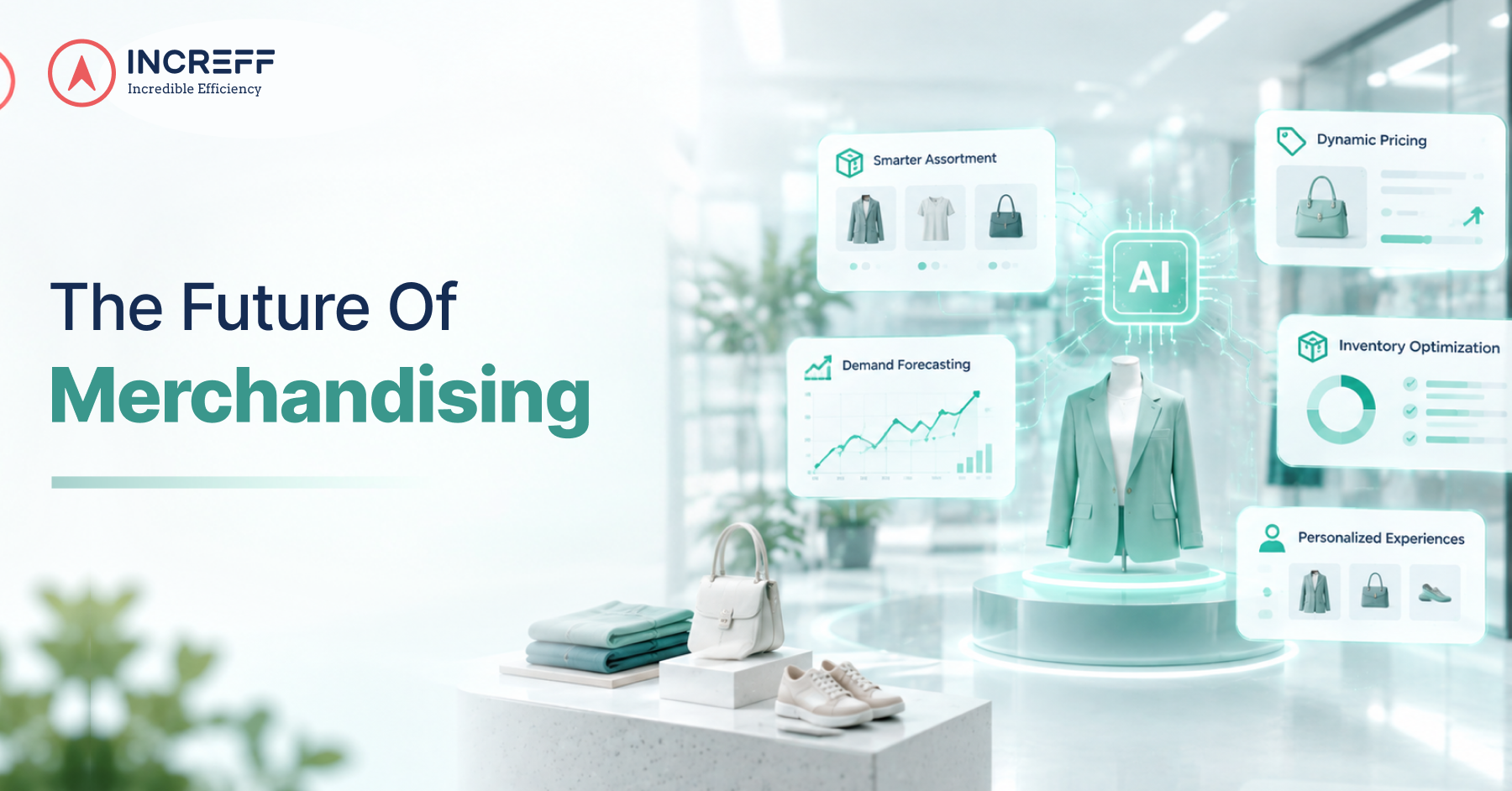
AI-powered merchandising software helps retailers spot these changes earlier and act faster. Increff uses AI to identify true demand, improve forecasting, optimize assortments and buying, manage inventory, and recommend pricing and markdown decisions. Retailers using the platform have seen sell-through improve by up to 14 percentage points, inventory holding reduce by 25%, and planning time reduce by 90%.
See how Increff puts AI to work across merchandising
Why are traditional merchandising systems losing margin?
Traditional merchandising systems are good at showing retailers what has happened. The problem is that they often stop there.
Teams still have to analyze the data, decide what to do, get approvals, and execute the change. By the time that process is complete, customer demand may have already changed.
How does Increff's AI merchandising software close the gap?
Increff rebuilt its merchandising suite as an AI-native platform, and it inverts every limitation above. It acts instead of watching, argues its case instead of exporting a number, differentiates per store and per size instead of averaging, and asks before it matters instead of leaving the decision with you.
One brain, 50+ specialists
The Decision Mesh turns every merchandising decision into a governed, explainable agent you can shape. MFP, Assortment, Buying, Pricing, Allocation and Transfers sit on one live canvas, so a change in any one of them is priced across all the others before you commit.
- A specialist per decision. Never-out-of-stock, size sets, open-to-buy, markdown timing, transfers, 50+ agents, each with its own levers, schedule and confidence.
- Wired like your business. Contract edges carry plans downstream; feedback edges carry results back. One change, and the ripple is priced end-to-end.
- Configure, don't conform: Every out-of-the-box agent is tunable lever by lever objectives, guardrails, autonomy, cadence. You can drag and rewire the mesh itself.
- Or build your own (Algo Studio): Compose entirely new agents from the same governed building blocks: your data features, your rules, your gates.
Beneath all of it sits the Data Foundry: 15 agents that reconstruct inventory, isolate promo noise and compute true demand before any plan trusts a number. That is the layer that makes fast action safe, and it is why the mesh can be trusted to work overnight rather than wait for a planner to validate every input.
The outcome is a work book instead of a report. By 06:00 the mesh has refreshed forecasts, drafted allocations, surfaced reorder candidates and quarantined anomalies so your team opens the day to decisions, each one traceable to the exact store × style behind it.
How Increff’s AI Merchandising Drives Retail Performance?
AI-powered merchandising can improve both speed and retail performance.
These improvements have also translated into measurable business results. One global sportswear company increased transfer-driven sales value by 3.9×, while a leading sports brand grew revenue by 16% alongside a 12% increase in average selling price.
How can retailers stay in control of AI-powered merchandising?
AI does not have to make every decision on its own.
Retailers can decide how much control they want to give the system depending on the type of decision.
Three levels of AI assistance
Manual:
The AI analyzes the data and recommends what to do. The retailer makes the final decision.
Guided:
The AI prepares the recommendation and the retailer reviews and approves it.
Autonomous:
The retailer sets the rules and goals. AI can make decisions automatically as long as they stay within those rules.
For example, a retailer could allow AI to automatically recommend inventory transfers while requiring approval for large markdowns.
Frequently Asked Questions
Q: How does AI improve merchandise planning and buying decisions?
A: AI reconstructs true demand by stripping out stockout and discount noise, then plans at store–SKU attribute level instead of category averages. It recommends what to buy, in what depth and size ratio, and flags risk early so buying is based on evidence, not last season's spreadsheet. Increff's AI merchandising suite runs these decisions across planning, buying, allocation, and markdown in one connected loop.
Q: Does AI improve retail demand forecasting accuracy?
A: Yes because it forecasts differently, not just faster. AI models use 17+ fashion attributes, seasonality, recency, event spikes, and true rate of sale rather than raw historical sales, and refresh continuously instead of once per season. Brands typically see better sell-through and lower inventory because forecasts hold at store and size level, not just at the aggregate.
Q: Is AI inventory planning better than rule-based software?
A: Rule-based systems apply fixed logic (min-max, fixed replenishment thresholds) that goes stale the moment demand shifts. AI planning self-learns, adapts per store and per size, and explains the driver behind each recommendation. The practical difference: rules tell you what was decided months ago; AI tells you what to do this week and why.
Q: Which retail platforms help brands move from seasonal planning to more frequent, agile buying?
A: Look for platforms with in-season replanning, open-to-buy management, forward inventory projection, and bestseller reordering not just pre-season range planning. Increff supports weekly/monthly WSSI, OTB cycles, dynamic assortment shifts, and in-season reorders, so buying becomes a continuous process rather than a two-times-a-year event.
Q: What retail SaaS solutions help brands reduce manual reports for merchandisers?
A: Platforms with exception-based dashboards and built-in root-cause analysis remove most manual reporting. Instead of pulling reports to find problems, the system surfaces the exceptions: broken size runs, ageing stock, underperforming stores with the diagnosis attached. Brands using Increff's co-pilot and automated modules have cut weekly merchandising man-hours by around 40%.
Q: What causes retail inventory imbalance across stores and how do I fix it?
A: Common causes: allocation based on store size or past averages rather than true demand, no size-level planning (leading to broken size runs), slow replenishment cycles, and no mechanism to move stock once it lands. The fix is demand-led allocation at store-SKU level, continuous replenishment, and systematic inter-store transfers so stock moves to where it will actually sell instead of waiting for markdown.
Q: Which software recommends profitable inter-store stock transfers?
A: Merchandising platforms with allocation and replenishment modules that score transfers on expected sell-through versus logistics cost. Increff's allocation and replenishment module recommends inter-store transfers alongside replenishment and replacement, ranking stores by style performance so only margin-positive moves are suggested. Brands have reported up to a 28% increase in rate of sale and 13% improvement in inventory health.