





TL;DR
The best planning and allocation tools in 2026 use AI, real-time inventory data, and SKU-store level demand signals to improve store-wise assortment decisions. While enterprise platforms like Blue Yonder, SAP, Oracle, and o9 offer broad planning capabilities, retail-focused solutions like Increff provide faster implementation and merchandising features purpose-built for fashion retailers.
👉Optimize Every Store's Assortment See Increff in Action .
If you're responsible for merchandise planning or retail operations across multiple stores, you've likely faced the same challenges: stockouts in high-performing stores, excess inventory in slower locations, and unexpected markdowns that hurt margins.
According to IHL, inventory distortion, overstocking and stockouts combined drains an estimated $1.77 trillion from enterprises globally each year. Most retailers are still making store-wise allocation and merchandising calls on planning cycles that lag real demand by weeks. In 2026, that gap is no longer acceptable.
Many retailers already have planning software in place but still struggle with stock imbalances across stores. The issue often isn't a lack of data, but whether the platform can turn that data into timely, store-specific inventory decisions.
What Is Store-Wise Assortment Planning?
Store-wise assortment planning determines which products, sizes, and quantities should be available at each retail location and allocates inventory accordingly. A store in South Mumbai should carry different product depth than one in a Tier 2 city, because their demand profiles are different.
It breaks down for predictable reasons: cluster-level allocation that ignores individual store performance, replenishment cycles too slow to respond to in-season sell-through, and size curves carried forward from last season unchanged. The tools below address these gaps with varying depth.

How Do These 8 Planning and Allocation Tools Compare in 2026?
1. Increff
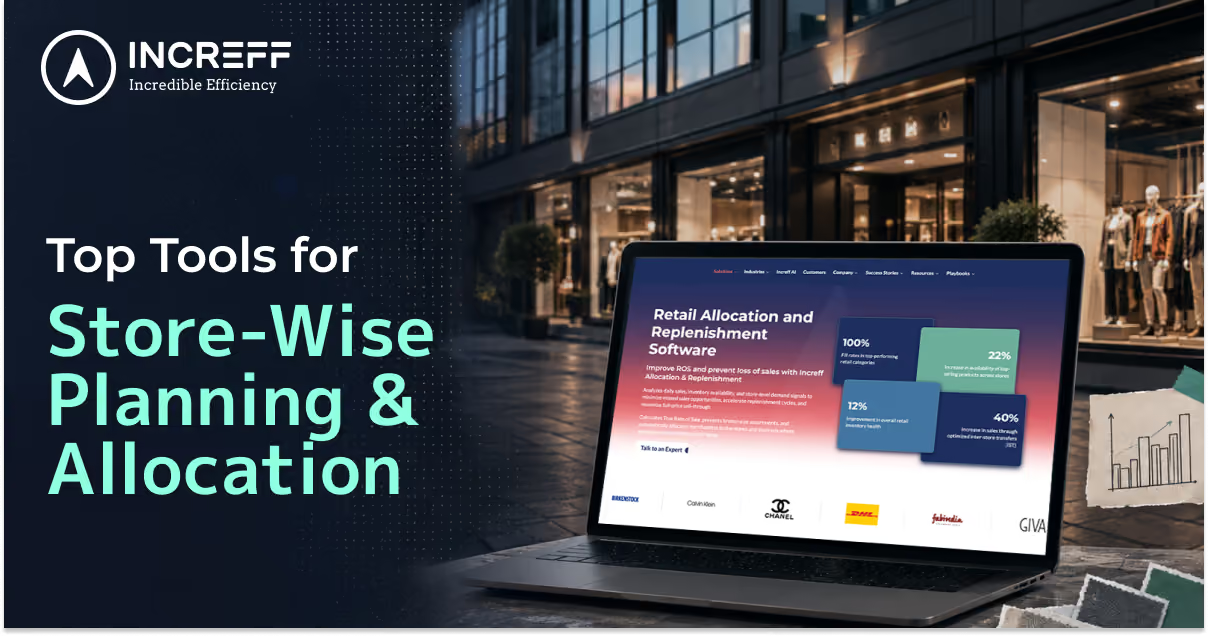
Increff is built specifically around retail merchandising mechanics. Its Allocation & Replenishment module calculates True Rate of Sale (True ROS) removing stockout days, broken sizes, and liquidation noise to produce a clean demand signal. Store-StyleRank™ translates that signal into ranked allocation priority by revenue potential, while dynamic size curve optimization and smart attribute-matched replacement logic keep assortments healthy at the store level. Connected to Planning & Buying and Merchandise Financial Planning, OTB calculations are grounded in sales forecasts, current stock, and store-level financial targets rather than averaged category benchmarks.
2. Blue Yonder
Blue Yonder's Luminate platform combines demand forecasting, inventory optimization, allocation, and supply planning in a unified cloud architecture. It uses probabilistic demand modeling giving planners a range of outcomes to plan against rather than a single forecast and an Inventory Ops Agent that proactively surfaces supply-demand mismatches before they become stockout or overstock events. Blue Yonder is the default evaluation starting point for retailers managing thousands of SKUs across hundreds of stores globally.
3. RELEX Solutions
RELEX processes granular demand signals, weather, local events, and store-level POS data to generate forecasts at the product-location level. Its unified architecture connects assortment planning with replenishment and space planning, so a change in assortment flows through automatically. RELEX's newer AI-driven forecasting models have shown up to 20% improvement in demand prediction accuracy over traditional statistical methods.
4. o9 Solutions
o9's Enterprise Knowledge Graph connects planning data across functions rather than storing it in disconnected flat tables. Merchandising, finance, and supply chain teams operate from the same model eliminating the planning drift that occurs when these functions run on separate cycles. Autonomous planning signals can trigger supply chain actions without manual intervention, useful in high-velocity environments.
5. Oracle Retail
Oracle Retail clusters stores by demand similarity and generates tailored assortment recommendations per cluster. It integrates natively with Oracle Xstore (POS), merchandising, and analytics tools. Scenario modeling lets teams stress-test assortment configurations against financial and inventory constraints before committing to a buy.
6. SAP Retail
SAP Assortment Planning uses AI-powered cluster-based optimization to generate product mix recommendations by store group. Because it sits inside the SAP ecosystem, assortment decisions connect directly to OTB, inventory valuation, and cost accounting without requiring reconciliation between systems. Pre-season and in-season planning workflows are well developed.
7. Anaplan
Anaplan's connected planning engine links assortment decisions directly to financial goals, supply chain constraints, and sales targets in a single model. Its Hyperblock real-time scenario modeling supports fast what-if analysis, and PlanIQ agents generate AI-driven demand signals that reduce human forecasting bias. Finance, merchandising, and supply chain teams can all work within the same platform, which reduces cross-functional planning misalignment.
8. Tools Group
Tools Group's SO99+ platform generates a distribution of possible demand outcomes at the location level rather than a single forecast, producing more resilient inventory policies. Once configured, it executes allocation and replenishment for the majority of SKU-location combinations automatically, freeing planners to focus on exceptions. Integration with most major ERP and POS systems is well supported.
How Does Increff Solve the Store-Wise Assortment Problem Differently?
Most store-wise assortment failures aren't planning failures. They're execution failures that get misdiagnosed as planning problems and by the time a planning cycle catches up, a fast-moving style has already stocked out in your best doors.
Increff's Allocation & Replenishment is designed to operate on the daily signal. True ROS removes the distortions of stockout days, broken sizes, liquidation noise that make standard rate-of-sale metrics unreliable, and gives merchants a clean demand signal for every store-style-SKU.
Store-StyleRank™ turns that signal into ranked allocation priority by revenue potential, so depth flows to the highest-opportunity combinations before the sell window closes. Size curve optimization updates dynamically to local demand signals; smart replacement logic routes the closest attribute-matched alternative when a bestseller is exhausted.
The result is higher full-price sell-through, fewer broken size situations, and OTB dollars that reflect real store-level demand.
👉 Book a demo with Increff today and transform your assortment strategy.
Frequently Asked Question
Q: How can I allocate inventory to stores based on local demand?
A: Use a system that calculates True Rate of Sale at the store-style-SKU level filtering out stockouts and broken sizes and ranks allocation priority by local revenue potential rather than applying uniform regional rules.
Q: Which software helps create store-specific assortments for fashion retailers?
A: Increff Allocation & Replenishment builds store-specific assortments by analyzing local sell-through, shopper demographics, and size performance to tailor the product mix and depth at each location.
Q: How do retailers reduce stockouts and excess inventory across stores?
A: By automating replenishment on daily demand signals, dynamically rebalancing inventory through inter-store transfers, and removing underperforming SKUs while restocking winners rather than relying on fixed reorder points or manual review cycles.
Q: What is the best allocation software for multi-store retail chains?
A: The best platforms combine True Rate of Sale calculation, automated replenishment, size curve optimization, and inter-store transfer logic so inventory flows to where it sells fastest across the entire store network.
Q: How can AI improve store-wise assortment planning and allocation?
A: AI identifies local top-sellers, predicts size demand by location, suggests attribute-matched replacements for exhausted styles, and continuously updates rankings replacing static templates with decisions that adapt to real store performance.
Q: How do leading retailers decide which products each store should carry?
A: By ranking every store-style combination on recent sales velocity, revenue potential, and local demand patterns then allocating depth to the highest-opportunity combinations before the sell window closes.
Q: What features should I look for in a retail planning and allocation platform?
A: Look for: True Rate of Sale calculation, store-level demand ranking, dynamic size curve optimization, automated replenishment and inter-store transfers, smart style replacement, and integration with your buying and financial planning workflows.