
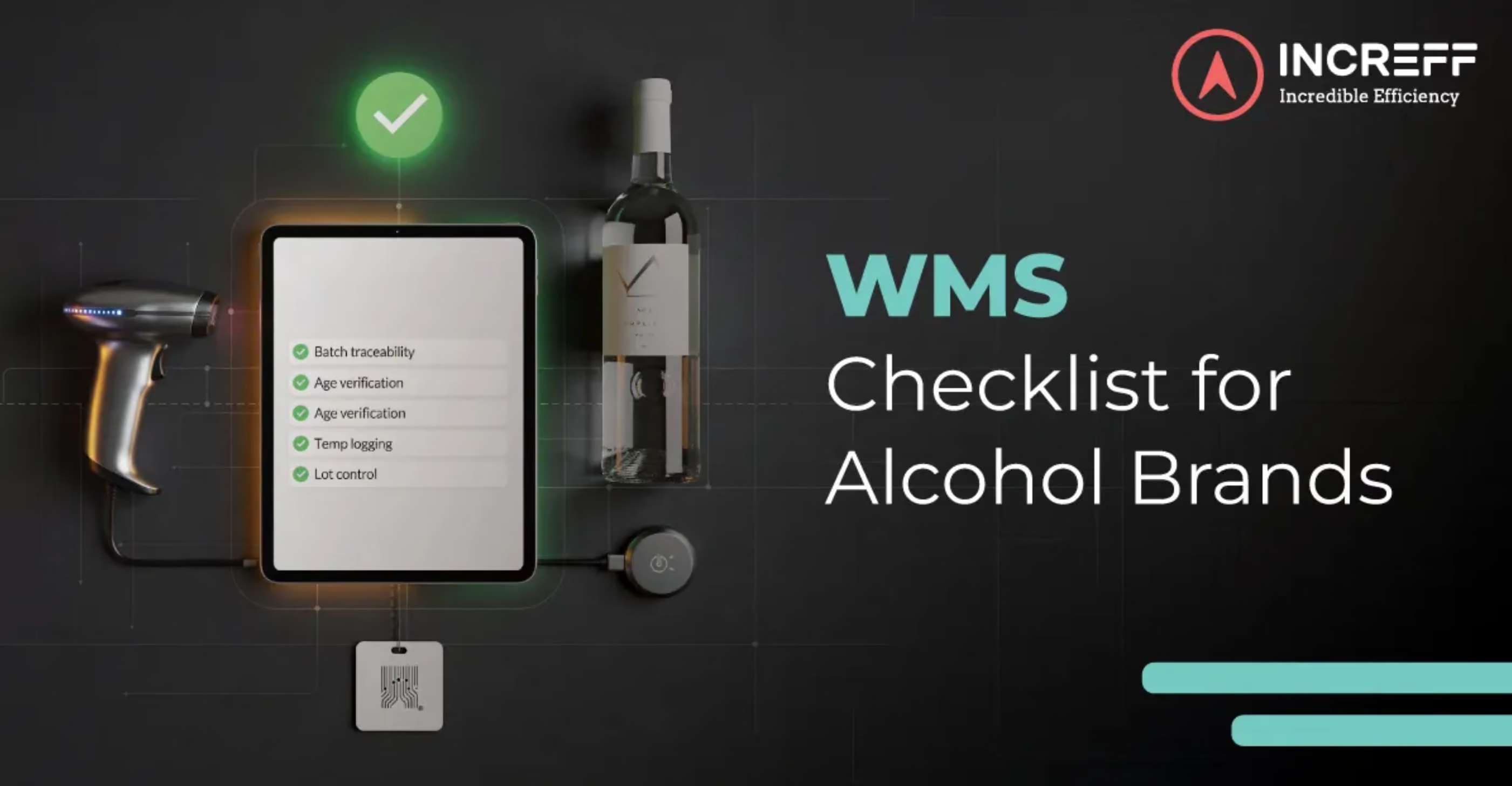





Alcohol warehousing in India comes with operational complexity that goes far beyond basic inventory storage. Between state-wise compliance regulations, batch and expiry tracking, distributor networks, and rising demand across retail and on-trade channels, even small warehouse errors can quickly become expensive problems.
The Indian alcoholic beverages market is expected to continue growing steadily, driven by premiumization, urban demand, and expanding retail distribution. As brands scale across states and channels, warehouse operations are becoming significantly more complex, increasing the need for real-time inventory visibility, batch traceability, and tighter warehouse controls.
For alcohol brands in India, warehouse accuracy is critical for maintaining compliance, reducing inventory losses, and ensuring smooth distributor and retail operations. Without the right Warehouse Management System (WMS), teams often struggle with inventory mismatches, batch-level traceability, audit readiness, and fulfillment inefficiencies that directly impact margins and operational control.
Key Takeaways
- What makes alcohol warehousing different: traceability, compliance and tighter exception handling.
- The best warehouse management systems prioritize lot/batch tracking, scan-based execution, and audit logs not just basic putaway and picking.
- A modern warehouse management system WMS should handle multi-UoM (bottle/case/pallet), mixed-case picking, and returns/recalls without spreadsheets.
- Integrations matter: your WMS must connect cleanly with ERP/OMS/carriers so teams don’t re-key or reconcile in multiple systems.
- The “right” WMS decision is about outcomes: higher inventory accuracy, faster fulfillment, fewer errors, and simpler compliance.
What features should alcohol brands prioritize in a WMS in 2026?
If you’re evaluating warehouse management solutions in 2026, treat this as your practical, alcohol-specific feature checklist. The goal is to modernize without creating new risk especially around compliance, traceability, and product quality.
1) Compliance and regulatory readiness
- TTB & tax reporting support: workflow-driven documentation and reporting to stay audit-ready and reduce manual compilation.
- State-level ABC alignment: traceable records and controlled processes that simplify state-by-state compliance needs.
- Certificate of Label Approval (COLA) considerations (US-focused): controls that help teams manage product variants and labeling constraints tied to ABV or product classification.
- Bonded warehouse support: ability to manage bonded vs duty-paid inventory states and support excise duty deferment workflows.
If your distribution is global, map these to your local excise authority equivalents the key requirement is that the WMS can maintain traceable, auditable inventory states and documentation.
2) Specialized inventory management for alcohol complexity
- Batch/lot + serialization tracking: critical for traceability across production lots, imports, and regulated distribution.
- FEFO/FIFO protocols: automated rotation for shelf-life-sensitive products (often more relevant for craft beer and certain wines, but useful for quality control broadly).
- Case breaking: manage both full cases and each/bottle units without inventory distortion.
- Raw material + finished goods management (for producers): track inputs (e.g., hops/malt) through to packaged/bottled inventory when your operation needs production-to-warehouse continuity.
3) Operational efficiency and product-quality protection
- Temperature & humidity monitoring: essential for protecting wine and certain spirits; look for native capability or clean sensor/IoT integrations.
- Barcode scanning + mobile execution: real-time logging that reduces errors in receiving, putaway, picking, packing, and shipping.
- Intelligent slotting: dynamic placement optimization to improve pick speed, reduce travel time, and lower mis-picks.
4) Integration and analytics
- Cloud-based architecture: supports multi-warehouse visibility and 24/7 access without brittle infrastructure.
- Demand forecasting integration (AI-powered where applicable): forecasting often lives outside the WMS, but your WMS should integrate cleanly so replenishment and staffing decisions reflect real demand signals.
- 3PL + ERP integration: connect with SAP/Oracle/Dynamics (or your stack) to prevent re-keying and maintain a single source of truth.
- E-commerce + distributor coordination: real-time visibility into inventory, order status, and delivery progress across channels.
How Do the Leading WMS Platforms Compare for Alcohol Brands?
Manhattan Associates
Manhattan Active WM is known for advanced warehouse orchestration, labor optimization, and omnichannel fulfillment. It performs well in high-volume environments where alcohol brands manage distributor, retail, and DTC orders together. The platform offers strong inventory visibility and warehouse automation support, but implementation can be expensive and operationally intensive for mid-sized brands.
Blue Yonder
Blue Yonder offers advanced demand planning, warehouse optimization, and real-time inventory management. Features like batch tracking, FIFO/FEFO rotation, and AI-driven fulfillment make it suitable for large beverage operations. However, alcohol-specific compliance workflows often require customization, which increases deployment time and cost.
SAP Extended Warehouse Management
SAP EWM is widely used by manufacturers and enterprises already operating within the SAP ecosystem. It provides strong process control, bonded inventory management, and structured compliance workflows, making it useful for alcohol brands dealing with regulated inventory movement across regions. The downside is higher implementation complexity and reliance on technical teams.
Oracle WMS Cloud
Oracle WMS Cloud focuses on warehouse scalability, real-time visibility, and cloud-based operations. It supports multi-location inventory management and structured warehouse workflows, which can help alcohol brands improve operational consistency across distribution centers. However, configuration and customization can still require significant implementation effort.
Infor WMS
Infor WMS is often considered by beverage producers that need tighter coordination between manufacturing, inventory, and warehouse operations. It supports lot tracking, warehouse automation, and inventory visibility, making it useful for breweries, distilleries, and wine producers. Compared to newer execution-focused systems, the interface and workflows may feel more enterprise-heavy.
Increff
Increff approaches warehouse management differently by focusing heavily on scan-led execution, inventory accuracy, and real-time operational visibility. Instead of large-scale customization-heavy deployments, the platform emphasizes faster adoption, reduced mis-picks, and disciplined warehouse execution. For alcohol brands looking to improve traceability and fulfillment efficiency without adding enterprise-level operational complexity, this can be a more agile approach
How Increff helps alcohol brands run compliant, accurate, high-velocity warehouses
Alcohol warehousing needs a WMS that is operationally strict (traceable, scan-led, auditable) while staying fast to run day-to-day. Increff’s approach is built around execution accuracy and real-time visibility so teams can reduce mis-picks, control regulated inventory movement, and keep inventory continuously reconciled.
High inventory accuracy through scan-based execution + traceability
Increff WMS is designed for scan-first workflows and serialized/item-level visibility, which supports tighter traceability and fewer manual touchpoints—critical for regulated and high-value SKUs.
Audit-ready operations via comprehensive logs and exception capture
For regulated categories, the ability to prove “what happened” matters. Increff emphasizes structured workflows with audit logs and clean inventory movement records—useful for compliance and reconciliation.
Complex picking and packing flows that reduce operational errors
Features like dynamic picklists, consolidated multi-channel operations, and structured returns workflows help reduce error rates and keep fulfillment flowing even when order profiles vary across B2B and DTC.
Conclusion
The right warehouse management system WMS for alcohol brands balances speed with control. It improves fulfillment throughput while keeping compliance, traceability, and inventory accuracy airtight. When evaluating warehouse management solutions, prioritize lot tracking, multi-UoM complexity, bonded/duty handling, scan-based execution, and clean integrations because those are the capabilities that most directly reduce risk and improve performance in alcohol warehousing.
Request a demo.
Frequently Asked Question
Q: How can an alcohol brand optimize warehousing operations for better efficiency and faster order turnaround?
A: Optimize slotting and pick paths, use scan-based receiving/putaway/picking, and run wave or batch picking during peaks. Add dock scheduling, cross-docking for fast movers, and strict FIFO/FEFO by lot to reduce touches, errors, and dispatch time.
Q: What features should alcohol brands prioritize when choosing inventory management software within a WMS?
A: Prioritize lot/batch and expiry tracking, end-to-end traceability for recalls/audits, and compliant controls (holds, restricted items, role-based access, audit logs). Also ensure strong replenishment, cycle counting, multi-warehouse visibility, accurate ATP, and reporting on shrinkage and order cycle time.
Q: What's the difference between an e-commerce order management system and a WMS?
A: An e-commerce order management system (OMS) manages orders across channels and decides where each one ships from. A WMS runs the warehouse itself — picking, packing, and dispatch. The OMS decides what and where; the WMS handles how.
Q: How does an e-commerce order management system integrate with marketplaces like Amazon, Myntra, and Shopify?
A: An e-commerce order management system connects to marketplaces through pre-built APIs, syncing inventory, orders, and catalogs in real-time. Orders from Amazon, Myntra, or Shopify flow into one dashboard, get allocated to the best location, and push tracking updates back automatically.
Q: Is an e-commerce order management system the same as Shopify or an ERP?
A: No. Shopify is a storefront; an ERP runs finance and operations. An e-commerce order management system sits between them — taking orders from every channel, orchestrating fulfillment across warehouses and stores, and syncing outcomes back to the ERP.