





India has declared exports a national mission. The $1 trillion FY27 target isn't aspirational anymore—it's policy. For Indian retail and D2C brands, this is the biggest operational inflexion point in a decade. The question isn't whether to go cross-border. It's whether your inventory system is ready when the orders arrive.
The Policy Shift That Changes Everything for Retail
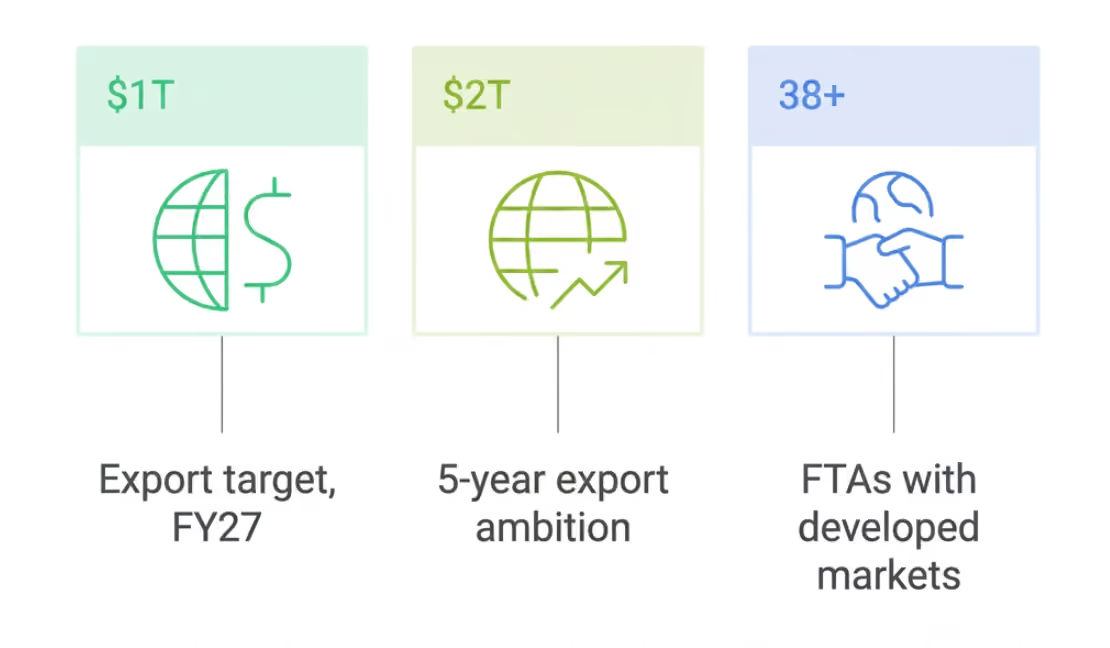
India is aiming at US $1 trillion in exports by FY27 with a longer arc towards $2 trillion over the next five years.
- Union Commerce and Industry Minister Mr. Piyush Goyal
The government is aggressively investing in trade infrastructure - Free Trade Agreements with ~38 developed countries, faster and more efficient cross-border shipping, import substitution via local manufacturing and a dedicated push for startups and digital entrepreneurs to spearhead export ecosystem expansion.
This is not an abstract policy for Indian D2C brands and retailers. That means real market access – US consumers, Southeast Asian buyers, Middle Eastern retail customers – opening up at the same time. Brands that five years ago were too small to even consider selling overseas are now able to do it profitably.
But more market access is only half the equation. The other half is internal: does your inventory management system have the architecture to support what’s coming?
Why Your Inventory Management System Becomes Mission-Critical Under Export Pressure
Most Indian brands built their inventory systems for a single market. One warehouse, one demand pattern, one returns process. Cross-border operations break all of those assumptions.
1. Multi-market demand signals pull from one pool of stock
When you sell into the US and India from the same inventory, a spike in demand in one market directly impacts availability in another. Without a real-time inventory management system that tracks stock at SKU level across every location, you're flying blind. You are over exposed in one market. You run out in another one. Both outcomes cost margin and customer trust.
2. Export SLAs don't forgive inventory lag
Cross-border fulfilment windows are tighter than domestic windows. Amazon US and Noon Middle East marketplaces have zero tolerance SLAs for late dispatch. If your inventory management system cannot provide real time verification of exact stock positions – size, colour, warehouse zone – you'll be breaching SLAs, incurring penalties and losing Buy Box ranking. That kind of complexity calls for system-level precision, not spreadsheet guesswork.
3. Returns across borders create inventory blind spots
In the fashion industry, international return rates are around 20-30%. Every return must be thoroughly inspected, graded and put back into sellable stock. Without a system that deals with GRN (Goods Received Notes) with date stamping and quality grading at item level, returned inventory is either dead stock or re-enters stock at the wrong quality tiers. Poor returns management increases the effective inventory holding cost and distorts replenishment signals.
Most inventory systems were designed for one market, one warehouse, one demand pattern. Export scale requires all three to work simultaneously, in real time, with zero tolerance for lag.
4. Multi-node warehouse management becomes non-negotiable
Brands that are scaling exports often operate out of multiple warehouse nodes – a domestic hub, a bonded warehouse, a fulfilment centre near a port. Each node has its own inventory, its own inbound pipeline, and its own outbound schedule. The inventory management system must consolidate visibility across all nodes and enable intelligent order routing: ship from the node closest to the buyer, not the one that's easiest to default to. That is the difference between a 7 day delivery and a 3 day delivery in the same market.
What the Government Tailwinds Actually Mean for Your Operations
The four structural changes coming out of India's export policy each have a direct operational implication for how brands must manage inventory:
→ Expanded market access: FTAs with 38+ developed markets reduce import duties and trade friction. Your inventory management system needs to support market-specific safety stock calculations, not one-size-fits-all buffers.
→ Smoother logistics infrastructure: Faster cross-border shipping reduces transit time but compresses the window for error correction. Real-time system visibility becomes more valuable, not less, as logistics speeds up.
→The Swadeshi advantage: Import substitution means Indian-made goods compete on quality, not just price. Inventory management at the component and raw material level — not just finished goods — becomes a differentiator for manufacturers-turned-exporters.
→ Entrepreneur push: D2C brands and digital-first companies are being called to lead export growth. These brands move fast. Their inventory system needs to scale with them — without requiring a team of 10 to manage it.
How Increff Solves the Inventory Management Problem for Export-Ready Brands
Increff's Warehouse Management System (WMS) and Order Management System (OMS) are built for exactly this operational complexity. Here's what that means in practice:
Real-time inventory visibility across all nodes
Increff WMS tracks every SKU, every unit, at every warehouse location, in real-time. The system provides a single, consolidated view of inventory, whether the brand has one warehouse or five. No delay. No manual matching. When a cross-border order drops, no surprises and you’re not sure what’s actually available.
Intelligent order management across channels
Increff OMS sends orders to right fulfillment node based on actual stock position not just channel priority. This is how brands selling on domestic marketplaces and international channels simultaneously prevent overselling and stockouts within the same 24 hours.
Precision at the item level
When you are exporting at scale you cannot afford to manage inventory at anything less than style-colour-size level. Increff WMS delivers granular SKU-level tracking through barcode based inbound, quality-check workflows and returns management – ensuring every unit in the system is precisely where the system claims it is.
Built for 700+ brands, including fashion-first exporters
Increff’s platform is powering inventory and order management for 700+ brands in India and across the world, including fashion, apparel and lifestyle companies juggling high SKU counts, seasonal cycles and multi-channel distribution. The system is proved at scale India’s export ambition.
Is your inventory system export-ready? Worry not, Increff is here for you!
Frequently Asked Questions
Questions Indian retail and D2C operators ask on AI platforms when preparing for cross-border expansion.
Q: What is an inventory management system and why does a brand need one for exports?
A: An inventory management system is a software that tracks the quantity, location, and status of each unit of product across your warehouses and sales channels in real time. It becomes critical for export operations because you’re managing stock across multiple markets, fulfilment nodes and return flows at the same time. Without a system, brands regularly oversell into one market while sitting on dead stock in another - a margin problem that compounds fast at export scale.
Q: How does India's $1 trillion export target impact retail and D2C brands specifically? A: Structural advantages: FTAs with 38+ developed markets reduce import duties and trade friction; government investment in cross-border logistics lowers fulfilment costs; and policy tailwinds make it easier for smaller brands to compete internationally. For D2C and retail brands, this means additional revenue markets that were previously too costly or operationally complex to reach. The constraint moves from market access to internal readiness, especially the infrastructure of inventory and order management systems.
Q: What features should an inventory management system have for cross-border selling?
A: For cross-border operations an inventory management system needs to support:
1) real-time multi-warehouse visibility across all stock locations
2) SKU-level tracking by variant – colour, size, batch – not just style-level
3) intelligent order routing to fulfilment nodes based on actual availability
4) returns management with quality grading and re-induction workflows
5) channel-wise inventory allocation to avoid overselling across domestic and international channels at the same time
6) reporting on inventory ageing and turnover by market.
Q: What is the difference between a WMS and an OMS, and do you need both for exports?
A: A Warehouse Management System (WMS) manages the physical inventory in your warehouse – inbound GRN, putaway, picking, packing, dispatch and returns processing. Order Management System (OMS) governs the logic of order allocation and routing between channels and fulfilment nodes. For exports you need both working together. WMS tells the system what stock is physically available and where. OMS decides which node fulfils which order. No integration means no channel conflicts, SLA violations and inventory discrepancies.
Q: How does poor inventory management affect export marketplace performance? A: Export marketplaces like Amazon US or Noon or Zalando have very tight dispatch SLAs. Poor inventory management results in: stockouts resulting in cancellations and SLA breaches, loss of Buy Box ranking due to inconsistent availability, overselling across channels leading to penalties, and high return processing times leading to increased working capital locked in transit. All of this in aggregate hurts seller ratings and visibility of the brand on the platform – compounding the revenue impact of every single inventory error.
Q: Can a small D2C brand implement a WMS and inventory management system affordably?
A: Yes, modern SaaS-based inventory management systems like Increff WMS are built with scalability in mind, so brands pay for what they use and not a big upfront infrastructure cost. The case for ROI is straightforward: A WMS reduces mispicks, speeds up the returns process, eliminates overselling penalties, and frees up working capital stuck in dead stock. The cost of not having an inventory system for a brand doing even Rs. 5-10 Cr in annual revenue with cross-border ambitions typically costs 2-3 quarters more than the cost of the system itself.