
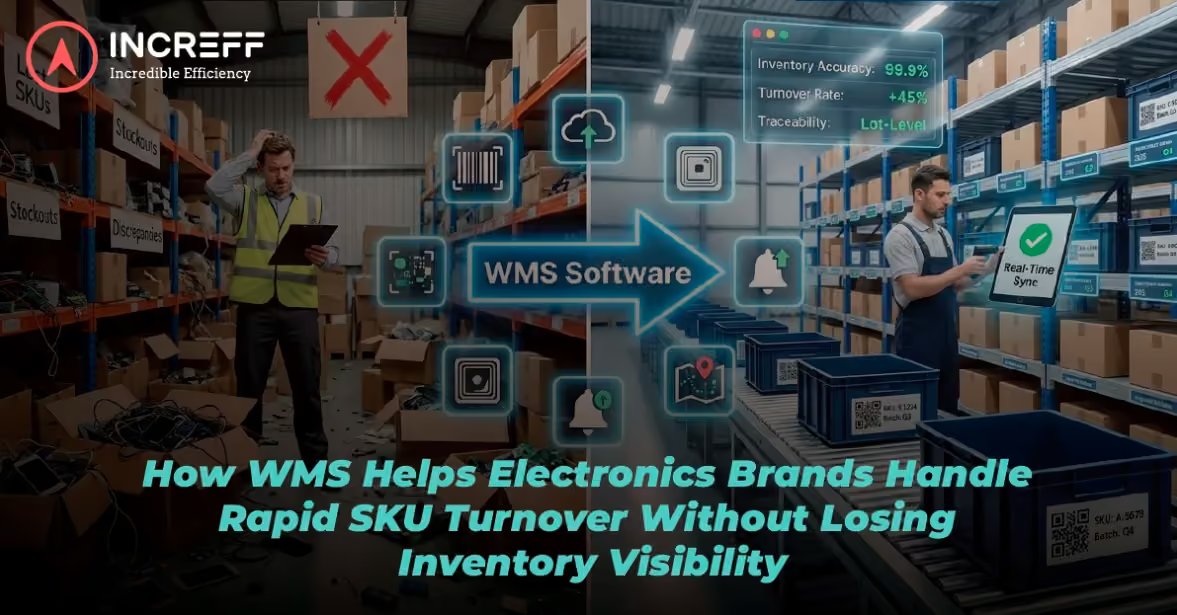





Electronics is one of the most unforgiving verticals in retail. Product lifecycles are shrinking. Gartner reports that the average consumer electronics product now has a shelf life of 12–18 months, down from over three years a decade ago. A study by IHL Group found that out-of-stocks alone cost retailers $1.77 trillion globally, with electronics among the hardest-hit categories.
Also read: Why Every Fast-Growing Warehouse Needs a Cloud-Based WMS in 2026
For operations and supply chain managers at electronics brands, the core problem is clear: SKUs multiply faster than most warehouse systems can track them, and every blind spot in your warehouse inventory is a margin leak. A modern warehouse inventory management system (WMS) isn't a luxury, it's the operational backbone that keeps SKU velocity from becoming SKU chaos.
Key Takeaways
- Electronics brands face uniquely high SKU turnover, making real-time warehouse inventory visibility non-negotiable.
- A WMS system automates the workflows — receiving, putaway, picking, and cycle counting that manual processes can't sustain at scale.
- Demand-driven slotting and dynamic bin allocation help warehouses keep pace with new product launches without restructuring.
- Increff WMS delivers the specific features electronics brands need: real-time inventory tracking, SKU-level control, and seamless integration with sales channels.
- Businesses using purpose-built warehouse inventory management solutions report measurable improvements in order accuracy, stock utilization, and fulfillment speed.
What Makes Electronics Warehouse Inventory Management Uniquely Challenging?
Not all warehouse inventory problems are equal. Electronics brands deal with a distinct set of pressures that generic warehouse operations don't face at the same intensity:
Compressed product lifecycles. A new GPU generation or wearable product line can render existing stock obsolete within months. Warehouse teams must track not just quantity, but product generation, firmware version, and compatibility attributes that standard systems often don't support natively.
High SKU proliferation. A single product launch can add dozens of SKUs overnight different storage variants, colors, bundled accessories, region-specific models. Each one needs its own bin location, tracking logic, and replenishment rule.
Serial number and IMEI tracking. Regulatory compliance and warranty management require electronics warehouses to track individual unit identifiers. This demands serialization at the item level, not just the SKU level.
Return complexity. Consumer electronics see higher return rates than most categories, often 15–20% in peak seasons. Returned units need to be rapidly assessed, restocked, or disposition-routed before they lose further value.
Without the right warehouse inventory management system, these pressures compound into chronic problems: misplaced stock, delayed shipments, failed audits, and write-offs that erode margins quarter after quarter.
How Does a WMS System Solve the SKU Velocity Problem?
A WMS system addresses SKU turnover challenges at every stage of the warehouse workflow not just at the point of picking.
Automated receiving and putaway. When a new SKU arrives, a WMS captures all relevant attributes — model number, serial range, expiry (for accessories with batteries), supplier batch and assigns an optimal bin location based on demand velocity and physical constraints. This eliminates the "where did we put it?" problem that plagues warehouses managing hundreds of active SKUs.
Dynamic slotting. As products age and new ones launch, slotting logic should adjust automatically. High-velocity new SKUs should move closer to dispatch zones; aging models should be flagged for markdown or consolidation. A WMS does this continuously, without requiring manual intervention from warehouse managers.
Real-time inventory visibility. A good WMS provides a live, SKU-level view of warehouse inventory across every bin, zone, and warehouse node. This isn't just operationally valuable, it feeds demand planning systems, prevents overselling, and allows customer service teams to give accurate delivery promises.
Cycle counting, not just annual audits. Annual physical counts are inadequate when SKU composition changes weekly. A WMS enables continuous cycle counting, allowing teams to audit fast-moving SKUs daily and slow-moving ones monthly without shutting down operations.
Why Does Inventory Visibility Directly Impact Revenue for Electronics Brands?
The connection between warehouse inventory accuracy and revenue is direct. When your WMS system gives you real-time visibility, three revenue-critical outcomes follow:
Fewer stockouts. Real-time reorder triggers prevent popular SKUs from going dark on your sales channels. For electronics, where a stockout on a hero product during a launch window can mean lost sales that never return, this is commercially significant.
Lower holding costs. Visibility into slow-moving SKUs allows procurement and sales teams to act on early promotions, bundles, or liquidation before obsolescence fully sets in. Electronics brands that lack this visibility typically discover slow movers too late.
Higher order accuracy. Mis-picks and incorrect shipments are costly in electronics — return logistics are expensive, and incorrect serial numbers or models create downstream warranty and support issues. A WMS with barcode or RFID-driven picking reduces mis-picks to near zero.
How Increff Solves These Problems for Electronics Brands
Increff WMS is purpose-built for the operational realities that high-velocity, high-SKU industries like electronics face.
SKU-level inventory control. Increff WMS tracks every unit at the SKU level across bin locations, giving warehouse managers a precise, real-time picture of what's where including serialized items, bundles, and multi-variant products common in electronics.
Intelligent putaway and slotting. The system assigns optimal storage locations based on demand frequency and product attributes, ensuring new launches are positioned for fast fulfillment from day one not after a manual reorganization.
Integrated cycle counting. Increff's continuous counting module allows electronics warehouses to maintain inventory accuracy above 99% without interrupting daily operations, which is critical when SKU composition shifts rapidly.
Omnichannel inventory orchestration. For electronics brands selling across D2C, marketplace, and B2B channels simultaneously, Increff WMS synchronizes inventory positions in real time across all channels preventing overselling during launch spikes and markdown events.
Returns management. Increff WMS includes structured returns workflows that allow electronics warehouses to assess, sort, and restock or disposition returned units quickly, recovering value from returns before product value degrades further.
Scalability for growth. Whether you're managing a single fulfillment center or a multi-node distribution network, Increff scales without requiring a re-implementation giving electronics brands a platform that grows with their portfolio.
Also read how serialisation benefits if you own a warehouse that needs to manage Electronics goods
Conclusion
For electronics brands, rapid SKU turnover isn't going to slow down product cycles will only compress further, and customer expectations for availability and speed will continue to rise. The brands that win are the ones that build warehouse inventory management as a competitive capability, not just a cost center.
A modern WMS system provides the real-time visibility, intelligent automation, and SKU-level control needed to keep pace. Increff WMS delivers exactly this purpose-built for the operational complexity that electronics brands navigate every day.
Request a demo.
Frequently Asked Questions
Q: What is a warehouse inventory management system (WMS), and why do electronics brands specifically need one?
A. A WMS is software that manages and optimizes all warehouse operations receiving, storage, picking, packing, and dispatch. Electronics brands need a purpose-built WMS because their inventory environment is uniquely complex: high SKU counts, short product lifecycles, serialization requirements, and high return rates. A generic ERP inventory module typically can't handle this level of operational detail.
Q: How does a WMS system improve inventory visibility in real time?
A. A WMS integrates with barcode scanners, RFID readers, and warehouse equipment to capture every movement of every item. This creates a live, accurate picture of inventory at the bin level which SKUs are where, in what quantity, and with what attributes. This data is updated in real time as items are received, moved, picked, or returned.
Q: Can a WMS handle serialized products like smartphones or laptops?
A. Yes. A WMS with serialization support captures individual unit identifiers (serial numbers, IMEIs) at receiving, tracks them through storage and picking, and records them against outbound shipments. This is essential for warranty management, recall handling, and regulatory compliance in electronics.
Q: How quickly does warehouse inventory accuracy improve after implementing a WMS? A. Most operations see significant accuracy improvements within the first 60–90 days of go-live, as systematic receiving, putaway, and cycle counting replace manual processes. Industry benchmarks suggest best-in-class WMS implementations achieve inventory accuracy above 99% within the first year.
Q: How does Increff WMS integrate with existing sales channels and ERP systems?
A. Increff WMS is designed for multi-channel integration; it connects with major ecommerce platforms, marketplaces, and ERP systems to synchronize inventory positions and order data in real time. This ensures that stock levels visible to customers and internal planning systems always reflect actual warehouse inventory, even during high-velocity sales events.
Q: Is a WMS suitable for mid-sized electronics brands, or only large enterprises?
A. A modern WMS like Increff is scalable and designed to support growth. It's as relevant for a mid-sized brand managing one warehouse as it is for an enterprise running a multi-node network. The key is choosing a system designed for your product category's specific complexity, rather than a one-size-fits-all solution.