
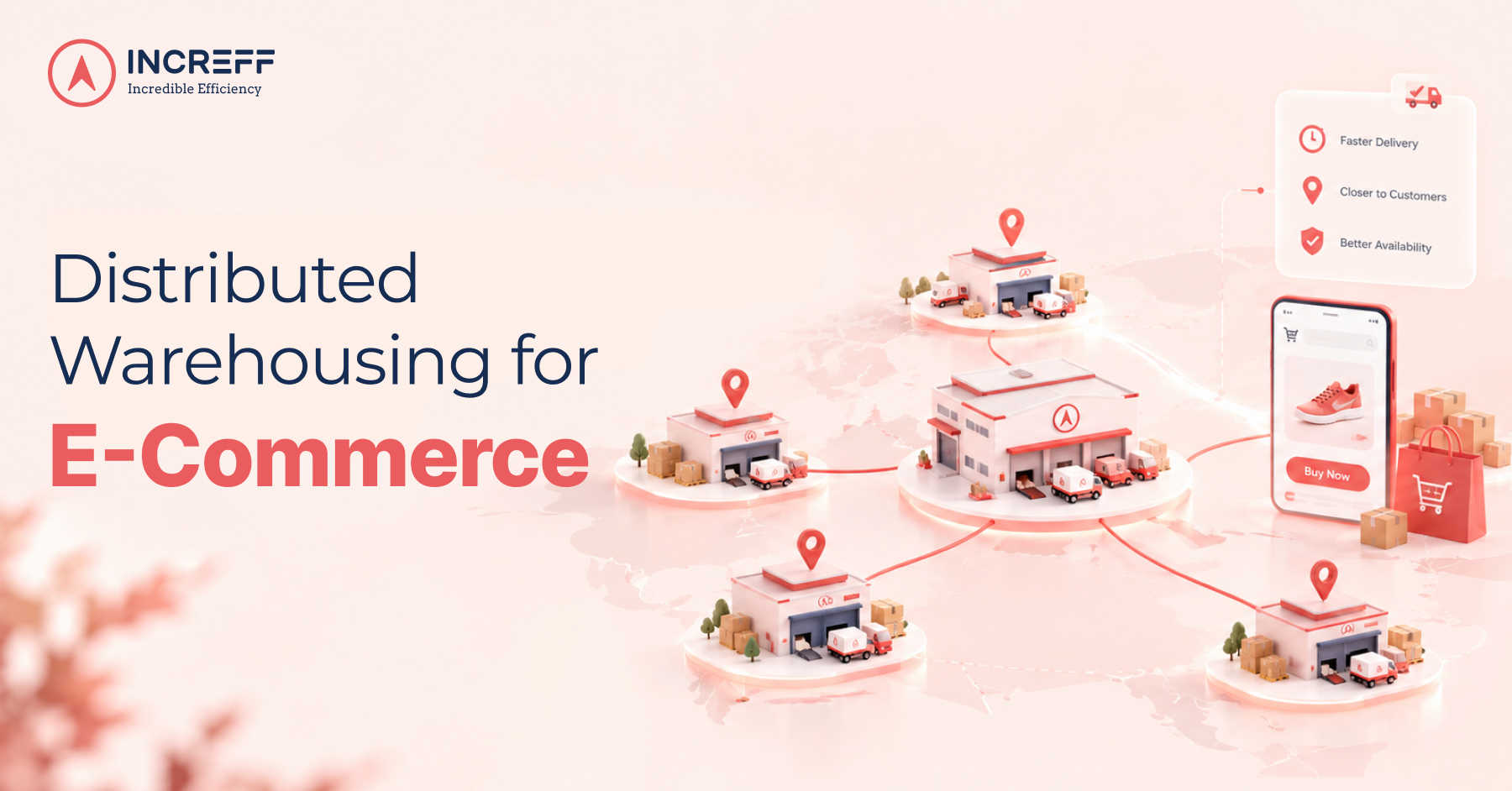





TL;DR
Distributed warehousing stores inventory across regional fulfillment centers to bring products closer to customers. It can reduce shipping costs, accelerate delivery and improve stock availability. However, these benefits depend on demand-led inventory placement, accurate stock visibility and intelligent order routing. Increff helps retailers coordinate warehouse operations, inventory allocation and order fulfillment through its WMS, OMS, and allocation and replenishment capabilities, making distributed inventory easier to manage across a connected retail network.
Increff has worked with 700+ brands across fashion, beauty, footwear and jewellery, helping retailers manage inventory across locations. By connecting warehouse operations, demand-led inventory allocation and order management, Increff helps retailers improve stock visibility, reduce fulfillment costs and ensure the right inventory reaches the right location at the right time.
What Is Distributed Warehousing?
Distributed warehousing is a fulfillment model in which a business stores inventory across multiple warehouses in different regions instead of relying on one central facility. When an order arrives, the system selects the most suitable location based on inventory availability, customer proximity, shipping costs and delivery commitments.
The objective is not simply to operate more warehouses. It is to position the right products closer to demand while keeping inventory visible and accessible across the network.
Distributed vs. Centralized Warehousing: What's the Difference?
Centralized warehousing prioritizes simplicity, while distributed warehousing prioritizes proximity. The right model depends on regional demand, shipping economics, inventory investment and warehouse operating costs.
7 Benefits of Distributed Warehousing for Ecommerce
1. Faster Delivery Times
When inventory is stored closer to customers, orders travel shorter distances and spend less time in transit. This can make next-day delivery more achievable and support same-day delivery where local inventory, warehouse capacity and carrier coverage allow it.
2. Lower Shipping Costs per Order
Shipping cost depends on distance, carrier zones, transportation modes and delivery commitments. Distributed warehousing allows warehouses to fulfill more orders from nearby locations, potentially reducing long-distance shipments and reliance on air freight.
In one deployment, Increff's Inter-Store Transfer helped a leading Indian fashion brand reduce logistics costs by 12%, with a significant share of air shipments shifted to surface transportation.
3. Better Inventory Availability
Demand rarely distributes evenly across regions. A product that sells quickly in Mumbai may move more slowly elsewhere, while seasonal preferences and local promotions create regional variations.
Distributing inventory according to regional demand, sales velocity and seasonality helps retailers position products where customers are most likely to purchase them.
4. Fewer Split Shipments
When items in the same order are stored at different locations, retailers may need to ship them separately. Each additional shipment can increase picking, packing, transportation and customer service costs.
Keeping frequently co-purchased products within the same fulfillment region can reduce split shipments. Order routing can also prioritize a single warehouse when it can fulfill the complete order within the required delivery window.
5. A More Reliable Customer Experience
Customers expect the right products to arrive within the promised delivery window. Distributed warehousing can help retailers meet these expectations through regional inventory availability and suitable fulfillment routes.
Accurate stock visibility is equally important. A nearby warehouse offers no advantage if the system shows inventory that is unavailable, already allocated or incorrectly recorded.
6. Greater Fulfillment Resilience
A disruption at one warehouse can affect order processing across an entire region. Distributed networks provide alternative fulfillment options when other locations have suitable inventory and available capacity.
For example, a temporary facility outage may allow nearby warehouses to absorb some orders that would otherwise be delayed.
7. Easier Expansion into New Markets
As ecommerce businesses expand into new cities, shipping every order from the original warehouse can increase transit times and transportation costs. Regional fulfillment centers bring inventory closer to new customer bases.
Before adding a warehouse, retailers should assess regional order density, expected sales, carrier coverage, storage costs and the inventory investment required.
Why Inventory Placement Matters More Than Warehouse Count
Operating multiple warehouses does not automatically make fulfillment faster or cheaper. The advantage comes from deciding what inventory each location should hold, how much it needs and when stock should move between locations.
Consider a retailer operating three regional warehouses. If a bestseller sells out in one region while excess units remain in another, the network may incur unnecessary transfers, missed sales and avoidable shipping costs.
An effective distributed warehousing strategy addresses four decisions:
- SKU placement: Which products should each warehouse stock based on regional demand and sales velocity?
- Stock depth: How much inventory should each location hold to meet demand without creating excess stock?
- Inventory rebalancing: When should stock move between warehouses to prevent shortages or excess inventory?
- Order routing: Which warehouse can fulfill an order at the lowest practical cost while meeting the delivery promise?
These decisions must evolve as demand changes. Promotions, seasonal peaks and regional sales trends can quickly change where inventory is needed. Inventory allocation, replenishment and order management must therefore operate as connected processes rather than isolated activities.
What Are the Challenges of Distributed Warehousing?
Distributed warehousing introduces additional costs and coordination requirements.
- Higher inventory investment: Stocking multiple locations may require additional safety stock, increasing the total inventory investment.
- Inventory imbalances: One warehouse may run out of a bestseller while another holds excess stock, resulting in missed sales and unnecessary transfers.
- Higher operating costs: Each facility adds storage, labor, handling, technology and management expenses.
- Complex returns: Returned products must be inspected, processed and restocked at an appropriate location.
- Inventory inaccuracies: Delayed updates across warehouses, ecommerce platforms and marketplaces can lead to overselling and cancellations.
The central challenge is balancing proximity with efficiency. Distributed warehousing succeeds when the savings and service improvements outweigh the additional costs of operating a more complex network.
What Should Distributed Warehousing Software Do?
Effective distributed warehouse management requires three capabilities to work together: accurate warehouse execution, intelligent inventory placement and coordinated order fulfillment.
1. Warehouse Execution Through a WMS
A warehouse management system (WMS) manages receiving, putaway, inventory tracking, picking, packing and dispatch. Accurate warehouse-level records provide the foundation for reliable allocation and routing decisions.
2. Inventory Placement and Replenishment
Inventory allocation determines how stock should be distributed across locations based on regional demand, sales velocity, product availability and seasonality. Replenishment and inter-location transfers help maintain appropriate stock levels as demand changes.
Increff's Inter Store Transfer helps retailers make better use of inventory across locations and optimize logistics costs.
3. Order Orchestration Through an OMS
An order management system (OMS) determines where an order should be fulfilled from, considering inventory availability, shipping costs, delivery commitments and fulfillment constraints.
Increff's Order Management System helps retailers coordinate order fulfillment across their retail network.
Conclusion
Distributed warehousing creates value when inventory is available in the right location, warehouse operations remain accurate and orders are fulfilled efficiently. This approach helps retailers look beyond the number of warehouses they operate and focus on how effectively their inventory serves demand. The objective is to improve availability, fulfill orders efficiently and control logistics costs as the business grows.
Frequently Asked Questions
Q: How can a WMS coordinate inventory across multiple warehouses?
A: A WMS tracks stock at bin and SKU level in each facility and syncs those counts to a central inventory layer in near real time. That gives every warehouse a shared, accurate view of what's available, so stock transfers, replenishment, and fulfillment decisions are made on live data instead of day-old spreadsheets. Increff WMS maintains ~99.5%+ inventory accuracy across nodes, with serialised, scan-based tracking.
Q: How does an OMS route orders across multiple warehouses?
A: The OMS pools inventory from all warehouses, stores, and fulfillment nodes, then picks the best node for each order based on availability, proximity, cost, and SLA. If no single node can fulfil the order, it splits it into sub-orders across locations and releases each to the relevant warehouse for picking. Increff OMS syncs inventory and orders every 15–30 seconds and reassigns unacknowledged orders automatically to protect SLAs.
Q: Which systems can scale from a single warehouse to a nationwide network smoothly?
A: Cloud-based, multi-node WMS and OMS platforms scale best, because adding a warehouse or store is a configuration change rather than a new deployment. Look for API-first integrations with marketplaces, POS, ERP, and 3PLs, plus support for mixed setups where some nodes run your WMS and others run a third-party one. Increff's Omni stack supports exactly this hybrid model.
Q: How can an OMS minimise split shipments and fulfilment costs?
A: By running a minimise-shipment algorithm: before allocating, it checks which single location can fulfil the largest share of the order and ships from there first, adding nodes only when unavoidable. Fewer parcels mean lower freight, packaging, and returns-handling costs. Increff OMS can optimise for either fewest shipments or shortest delivery distance, depending on what you configure.
Q: Which solutions allow flexible rule-based order routing across warehouses?
A: Platforms with configurable routing engines, where rules can be set on pincode or cluster, order value, weight, units, brand, channel, and node priority. Increff OMS uses cluster and area-cluster mappings so brands can decide which warehouses serve which regions, and change that logic as the network grows.
Q: Can an OMS route orders for same-day delivery?
A: Yes. By routing from the node closest to the customer, usually a store or regional warehouse, and releasing the order to pick immediately against delivery-slot cut-offs. Store fulfilment plus courier allocation rules based on serviceability makes same-day and next-day feasible without extra inventory.
Q: What inventory optimization tools help reduce inter-store transfers and associated costs?
A: Allocation and replenishment tools that place stock by local, size-and-style-level demand at the point of initial allocation, so corrective transfers are rarely needed. Pairing this with distributed warehousing and a unified inventory view means orders are served from existing stock instead of moved between stores.
Q: Which platforms help optimize safety stock while maintaining high order fulfillment rates?
A: Platforms that expose one connected inventory pool rather than channel-wise buffers. When all nodes draw from a single pool, you need far less safety stock per location to hit the same fill rate. Demand-forecast-driven replenishment then sets buffers by SKU velocity and lead time instead of flat percentages. Increff clients have sustained 99.9% inventory accuracy and 99.95% SLA adherence on this model.