
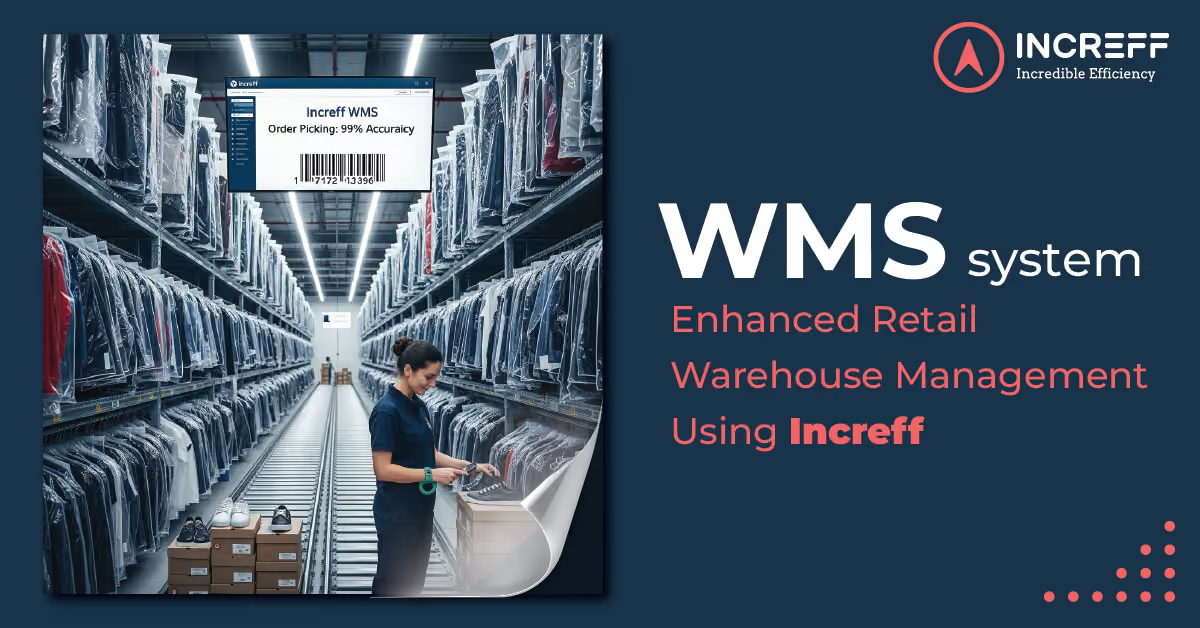





An advanced Warehouse Management System (WMS) is a crucial, game-changing solution in this exact situation. WMS software is the strategic brain of your warehouse operations, intended to optimize all aspects of your management procedures, from outbound shipping to inbound receiving within a WMS system. It is not just a tool for inventory tracking.
Also read how about 4 myths on Store Sales Maximization
This blog post will take you on a thorough exploration of the development, essential features, and priceless advantages of a contemporary warehouse management system cloud. We will examine the ways in which Increff’s specialized platform for managing retail warehouses functions as a potent warehouse management tool, designed to:
• Maximize operational workflows across the floor.
• Greatly improve management effectiveness through automation.
• Eventually boost profitability in the ever-changing retail industry.
• Provide a significant competitive edge in the cutthroat market of today.
Ready to see how an advanced WMS can solve your manual bottlenecks? Request a Demo Today.
Also read on: How US Retailers Can Choose the Right WMS Provider and Deployment Model.
Warehouse Management’s Development: From Chaos to Control
The story of warehouse management is one of constant innovation and adaptation, propelled by the growing complexity of international trade. In the early days, a warehouse was frequently just a sizable storage area where items were received, manually recorded, and then retrieved. Paper ledgers were the primary method of tracking stock, and the personal memory of long-term staff was often the only way to locate specific items.
The transition to digital began with the introduction of barcode scanning, which enabled quicker and more precise data capture. While early on-premises installations necessitated large hardware capital expenditures and dedicated IT teams for upkeep, the most recent and significant change has been the move of the Warehouse Management System (WMS) to the cloud. This modern platform provides previously unheard-of levels of accessibility, scalability, and flexibility.
What is a warehouse management system (WMS)?
A Warehouse Management System (WMS) is a software program created specifically to manage and maximize all aspects of warehouse operations, from the time products are delivered to their destination to the loading dock. WMS software is the strategic brain of your warehouse operations, functioning as advanced warehouse management inventory software that optimizes everything from inbound receiving to outbound shipping. Its main goals are to give real-time visibility into inventory levels, maximize warehouse space utilization, simplify operational workflows, and greatly improve the precision and effectiveness of management procedures.
It is important to distinguish a WMS from an ERP system. While an ERP handles high-level business functions like finance and HR, a WMS offers the granular, bin-level tracking and picking route optimization necessary for true warehouse optimization. Both systems work best when they integrate seamlessly, allowing the ERP to handle the "business" and the WMS to handle the "movement"
Essential Features of an Ideal Retail Warehouse Management System
An integrated management system that coordinates all warehouse operations and guarantees a smooth flow of goods to retail customers is far more effective than a simple inventory tracker. The warehouse management platform from Increff offers an extensive feature set designed to satisfy the particular and ever-changing needs of the retail industry.
Logistics and Receiving for Inbound Shipments
The first crucial stage is the movement of goods into the warehouse. Increff excels in pre-receipt planning by processing Advance Shipment Notices (ASNs) and directing operators to the best storage locations through "Directed Put away" based on product velocity and size. At its core, the system offers network-wide visibility, allowing you to see inventory in real time from central distribution centers down to individual retail stores
Smart Slotting & Inventory Control:
At the core of Increff’s WMS is a clever approach to inventory optimization that provides real-time, network-wide visibility from central distribution centers to individual retail stores. The system uses dynamic slotting to continuously optimize warehouse layouts, strategically placing fast-moving items near shipping areas to maximize space and reduce travel time. It also features essential batch and serial number tracking for expiration dates or recalls, while automated cycle counting ensures high stock accuracy with minimal operational disturbance. By streamlining these processes, the system helps retailers prevent overstocking, lower holding costs, and maintain consistent product availability.
Order Processing and Picking Efficiency:
Effective order fulfillment is perhaps the most significant feature of the system. Increff uses advanced techniques to enhance accuracy, such as:
- Wave and Zone Picking: Releasing orders in groups or assigning pickers to specific areas to minimize travel.
- Batch and Cluster Picking: Gathering items for multiple orders at once or into different containers simultaneously to streamline the process.
Labor Management and Monitoring of Performance
Increff’s WMS optimizes the crucial human element by using real-time performance metrics to track team and individual productivity. The system ensures efficient workforce allocation through accurate task assignment and prioritization, which reduces idle time and lowers labor costs. This data-driven approach allows for objective performance reviews and identifies specific areas for worker training or process improvements. Ultimately, these labor management features enhance overall warehouse effectiveness while maintaining high operational standards.
Returns, Shipping, and Value-Added Services:
Increff’s WMS ensures efficient shipping by integrating with carriers to automatically select the best options based on price and speed while generating accurate documentation. The system also streamlines reverse logistics, allowing for prompt receipt and inspection of returns to minimize losses and maintain customer satisfaction. Additionally, it cleverly incorporates value-added services like kitting and special packaging into the fulfillment workflow to ensure accuracy before shipment. By managing outbound processes and returns holistically, the platform helps retailers build a loyal customer base
Increff’s Warehouse Management Platform’s Strategic Benefits
In the highly competitive retail industry, you need a strategic warehouse management platform that serves as a business accelerator.
Real-time visibility and insights based on data
Increff’s warehouse management platform serves as a centralized data hub by combining information from every warehouse activity into a single source of truth. This unified data stream powers personalized dashboards that highlight critical performance indicators (KPIs) for management teams. By shifting from conjecture to data-driven insights, businesses can engage in proactive decision-making, identifying and resolving operational bottlenecks before they impact the supply chain
Improved Inventory Precision and Preventing Losses
A core benefit of the system is the significant reduction in inventory inconsistencies, which helps lower shrinkage and prevents the buildup of unprofitable dead stock. Through detailed tracking capabilities—including batch, lot, and serial number monitoring—the system ensures that every item is fully accounted for. This high level of precision directly optimizes working capital by freeing up cash flow that would otherwise be restricted by lost or excessive inventory
Reduced Costs and Increased Operational Efficiency
The platform drives efficiency by using workflow automation to optimize picking paths, which reduces human error and boosts worker productivity. These streamlined operations lead to lower carrying costs by minimizing the expenses associated with holding excess stock. Furthermore, the system ensures that space utilization is maximized, allowing businesses to use every square foot of their warehouse to its full potential
Scalability and smooth integration
Designed to fit within a broader technological ecosystem, Increff provides seamless integration with e-commerce platforms, Order Management Systems (OMS), and ERPs. Its cloud-native architecture offers inherent scalability, allowing the system to easily expand to accommodate new warehouse locations and surges in order volume. This flexibility provides essential future-proofing, helping businesses avoid the need for costly infrastructure upgrades as they grow.
Customer Contentment and a Competitive Advantage
By streamlining warehouse procedures, the platform enables faster delivery times that help retailers meet ambitious promises and increase customer happiness. The system supports flexible fulfillment options, efficiently handling B2B shipments, e-commerce orders, and in-store pickups (BOPIS). Ultimately, building a reputation for precise and timely order completion fosters brand loyalty and provides a significant competitive edge in the modern market
An advanced WMS is needed by whom?
Some businesses will benefit more than others from putting in place a high-end retail warehouse management system like Increff’s:
• Growing Retailers: Those managing inventory across multiple distribution centers or store locations.
• E-commerce Companies: Online sellers struggling to scale picking procedures as order volumes rise.
• Complex Inventory Managers: Businesses with diverse SKUs, expiration dates, or handling requirements.
• Inefficient Manual Operators: Companies facing high labor costs, frequent mispicks, and erroneous stock counts.
• Omnichannel Brands: Those seeking to integrate online and offline experiences perfectly.
Best Practices for Using Increff in a WMS Implementation
Increff takes a methodical approach to guarantee a seamless transition:
Evaluation and Planning:
- Gaining a comprehensive grasp of unique retail requirements and current pain points.
- Performing a thorough analysis to map out areas for optimization.
Configuration and Customization:
- Tailoring the system to specific operational workflows and inventory rules.
- Ensuring the software works flawlessly with unique business procedures.
Data Migration and Testing:
- Safely transferring legacy data to the new cloud system.
- Conducting extensive testing to ensure all features function as intended.
Support and Training:
- Empowering the team through thorough user training sessions for staff and management.
- Providing committed support to assist with any questions post-implementation.
Rollout Strategy:
- Recommending either a “big bang” launch or a phased rollout depending on the business’s risk tolerance.
Prospects for Warehouse Management Systems
The future of warehouse management systems suggests that they will become even more intelligent, automated, and integrated. In the upcoming years, we will witness deeper integrations with cutting-edge technologies.
Artificial Intelligence and Machine Learning: Improving predictive analytics for labor management optimization, dynamic slotting, and demand forecasting.
Real smart warehousing is made possible by the Internet of Things (IoT), which provides hyper-granular, real-time data from every area of the warehouse.
Automation and Robotics: More advanced robotic solutions that are expertly coordinated by the WMS can handle various tasks, including autonomous transport and picking and packing.
Blockchain Technology: May be applied to improve supply chain transparency and product traceability.
In conclusion
Effective merchandise inventory management is now essential for survival and expansion in the competitive retail industry. A contemporary warehouse management system cloud WMS system, powered by warehouse management inventory software, turns a conventional warehouse into a highly optimized, intelligent management center, and it is the essential foundation of successful supply chain operations. Moving to state-of-the-art retail WMS software is about much more than just tracking merchandise; it’s about:
• Gaining unmatched productivity across the entire workforce.
• Attaining perfect inventory accuracy to eliminate dead stock.
• Providing exceptional customer experience that fosters enduring loyalty.
The state-of-the-art warehouse management platform from Increff is carefully crafted to offer these benefits. Our solution boosts your retail operations by providing real-time visibility, optimizing labor and space, and integrating seamlessly with your current business systems.
Are you prepared to turn your Warehouse Management System (WMS) into a strategic advantage rather than a cost center? Contact us now. The next sensible step is to collaborate with a leader in warehouse inventory management systems if you want to obtain a clear competitive advantage, guarantee smooth inventory flow, and continuously surpass customer expectations. We cordially encourage you to investigate how Increff’s cutting-edge retail warehouse management system can transform your business and advance operations.