
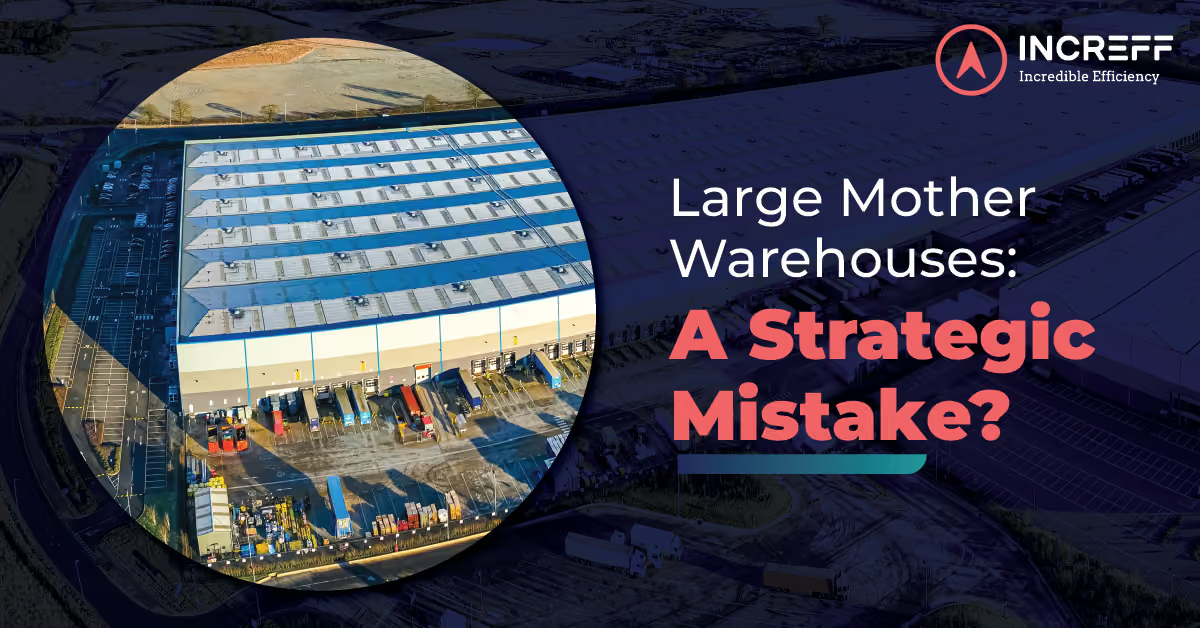





For decades, the retail world operated under a singular mantra: Scale is king. The "Mother Warehouse" as a massive, multi-acre hubs intended for centralization and bulk handling—was born out of this philosophy. The reasoning was straightforward: centralize inventory to reduce overhead and improve long-distance shipping.
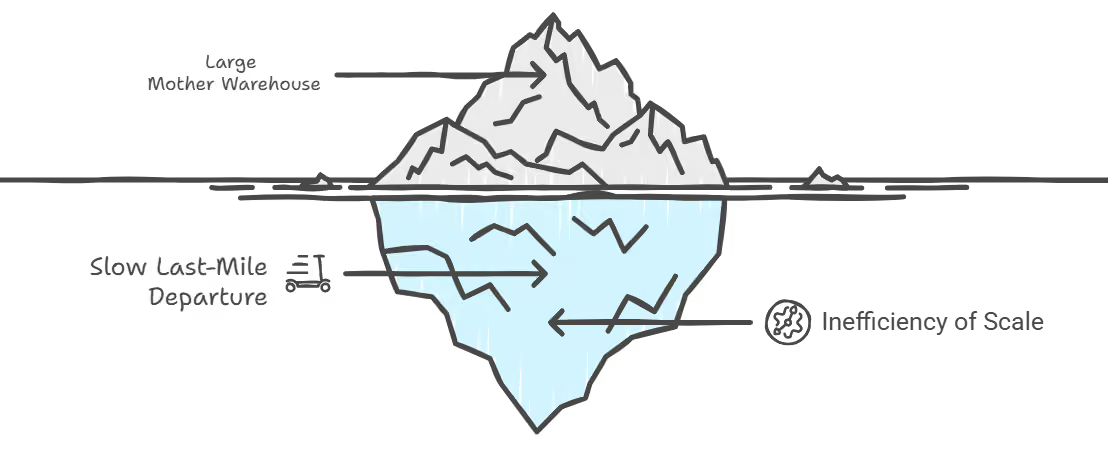
However, that reasoning is changing now. The strategic value of these expansive monoliths is changing as consumer expectations move toward hyper-localization and instant gratification. Here are some reasons why distributed retail is the way of the future and how companies are modifying their infrastructure to make the world faster.
With Increff, we help you understand how to navigate around the issue.
The New Architecture: Dark Stores and Distributed Inventory
Dark Stores, which are tiny, hyper-local fulfillment nodes situated inside city limits, are causing a fundamental shift in the retail supply chain. Brands can accomplish what a centralized hub cannot: lightning-fast delivery and drastically reduced last-mile costs by placing inventory closer to the customer.
The Mother Warehouse's function in this new ecosystem is shifting from daily fulfillment to specialized support. Its redefined purpose includes:
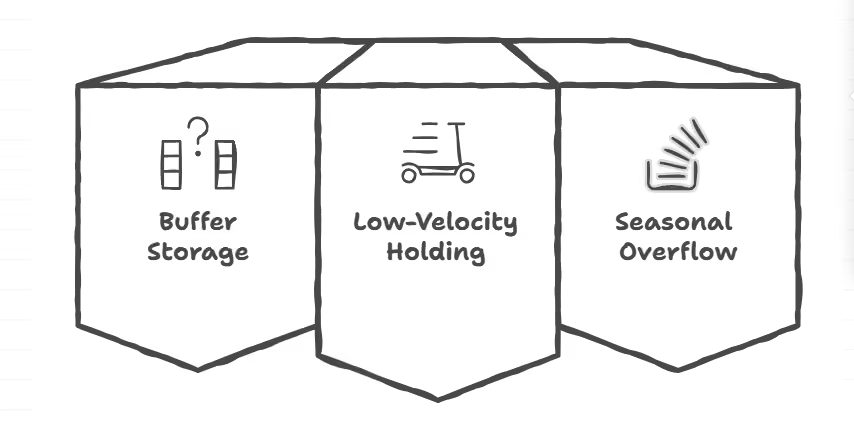
- Seasonal Overflow: Acting and serving as a strategic holding pen for peak-period stock.
- Buffer Storage: Maintaining deep-reserve quantities of new collections/stock
- Low-Velocity Holding: Keeping goods that don't warrant a local dark store's expensive shelf space.
Signals from the Market: The Shift in Action
Leaders in the industry are already moving away from traditional over-centralization and toward more flexible configurations.
1. The Rigidity of Massive Automation
One of the most advanced automated warehouses in the world was recently purchased by a large international fashion retailer. It was created for a conventional offline demand model, despite being an engineering marvel. As consumer patterns shifted rapidly toward e-commerce, the facility’s fixed design struggled to adapt. It teaches us that agility is frequently more valuable than pure volume in a market that is changing.
2. The Rise of Distributed Flow-Through Logistics
A leading multi-national conglomerate has begun bypassing the central hub entirely for a significant portion of its inventory. They have eliminated the "middle man" stop at the central warehouse by shipping straight from manufacturers to local nodes and stores. A large central footprint is less necessary when goods are transported straight to the point of consumption.
3. Preparing for Autonomous Delivery
As drone and autonomous delivery technologies move toward mainstream adoption, "proximity to the porch" becomes the most critical metric. These technologies require hyper-local launch points. A centralized facility located on the outskirts of a city cannot easily support a 15-minute delivery window; only a distributed network can.
Navigating the "Base-Effect" Challenge
Why are big warehouses still being built if the trend is toward smaller nodes? A lot of the time, the answer is how fast the whole market is growing.
As a business grows, a 10% growth rate on a large existing base still needs a lot of new physical space. Modern leaders need to make sure they don't confuse this need for space with a sign that the old model is still working. Instead of just building a bigger, single location, the distributed network should be expanded to meet the need for more capacity.
Two Strategic Considerations for Large-Scale Facilities
- Capex and Reusability: To set up a mega-warehouse, you need to spend a lot of money on special automation and fixed layouts. In a market that changes quickly, this money can get "locked" into a certain way of doing business that may not be useful in five years.
- Operational Adaptability: Large warehouses are geographically fixed. It is hard to change their size or move them when micro-markets change. On the other hand, dark stores are modular and can be opened or closed based on how many people want to shop in that area at the time.
The Bottom Line: A Balanced Future
The retailers of tomorrow will not be defined by how much square footage they own, but by how effectively they position that square footage.
The most resilient model is a hybrid one:
- Primary: A distributed network of agile Dark Stores for rapid, day-to-day fulfillment.
- Secondary: A streamlined Mother Warehouse acting as a high-density, low-velocity buffer.
This method is quicker, cheaper in the long run, and most importantly, it is ready for the next stage of business.