





For fast-growing retail brands, “inventory accuracy” is often treated as a simple number on a dashboard. But in reality, it is the heartbeat of your operations. It determines whether orders ship on time, whether warranties can be honored with confidence, and whether your year-end audits feel routine or like a forensic investigation.
In a recent conversation with a prospect, a specific problem stood out—not because it’s rare, but because it is a "quiet killer" of warehouse efficiency often overlooked in warehouse management solutions.
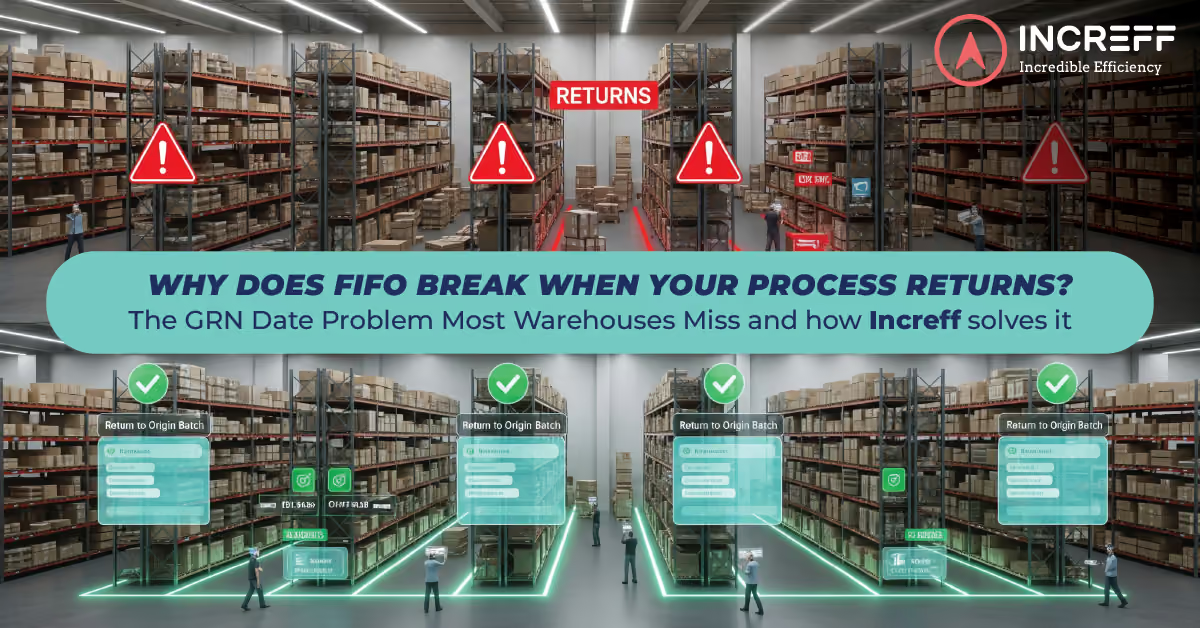
The issue? FIFO (First-In, First-Out) collapses the moment a return hits the warehouse.
When an item loses its original history, your decision-making becomes inaccurate even within advanced warehouse inventory management systems..
WMS Logic Failures: How Return Processing Distorts Inventory Aging Reports
On the surface, a return looks like a simple loop. A product comes back, passes Quality Control (QC), goes back into stock, and becomes sellable again.
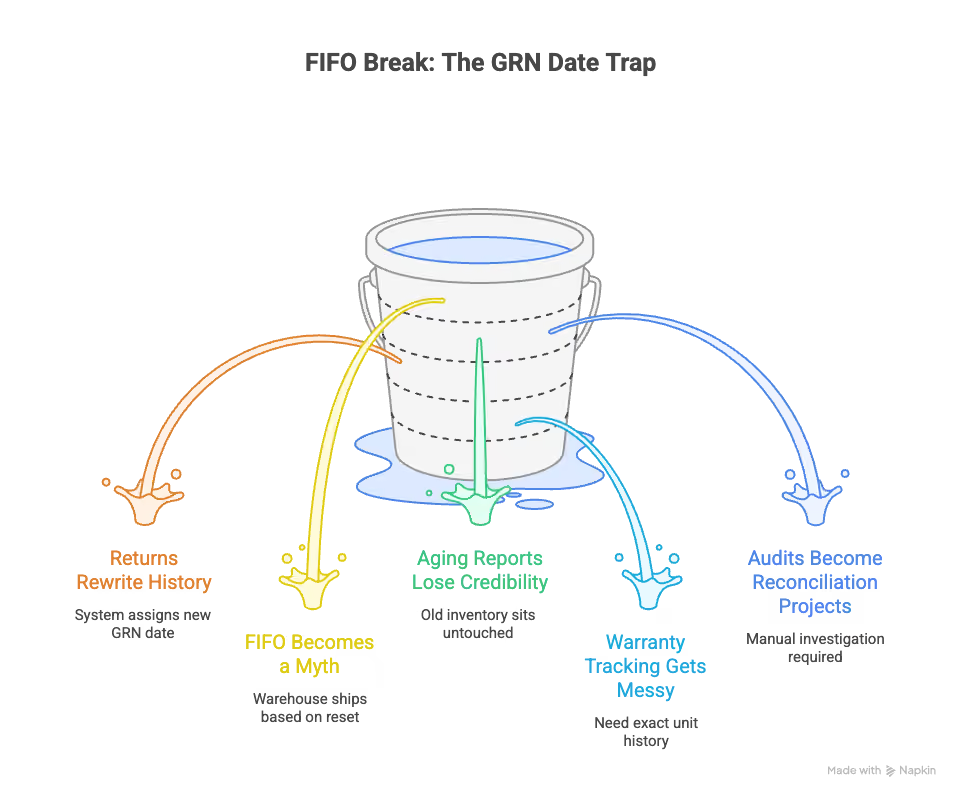
However, many conventional warehouse management systems (WMS) treat this re-inventory step as a "reset" button. Instead of preserving the original date the item first entered your warehouse, the system assigns a new, fresh GRN (Goods Received Note) date based on the day the return was received.
Suddenly, a six-month-old product is treated by your system as "brand new" stock, which distorts insights across warehouse inventory management systems. This single data error creates a massive ripple effect across your business:
- FIFO Becomes a Myth: Your pick logic may be set to “oldest first,” but if returned items keep getting new GRN dates, the warehouse ends up shipping the latest resets instead of the actual oldest physical inventory.
- Aging Reports Lose Credibility: Your dashboards might show healthy, "fresh" stock, while genuinely old inventory sits untouched in the back of the rack, silently depreciating or nearing its expiry (FEFO).
- Warranty & Lifecycle Chaos: For premium brands where warranties run 2 to 5 years, guesswork isn't an option. If you don't know exactly when a specific unit first arrived, you can’t accurately track its lifecycle within most warehouse management solutions.
- Audits Become "Detective Work" Without a reliable history, every exception triggers a manual investigation. Your warehouse team ends up doing reconciliation projects instead of fulfilling orders due to gaps in warehouse inventory management systems.
The Increff Solution: Preserve Identity, Protect History
Increff Warehouse Management System (WMS) is a unique, one of its kind, cloud-based warehouse management software that resolves the returns dilemma at its core. At Increff, we treat a return as a workflow event, not a new inventory birth. That one design choice prevents the GRN reset problem entirely, making it a standout among warehouse management solutions.
Most WMS systems “re-receive” returned goods the same way they receive fresh inbound. The moment they do that, they overwrite the original receipt timestamp and accidentally create new-age inventory. Increff avoids this by making sure every unit carries an identity and a history that cannot be rewritten, strengthening accuracy across warehouse inventory management systems.
1) Serialized inventory: every unit is trackable, not anonymous
Increff WMS runs on scan-based serialization, where every physical unit gets a unique Serial ID at the time of inbound receiving. From that point onward, the system does not just store “SKU quantity”. It stores which exact pieces exist, and where they are.
Because each Serial ID is persistent, the system can always answer:
- When did this unit first enter the warehouse?
- Which bin has it lived in?
- Which order did it ship in?
- When did it return, and what was its QC outcome?
This “unit-level truth” is what makes the GRN date problem impossible to create reinforcing modern warehouse management solutions.
2) Return processing that does not rewrite the original GRN
In Increff, returns go through a dedicated returns workflow (gate entry → scan → QC → disposition), and the unit’s original inward / GRN date remains intact.
What changes on return is the status of the Serial ID, not the identity:
- The unit becomes “Returned” (or “In QC”, “Quarantined”, “Restockable”, etc.)
- The system logs a return event timestamp
- But the original receipt timestamp stays as the unit’s inventory age anchor
So when the item becomes sellable again, it re-enters available inventory without becoming “new stock” in the eyes of FIFO / FEFO logic.
3) FIFO and FEFO that stay correct even with high return volumes
Because picking is driven by the oldest original receipt date (and not the latest return date), your FIFO configuration actually behaves like FIFO in real life.
That means:
- Returned units do not jump the queue.
- Aging reports do not artificially “freshen” inventory.
- FEFO logic remains reliable for expiry-sensitive categories.
In simple terms, Increff ensures your dispatch logic follows physical reality, not system-created timestamps.
4) A clean audit trail, with unit-level traceability
Every scan in Increff creates an unbroken chain of custody for that Serial ID, from receiving to dispatch to returns and restocking. This makes audits and investigations faster because the system already holds the journey.
Instead of asking the warehouse team to reconstruct history manually, you can pull a unit’s trail and see:
- Original GRN and inward references
- All bin movements
- Order linkage
- Return linkage
- QC result and final disposition
5) Strong reverse flow controls: QC + proof + flexible disposition
Returns are where most warehouses lose control, so Increff makes this flow explicit and system-led:
- Scan-led gate entry and GRN for returns
- Multi-step QC workflows with role-based actions
- Optional visual proofing (photo/video) to reduce disputes
- Clear disposition paths: restock, quarantine, vendor return, scrap, or refurb flows depending on business rules
The outcome is that returned inventory is accounted for immediately, made available only when compliant, and aged correctly the moment it is restocked.
Why This Matters for Scaling Brands
In the world of online scaling, returns are no longer an "edge case"—they are a constant. If your system resets the clock every time a product comes back, you are operating on a foundation of bad data.
Increff ensures that inventory retains its truth: the same item remains the same item, no matter how many times it moves. That is how you achieve FIFO you can trust, aging you can act on, and audits you can face without firefighting.
Conclusion: Don't Let Your WMS Dictate Your Strategy
Your warehouse technology should support your business rules, not force you to work around them. When a WMS resets GRN dates, it effectively takes away your ability to manage inventory by age, quality, or lifecycle.
For brands moving into high-growth phases—especially in segments where expiry (FEFO) and long-term warranties are critical—reclaiming "inventory truth" is the only way to scale sustainably. By preserving the identity of every unit from day one, you transform your warehouse from a place that stores boxes into a precision-driven fulfillment engine.
Is your current WMS "resetting" your inventory age? It’s time to move to a system that remembers. Learn more about Increff WMS.
Frequently Asked Questions (FAQ)
Q: What is a serialised inventory?
A: Serialised inventory is inventory where each individual unit is given a unique serial ID/barcode (in addition to the SKU), so the warehouse can track exactly which item was received, stored, picked, packed, and shipped. It improves traceability, reduces mismatches, and is especially useful for high-value or warranty-linked products
Q: What are the best practices for verifying GRM in warehouse operations?
A: Verify GRM by doing a 3-way match (PO vs invoice/ASN vs physical receipt), using scan-based receiving (including serial/lot scans where applicable), recording QC results and discrepancies (short/excess/damage) immediately, and keeping exceptions in a hold/segregation zone until approvals and corrections are completed with a clear audit trail.
Q: What does GRN stand for in supply chain management?
A: GRN stands for Goods Receipt Note. It is the document or system entry used to confirm that goods have been received into the warehouse against a purchase order or inbound shipment, and it typically captures received quantities, QC status, and any discrepancies.
Q: What is a Warehouse Management System?
A: A Warehouse Management System (WMS) is a software system that plans, manages, and controls warehouse operations from inbound receiving to outbound dispatch. It helps run processes like receiving, put-away, inventory tracking, cycle counting, picking, packing, shipping, returns, and operational reporting to improve accuracy and productivity.
Q: What are the best Warehouse Management Softwares available in India?
A: The best WMS in India depends on your volume, complexity, and integrations, but commonly evaluated options include Increff WMS (well suited for high-accuracy, scan-driven and serialized operations), Unicommerce, Vinculum, and enterprise suites like SAP EWM, Oracle WMS Cloud, and Infor WMS for larger, more complex warehouse networks.