





If you're an Operations Director or Supply Chain Head at a retail brand preparing for Diwali, Big Billion Days, or an End-of-Season Sale (EOSS) in India, your biggest fear isn't low demand, it's your own systems cracking under it.
According to a 2024 Gartner report, businesses with centralized order and inventory systems experience up to 50% faster order-to-delivery cycles. Yet every festive season, dozens of brands mid-market and enterprise alike log SLA breaches, oversell incidents, and warehouse gridlocks because their order management system or WMS simply wasn't built for burst. The difference between a sale that drives revenue and one that drives cancellations often comes down to which platform is running your operations behind the scenes.
This guide compares the most widely used OMS and WMS platforms in India Increff, Unicommerce, Vinculum, and Anchanto specifically through the lens of peak-season reliability.
Key Takeaways
- Peak sale events expose four structural failure points: inventory desync, manual routing, warehouse throughput ceilings, and weak returns management
- Unicommerce and Vinculum are strong all-round platforms for omnichannel operations; both show performance variability at extreme peak loads
- Anchanto serves India and Southeast Asia well for brands with cross-border operations but has reported high-season lag
- Increff's OMS and WMS are designed specifically for high-velocity retail environments, with native integration between the two systems
- The most critical capability during a sale is not feature count it's how well your OMS and WMS communicate with each other in real time
What Actually Goes Wrong With OMS and WMS Systems During Peak Sales?
Most festive season failures aren't random. They follow a predictable pattern across platforms:
- Inventory desync: When D2C, Amazon, and Flipkart listings draw from the same physical stock but don't share a live inventory pool, overselling becomes unavoidable once order velocity spikes.
- Manual order routing: Any OMS system that requires human intervention to decide which fulfillment node handles which order collapses when volumes jump 3–5x overnight.
- Warehouse throughput ceilings: A WMS optimized for 500 orders/day hits hard limits at 5,000 if pick paths, batch workflows, and packing stations aren't designed for burst capacity.
- Disconnected OMS-WMS handoff: When the OMS and WMS are different vendors, order confirmation-to-pick instruction latency increases often through file-based or scheduled syncs that can't keep pace during a flash sale.
Understanding these failure modes is what makes a side-by-side comparison useful. Each platform handles these differently.
How Do the Leading OMS Platforms in India Compare for Peak Sales?
Unicommerce
Unicommerce is the most widely deployed OMS/WMS in India, managing operations across 6,000+ warehouses. Its strength is centralized control across many locations with strong marketplace integrations Amazon, Flipkart, Meesho, Myntra, and others. For brands running high-SKU, multi-warehouse operations, Unicommerce's omnichannel order orchestration works well under normal-to-elevated load.
The caveat for peak events: Unicommerce's routing logic, while configurable, often requires significant pre-configuration before a sale to perform optimally. Teams that haven't set up routing rules and priority nodes well in advance can find themselves managing exceptions manually during the event itself.
Best for: Mid-to-large brands needing broad marketplace coverage and centralized inventory across many warehouses.
Vinculum (Vin eRetail)
Vinculum's order management software is modular and flexible, with strong marketplace catalog support and omnichannel inventory management. Brands like Biba, Nykaa, and MyGlamm have used Vinculum's WMS for multichannel operations. Its reconciliation features and discount/loyalty management make it a good fit for brands running promotional mechanics alongside a sale event.
Where Vinculum shows strain is in warehouse-floor throughput at extreme volumes. Its picking and dispatch workflows, while capable, are not as tightly optimized for high-velocity e-commerce environments as platforms built specifically for that use case. The steeper learning curve also means peak-season onboarding of additional warehouse staff takes longer.
Best for: Omnichannel retailers with complex promotional structures and cross-channel loyalty programs.
Anchanto
Anchanto's OMS is built for brands operating across India and Southeast Asia, with smart routing, automatic catalog sync, and kit/bundle management. For brands with cross-border complexity managing both Indian and regional APAC operations from a single platform Anchanto offers genuine value.
The peak-season concern, as noted in multiple platform reviews, is occasional performance lag under high-season load. For brands whose peak events are concentrated and intense (a 48-hour Diwali window, for example), this is a meaningful risk. Anchanto is better suited to brands with more distributed, continuous sales patterns than sharp, high-intensity spikes.
Best for: India + Southeast Asia brands with regional expansion needs and omnichannel catalog complexity.
Increff OMS
Increff's Order Management System is built specifically for high-velocity Indian retail. A unified live inventory pool eliminates overselling across all channels in real time. Rule-based routing assigns orders to the right fulfillment node automatically — no manual intervention. SLA dashboards flag at-risk orders before they breach. And unlike the other platforms here, Increff's OMS and WMS operate as a native pair, with no batch sync or API latency between order routing and warehouse instruction.
Best for: Mid-to-large retail brands running high-intensity multichannel sale events who need tight OMS-WMS coordination out of the box.
How Do the Leading WMS Platforms Compare When Warehouse Volumes Spike?
A WMS failure during a sale looks different from an OMS failure. It's not a data problem, it's a physical one. Orders queue up inside the warehouse faster than they can be picked, packed, and dispatched. Here's how the major platforms handle it:
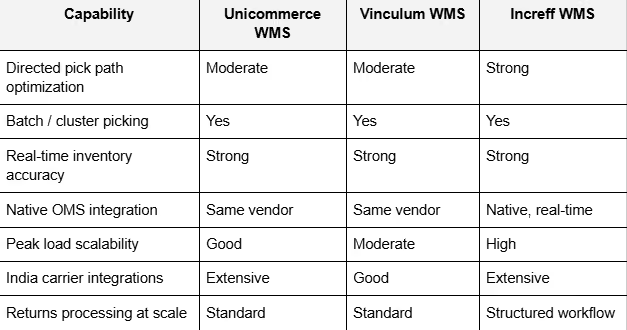
The consistent differentiator across high-volume warehouse environments is pick path optimization and how seamlessly the WMS receives instructions from the OMS. Latency in that handoff — even 30–60 seconds — creates cascading delays when 200 orders arrive per minute.
How Does Increff Help Retailers Win During Festive and EOSS Events?
Most peak-season failures aren't execution failures. They're infrastructure failures that were baked in months before the sale went live.
Increff's Order Management System and Warehouse Management System are designed from the ground up for the volume intensity and multichannel complexity of Indian retail. And critically, they work as a native pair, not two systems patched together via API.
On the OMS side: a single, real-time inventory pool shared across every channel eliminates overselling before it happens. Configurable routing logic automatically assigns each order to the optimal fulfillment node warehouse, store, or vendor without human intervention. SLA dashboards give operations teams live visibility into at-risk orders, so action happens before a breach, not after. For brands running omnichannel operations, Increff's Store Management System extends this capability to physical stores, enabling Ship from Store and BOPIS to absorb demand overflow from the central warehouse mid-sale.
On the WMS side: directed picking, batch workflows, and real-time inventory accuracy are designed for environments where order volumes can go from 500 to 5,000 per day with no system performance drop. The WMS picks up each routed order from the OMS instantly — no file transfer, no scheduled sync, no delay. That seamless loop is what keeps dispatch timelines intact when the queue is moving at 10x normal velocity.
The result is measurable: fewer cancellations, cleaner marketplace seller ratings, lower cost per order, and a fulfillment operation that doesn't require a war room every time a sale goes live.
Conclusion
Choosing the right OMS and WMS before a peak sale event isn't a software decision it's an operational risk decision. Every platform covered in this guide has genuine strengths. The right fit depends on your order volumes, channel mix, warehouse complexity, and how much manual intervention your team can realistically absorb when thousands of orders arrive in the first hour of a sale.
What this comparison makes clear is that peak-season reliability isn't about feature lists. It's about inventory accuracy, routing speed, warehouse throughput, and how seamlessly your OMS and WMS work together under pressure. Audit those four things against your current setup and if gaps exist, close them well before your next big sale window opens.
Request a demo.
Frequently Asked Questions
Q: Can a single OMS system handle both D2C and marketplace orders during a flash sale?
A: Yes, provided it maintains a unified real-time inventory pool and automated routing. The risk arises when OMS platforms sync inventory on a scheduled batch basis; even a 15-minute sync gap will result in oversells during a flash sale. Real-time sync is non-negotiable for concurrent multi-channel events.
Q: How early should we evaluate or switch our order management software before a peak sale?
A: A minimum of 8–12 weeks before a major sale event. This allows time for channel and carrier integration, routing rule configuration, team training, and at least one simulation run before go-live. Switching platforms in the 2–3 weeks before a sale is high-risk regardless of which platform you move to.
Q: What is the biggest mistake brands make with OMS/WMS configuration before a sale? A: Running their routing rules and warehouse workflows in default mode. Peak events require pre-configured priority routing, carrier failover rules, and warehouse zone assignments that are tuned specifically for burst capacity. Most platforms support this but it requires deliberate setup, not just having the software running.
Q: Does Increff's OMS work if we already have a different WMS in place?
A: Increff's OMS can integrate with third-party WMS platforms via API. However, the tightest performance during peak events comes from running Increff's OMS and WMS as a native pair, where order routing and warehouse instruction happen in real time without external API latency.