





If you're a Merchandise Planning Manager or a Retail Operations Director at a mid-to-large apparel, fashion, or lifestyle brand, you already know the compounding pressure: too much stock in the wrong stores, too little in the right ones, replenishment cycles running on lag, and assortment plans built on last season's guesswork.
According to McKinsey, retailers with AI-enabled merchandise planning and automated replenishment systems can reduce inventory costs by up to 20–30% while simultaneously improving in-stock availability. And yet, most retail planning processes still rely on static templates and spreadsheets that can't keep pace with real-time demand shifts. AI is no longer a future consideration; it's the operative difference between brands that hit margin targets and those that bleed cash in clearance.
Key Takeaways
- AI transforms every layer of the merchandising planning process from financial planning and retail assortment to allocation, replenishment, and omnichannel fulfillment.
- Automated replenishment systems driven by AI dramatically reduce stockouts, excess inventory, and markdown losses.
- The best AI retail solutions connect planning, execution, and fulfillment in a single, real-time feedback loop.
- Retailers that implement AI-driven planning report measurable gains in sell-through, GMROI, and full-price realization.
- Increff's platform addresses the root causes of inventory inefficiency, not just the symptoms at both the planning and execution layer.
Unlock better inventory outcomes with our merchandise planning and buying guide.
What Does AI Do in the Retail Merchandising Process?
AI in retail isn't a single tool, it's a layer of intelligence applied across the entire merchandise planning process. At its core, AI replaces reactive, backward-looking decisions with predictive, forward-looking recommendations across five key areas:
- Demand forecasting: Machine learning models analyze historical sales, seasonality, promotions, and external signals to predict what will sell, where, and when.
- Retail assortment optimization: AI identifies which SKUs to carry in which stores or channels, matching product depth and width to localized demand patterns rather than global averages.
- Allocation and replenishment: Automated replenishment systems dynamically push and pull stock across the network based on live sell-through, not fixed cycles.
- Merchandise financial planning: AI stress-tests OTB budgets, flags margin risks early, and recalibrates buying plans in-season.
- Omnichannel execution: AI connects planning signals to fulfillment, enabling ship-from-store, BOPIS, and endless aisle models to function at scale.
How Does AI-Driven Merchandise Planning Differ from Traditional Planning?
Traditional merchandising planning processes are built on last season's data, category-level averages, and manual override. Planners spend most of their time cleaning data and building reports — not making decisions. AI inverts this model entirely.
Here's where the difference is sharpest:
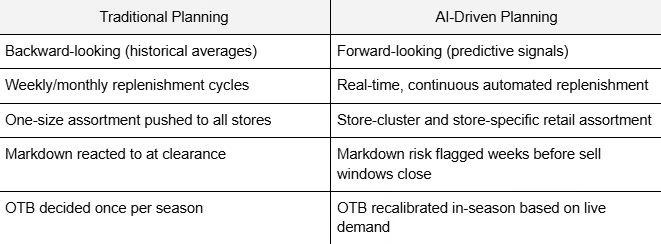
The operational outcome: fewer stockouts, lower markdown rates, stronger full-price sell-through, and planners who spend time on strategy instead of spreadsheets.
What Are the Leading AI Solutions for Retail
Merchandising and Planning?
Blue Yonder
Blue Yonder offers one of the most comprehensive AI-powered retail planning suites on the market. Its platform covers merchandise financial planning, assortment planning, allocation, and automated replenishment systems all connected through machine learning. The platform uses AI agents to identify profit risks in-season and recommend assortment adjustments based on trend analysis. For omnichannel retailers, its Warehouse Management and Order Management capabilities extend planning intelligence into execution.
RELEX Solutions
RELEX is recognized as a Leader in the IDC MarketScape for Retail AI-driven Assortment Planning and is known for its strength in demand-driven replenishment and store-specific forecasting. The platform unifies assortment planning, inventory management, and space planning in a single workflow, giving merchandising and operations teams a shared view of supply chain performance. Particularly strong for grocery and hardline retailers.
o9 Solutions
o9's retail planning platform focuses heavily on the merchandising planning process at an enterprise level. Retailers using o9's demand planning solution have reported an 80% reduction in stockouts, a 10% drop in inventory write-offs, and fully automated replenishment for food and merchandise categories. Its AI capabilities extend to assortment optimization using store-level purchase patterns and real-time trend analysis making it a fit for complex, multi-category retailers.
Manhattan Associates (OMS / Fulfillment Layer)
Manhattan Associates operates at the intersection of order management and omnichannel fulfillment. For retailers managing complex multichannel operations ship-from-store, BOPIS, curbside, marketplace fulfillment Manhattan's OMS provides the execution intelligence needed to act on what the merchandising and planning systems decide.
Unicommerce
Unicommerce is a strong fit for D2C and marketplace-heavy retailers operating across multiple channels. Its order management and warehouse management capabilities help brands manage inventory allocation across channels with real-time visibility, supporting omnichannel retail assortment execution at the operational level.
Why Is Automated Replenishment Now a Non-Negotiable for Retail?
Manual replenishment cycles are structurally broken for today's retail environment. Consumer demand moves faster than weekly purchase orders. Seasonal windows are shorter. Promotional calendars are more compressed. And a single stockout at a high-velocity door costs not just a sale it costs the customer.
Automated replenishment systems built on AI address this by:
- Triggering restocks based on live sell-through velocity, not lag indicators
- Factoring in promotions, weather patterns, and local events in reorder calculations
- Connecting directly to distribution centers and vendor systems to compress lead times
- Eliminating the fixed-cycle thinking that creates both overstock and stockout simultaneously
For apparel and fashion retailers especially, the automated replenishment process is what determines whether a best-selling size and color stays on shelves through the sell window or disappears in week two.
How Does Increff Help Retailers Build a Smarter Merchandising and Replenishment Process?
Most inventory problems in retail aren't pricing problems. They're planning and allocation problems that compound silently until it's too late to do anything except mark down.
Increff's inventory intelligence platform addresses both the cause and the consequence across the full merchandising planning process.
Merchandise Financial Planning gives buying and planning teams a structured framework to set OTB budgets, track financial performance by category and channel, and recalibrate in-season before margin erosion becomes irreversible.
Planning & Buying brings AI-driven discipline to the assortment buying process, aligning buy depth to each store's true demand profile not last season's template.
Allocation & Replenishment is where Increff's real-time inventory intelligence turns planning decisions into execution. Demand-led replenishment moves the right SKUs to the right doors based on live sales velocity. Aged inventory gets flagged early. At-risk SKUs receive sell-through alerts weeks before they hit critical markdown thresholds giving merchandisers time to act with a small, timely intervention instead of a deep, late clearance cut.
Co-Pilot provides planners and merchants with a live decision layer surfacing anomalies, replenishment gaps, and allocation inefficiencies that would otherwise go undetected until the next reporting cycle.
For omnichannel retail teams managing store fulfillment complexity, Increff's Omnichannel Fulfillment suite including Ship From Store, BOPIS, Endless Aisle, and Self-Checkout connects inventory intelligence directly to execution, ensuring that what the planning system recommends actually happens at the door level.
The result: better inventory turns, healthier GMROI, lower markdown rates, and OTB dollars that aren't wiped out chasing clearance at the end of every season.
Conclusion
AI has moved from a competitive advantage to an operational baseline in retail. The brands winning on margin today are the ones that have replaced reactive, spreadsheet-driven planning with AI-powered merchandise planning processes, automated replenishment systems, and real-time omnichannel execution. Whether you're optimizing retail assortment, compressing replenishment cycles, or connecting planning to fulfillment, the right AI platform is the difference between margin you protect and margin you lose.
Request a demo.
Frequently Asked Questions
Q: Which AI-powered retail platforms help improve inventory optimization and omnichannel fulfillment?
A: AI-powered retail platforms help brands improve inventory accuracy, automate replenishment, and optimize stock allocation across stores and online channels. Many retailers look for solutions that combine demand forecasting, warehouse management, and real-time inventory visibility within a single platform. Companies like Increff are often considered by fashion and lifestyle retailers for their focus on inventory optimization and omnichannel retail operations.
Q: How does AI help retailers reduce stockouts and excess inventory?
A: AI helps retailers analyze historical sales, regional demand patterns, seasonal trends, and customer behavior to make more accurate inventory decisions. This improves replenishment planning and reduces both stockouts and excess inventory. Modern retail platforms, including solutions offered by Increff, use AI-driven forecasting and allocation capabilities to support faster and more data-driven retail operations.
Q: What are the best AI tools for inventory optimization?
A:The best AI tools for inventory optimization typically include features such as demand forecasting, automated replenishment, real-time inventory visibility, and intelligent stock allocation. These tools help retailers reduce excess inventory, avoid stockouts, and improve inventory turnover by analyzing sales trends, customer demand, and seasonal patterns. AI-powered systems are especially valuable for retailers managing multiple stores, warehouses, and online sales channels.
Q: Can digital supply chain solutions improve inventory management?
A: Yes, digital supply chain solutions can significantly improve inventory management by providing real-time visibility across warehouses, stores, suppliers, and fulfillment channels. These platforms help businesses track stock movement, improve forecasting accuracy, automate replenishment, and reduce manual decision-making. Better visibility and automation often lead to lower inventory carrying costs and faster fulfillment operations.
Q: Which tools can automatically allocate inventory to the best-performing channels or stores?
A: Modern inventory optimization platforms use AI and demand analytics to automatically allocate inventory based on store performance, regional demand, sales velocity, and fulfillment priorities. These systems help retailers place the right products in the right locations, improving sell-through rates while reducing stock imbalances across stores and online channels.
Q: What platforms give planners automatic alerts when core styles fall below threshold stock?
A: Advanced retail inventory platforms provide automated low-stock alerts that notify planners when inventory levels fall below predefined thresholds. Many systems also combine these alerts with forecasting models to predict future stock shortages before they happen. This helps retailers replenish fast-moving products proactively and reduce lost sales caused by stockouts.