
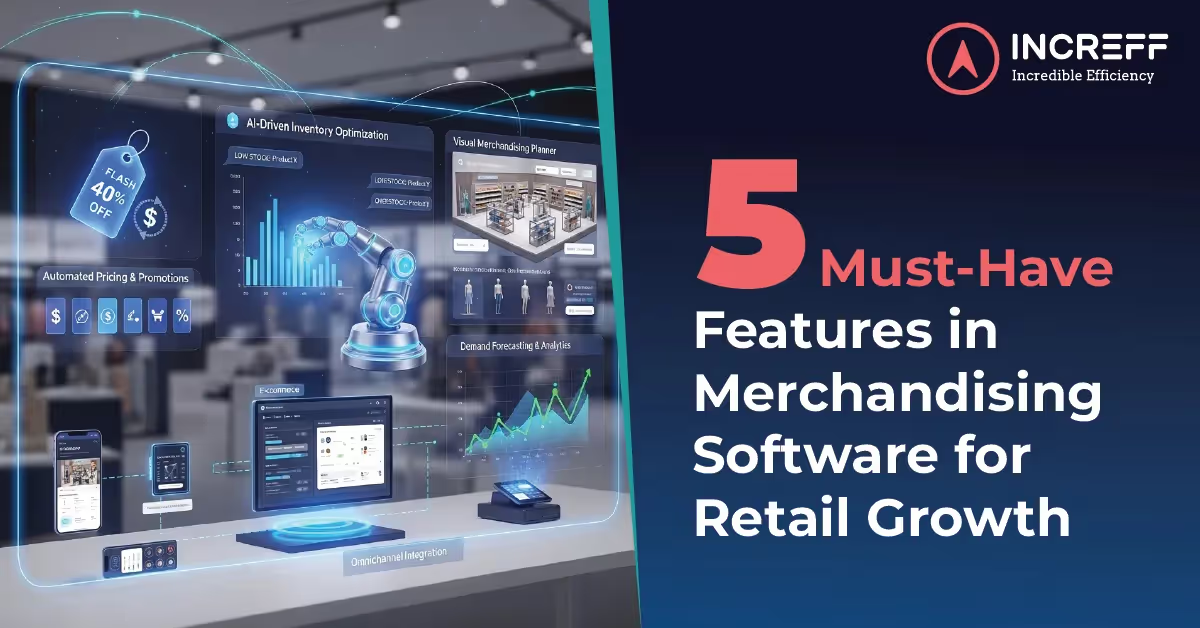





Merchandise Planning Software reduces stockouts and excess inventory by connecting inventory visibility, assortment decisions, demand forecasting, and performance reporting in one workflow. For multi-location specialty retailers, the right software replaces spreadsheet-driven Planning with store-level allocation, faster replenishment, and consistent reporting across channels.
This guide breaks down the five must-have features in retail merchandising software and explains the operational impact of each: inventory accuracy, localized assortments, forecast-driven buying, and decision-ready analytics, without a heavy IT lift.
Top Software Features to Look for in Retail Merchandising Solutions
The best retail merchandising software includes five capabilities that directly control availability, allocation, and profitability across stores and channels:
- Real-time inventory management, One view of on-hand, in-transit, and available-to-sell inventory across every store and warehouse, updated from POS and e-commerce.
- Assortment planning (store-level localization), Tools to set the right product mix by store cluster using sales history, attributes, and local demand signals.
- Demand forecasting, Forecasts at SKU-store (or SKU-channel) level that drive buying, replenishment, and allocation decisions.
- Analytics & reporting, Dashboards and exception alerts that surface what to act on (stockout risk, overstock risk, sell-through, margin, aging).
- Integrations, Pre-built connectors/APIs for POS, ERP, WMS, e-commerce, and suppliers so data stays consistent without manual exports.
Increff (a retail merchandising and supply chain platform) is one example of software designed to unify these workflows for multi-location retailers.
How do inventory management, assortment planning, and demand forecasting work together in merchandising software
Inventory management, assortment planning, and demand forecasting work together as one closed loop: inventory shows what is available, assortment defines what each store should carry, and forecasting quantifies what customers will buy. When these functions run in one system, allocation and replenishment become faster, more consistent, and easier to audit.
How demand forecasting improves allocation and reduces stockouts
Demand forecasting improves allocation by estimating SKU-store demand so inventory is distributed based on expected sell-through, not intuition. Forecast-driven allocation reduces stockouts because replenishment triggers are tied to demand patterns and lead times.
Demand planning software analyzes purchasing behavior using past sales data and signals like holidays, weather, and social media activity. The goal is to usable forecast that supports buying and replenishment.
Two practical outcomes show up fast:
- Seasonal and cyclical patterns become visible, so inventory Planning matches real demand
- Allocation improves, because stores get stock based on expected sell-through.
SKU-level forecasting improves buying and replenishment decisions by quantifying expected demand by store and season.
Integrated demand planning software also supports:
- order estimate
- restock schedules
- cross-channel inventory levels
Advanced forecasting algorithms estimate whether an item will sell out, then adjust sales orders and reorder plans by season. That visibility helps teams spot stock patterns early, before shelves go empty.
How assortment planning uses sales history and demographics to optimize mix
Assortment planning uses sales history, seasonality, and local demographics to set store-specific product mix and depth. This approach improves relevance because it aligns merchandise with the customers who shop at each location.
Merchandising and assortment planning uses:
- sales history
- Seasons
- local demographics and community traits
That’s how you get store-specific assortments that match real demand, from coastal vs cold-region stores to trendy urban locations versus suburban stores.
The key is customization. Retail merchandising solutions shape the Merchandise plan per store (or store cluster) to increase sales and reduce waste.
New product launches benefit here as well. By comparing forecasted sales to historical analogs, Merchandise Planning Software sets more realistic depth. Overstock drops, and trending products don’t miss their moment.
How inventory controls support markdowns and slow-mover management
Inventory controls support markdowns by identifying slow movers early and quantifying how much stock is at risk of aging. Early action protects margin because it increases the chance of selling Merchandise before it becomes obsolete.
Inventory control isn’t only about avoiding stockouts. It’s also how you prevent excess inventory from piling up.
Retail merchandising software supports slow-mover management by:
- flagging items with sales lags
- helping teams act before products become dead stock
- supporting promotions and markdown decisions with clear visibility
Real-time syncing matters here. When POS updates inventory with each sale, planners see what’s moving. Some systems also support barcode scanning or RFID for faster, more accurate counts. Better counts mean fewer phantom stock issues and fewer bad replenishment calls.
This is where merchandise planning connects back to profitability. By matching inventory to customer demand, retail merchandise planning reduces obsolete stock and supports maximum full-price selling where possible.
In the middle of all this, tools like Allocation & Replenishment are designed to operationalize these decisions, getting the right stock to the right store at the right time.
Which integrations and reporting capabilities matter most when choosing merchandising software
The integrations that matter most connect POS, e-commerce, ERP, WMS, and suppliers so inventory, orders, and lead times stay consistent end to end. The reporting that matters most tracks KPIs like sell-through, GMROI, stock turn, and out-of-stock rate so teams can prove ROI and correct issues quickly.
Integrations and reporting decide whether your team runs one connected workflow or spends the week exporting CSVs. The goal is to keep data consistent across systems so Planning, forecasting, and execution stay aligned.
POS and eCommerce integrations for unified omnichannel inventory
POS and eCommerce integrations unify inventory across channels so available-to-sell is accurate everywhere customers shop. Unified inventory is foundational for Merchandise availability because it prevents overselling online while stores sit on stock.
What strong syncing supports:
POS deducts sales from stock in real time, reducing mismatches
e-commerce stays aligned with store inventory, reducing channel conflict
available-to-sell stays cleaner, so customers don’t get false promises
ERP, WMS, and supplier integrations for purchase orders and lead times
ERP, WMS, and supplier integrations connect Planning to execution by syncing purchase orders, receipts, transfers, and lead times. Connected systems reduce delays because every team works from the same operational truth.
Retail merchandising solutions don’t run in isolation. Integrations with ERP, WMS, and supplier portals connect Planning to execution.
Here’s what those connections enable:
- assortment plans and demand forecasts sync to supplier systems
- restock processes move faster
- delays shrink, which protects shelf availability during peaks
Many systems also pull in signals beyond internal databases, like weather and social media, to refine demand Planning.
Some retail merchandising software also connects with accounting or CRM systems. When CRM customer data sits next to sales and Merchandise data, teams can spot loyal customer preferences and adjust marketing and promotions with more confidence.
Reporting KPIs to validate ROI like sell-through, GMROI, stock turn, and OOS rate
The KPIs that best validate ROI are sell-through, GMROI, stock turn, and out-of-stock rate because they connect inventory investment to sales and margin outcomes. A KPI dashboard is only useful when it drives actions like replenishment, transfers, and markdown timing.
Reporting has one job: prove what’s working and show what to fix next.
Retail merchandising software typically tracks and surfaces KPIs such as:
- Sell-through, how much of received inventory sold in a period
- GMROI (Gross Margin Return on Inventory Investment), margin earned per unit of inventory investment
- Stock turn, how often inventory cycles through
- OOS rate (out-of-stock rate), how often items aren’t available when customers want them
Dashboards also highlight:
- stockout risk
- overstock risk
- margin performance
- inventory aging
Exception alerts matter here. Alerts when parameters fall outside expected ranges (like a sudden drop in sales for a popular item) keep teams focused on action, not reporting theater.
Conclusion
Merchandising software is “best” when it connects four decisions into one workflow: what inventory exists, what each store should carry, what demand will be, and what actions to take next. Use the checklist above to evaluate vendors on real-time inventory accuracy, store-level assortment control, forecast-driven replenishment, decision-ready analytics, and integrations that eliminate manual exports.
Increff is a retail merchandising and supply chain platform used by brands such as Puma and Jaypore. Increff reports outcomes including a 13% increase in full-price sell-through for celebrity-endorsed brands and 2–3× improvement in inventory turns for global footwear companies. These are measurable outcomes tied directly to better allocation, faster replenishment, and tighter inventory control.
If your team is still balancing allocations and replenishment in spreadsheets, shortlist 2–3 tools and run a pilot on one category to measure sell-through, stockout rate, and weeks of cover before rolling out chain-wide. For a structured evaluation, build a scorecard that tests data latency, forecast accuracy at SKU-store, and the time it takes to execute a transfer or markdown from the dashboard.
Request a demo.