






The Ship-From-Store Playbook: Mastering Holiday Fulfillment with Your Store Management System
Holiday ship from store (SFS) works when stores ship only what they truly have on hand, and associates can pick, pack, and hand off to carriers through a guided workflow that hits cutoffs. A store management system is the execution layer that makes SFS reliable at peak by keeping inventory accurate in real time and standardizing store fulfillment work. This playbook shows how to run a ship from a store with fewer cancellations, faster handoffs, and tighter cost control using a ship from store fulfillment platform that connects routing decisions to store execution.
What is Ship From Store and why does it matter for holiday fulfillment
Ship from store fulfills e-commerce orders from retail stores instead of only from a distribution center (DC), letting you ship from inventory closer to the customer during peak. It matters most during holidays because DC capacity, carrier cutoffs, and expedited shipping costs tighten at the same time.
How does SFS reduce stockouts delivery times and peak shipping costs
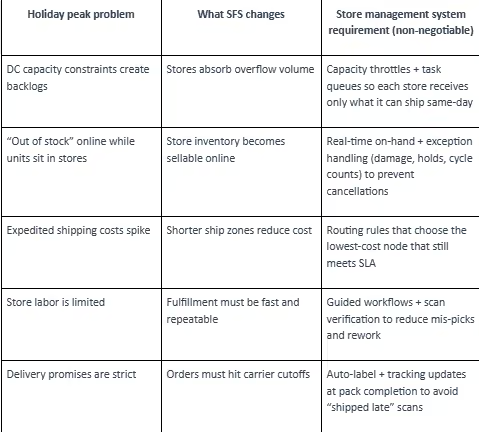
SFS reduces stockouts and shipping costs by making store inventory sellable online and shortening ship distance when routing and store execution are controlled by a store management system and the OMS.
- Maximizing inventory: SFS makes shelf and backroom units sellable online, so you don’t lose sales because the DC shows “out of stock.” This only works when store on-hand is accurate and synced to the OMS.
- Speed to customer: Shipping from a local store cuts last-mile distance, supporting faster delivery without premium service levels.
- Lower shipping costs: Shorter ship zones often mean lower carrier costs than shipping fast from a faraway DC.
- Demand overflow relief: When the DC is at capacity, stores can absorb overflow volume and keep orders moving.
- Better margins: Moving inventory closer to the customer helps you sell through without leaning as hard on end-of-season markdowns.
How does a store management system enable Ship From Store execution end to end
A store management system enables SFS by maintaining real-time sellable inventory and by giving associates a scan-driven pick/pack/ship workflow with exception handling, label printing, and tracking updates back to the OMS.
A store management system runs store operations (inventory, tasks, transactions) and becomes the execution console for store fulfillment.
Store management system (SMS): Software that coordinates store inventory, associate tasking, and in-store transactions beyond POS, so stores can operate like micro-fulfillment nodes.
Ship-From-Store (SFS): A process where the order management system (OMS) allocates an online order to a store, and store associates pick/pack/ship it with carrier handoff.
Key SMS capabilities that SFS depends on:
- Real-time inventory accuracy: Keeps store on-hand in sync with the OMS so allocation decisions are based on sellable stock.
- Associate tasking and labor controls: Assigns, prioritizes, and time-boxes fulfillment work so SFS doesn’t overwhelm store labor.
- Guided fulfillment workflows: Standard pick/pack/ship steps with scan verification and exception paths (short pick, substitution, damage).
- Omnichannel services (BOPIS/BORIS): Buy Online Pick Up In Store and Buy Online Return In Store workflows that share the same inventory truth.
- Carrier/label integration: Prints labels and pushes tracking back to the OMS at pack completion.
- Endless aisle: Lets associates sell from network inventory (DC + other stores) when the local store is out of stock.
How do real time inventory accuracy and routing rules make SFS reliable
SFS becomes reliable when routing uses capacity and SLA rules and stores publish real-time sellable inventory (not just “on-hand”) back to the OMS, so allocation decisions match what can actually ship today.
Operational flow (end-to-end):
- Inventory broadcast: The SMS publishes sellable on-hand (not just “in store”) to the OMS in near real time.
- Order routing: The OMS allocates orders using rules (distance, inventory depth, store capacity, margin/SLA).
- Store execution: The SMS issues pick tasks, enforces scan-verify at pick/pack, prints labels, and posts tracking back to the OMS.
How should teams handle inventory mismatches split shipments and carrier cutoffs
Handle exceptions with system-guided paths that update sellable inventory and tracking immediately, so the OMS can re-route before the customer promise breaks.
Common exceptions the store management system needs to support:
- Inventory mismatches: Cannot find, damage, or holds must move units out of sellable inventory quickly so the OMS stops allocating against them.
- Short picks and substitutions: When policy allows, confirm what ships and what doesn’t, with updates back to the OMS.
- Split shipments: If an order can’t be completed from one store, split or re-route without losing tracking integrity.
- Carrier cutoffs: If an order risks missing same-day scan, re-prioritize, re-route, or switch carrier service where allowed.
What is the Increff Store Management System advantage
Increff Store Management System connects OMS allocation to store execution so routing decisions reflect real store inventory and real store capacity, which is what a ship from store fulfillment platform must do at peak.
Increff Store Management System is a store operations and fulfillment platform that turns stores into controlled fulfillment nodes for SFS, BOPIS, and returns. It connects store execution (tasking, scan workflows, packing, carrier labels) with OMS allocation so routing decisions match what stores can ship.
The Increff Store Management System supports holiday SFS with:
- Single inventory truth across DC + stores: Allocation uses sellable inventory, reducing short-picks and cancellations.
- Guided SFS workflows for associates: Pick/pack/ship tasks with scan verification and exception handling.
- Routing inputs that protect stores: Capacity and SLA constraints prevent over-allocation to labor-constrained locations.
- Carrier-ready shipping execution: Label generation and tracking updates happen at pack completion to hit cutoff discipline.
Which core SFS metrics should you track daily during holiday peak
Track fill rate, time-to-ship, pick/pack error rate, take rate, and cost per order daily to predict on-time delivery and prevent cancellations before they spike.
- SFS fill rate: Percentage of eligible orders a store successfully fulfills. Fill rate reflects inventory accuracy and how well the store fulfillment system keeps sellable stock clean.
- Time-to-ship: Time from order release to the store to the carrier scan. This exposes workflow friction and cutoff misses.
- Error rate (pick/pack): SFS orders that trigger customer complaints due to wrong items or quantities. This ties directly to scan compliance and the usability of store management software.
- SFS take rate: Percentage of online orders fulfilled through SFS. Take rate shows whether you’re scaling omnichannel fulfillment across the network.
- Cost per order (CPO): Total cost of an SFS order compared to a DC order.
Conclusion
Holiday SFS performance comes down to two controllables: real-time sellable inventory and a scan-driven store workflow that consistently hits carrier cutoffs. A store management system enforces both at scale across 50–300 stores, and a ship from store fulfillment platform ties allocation, execution, and tracking into one loop