
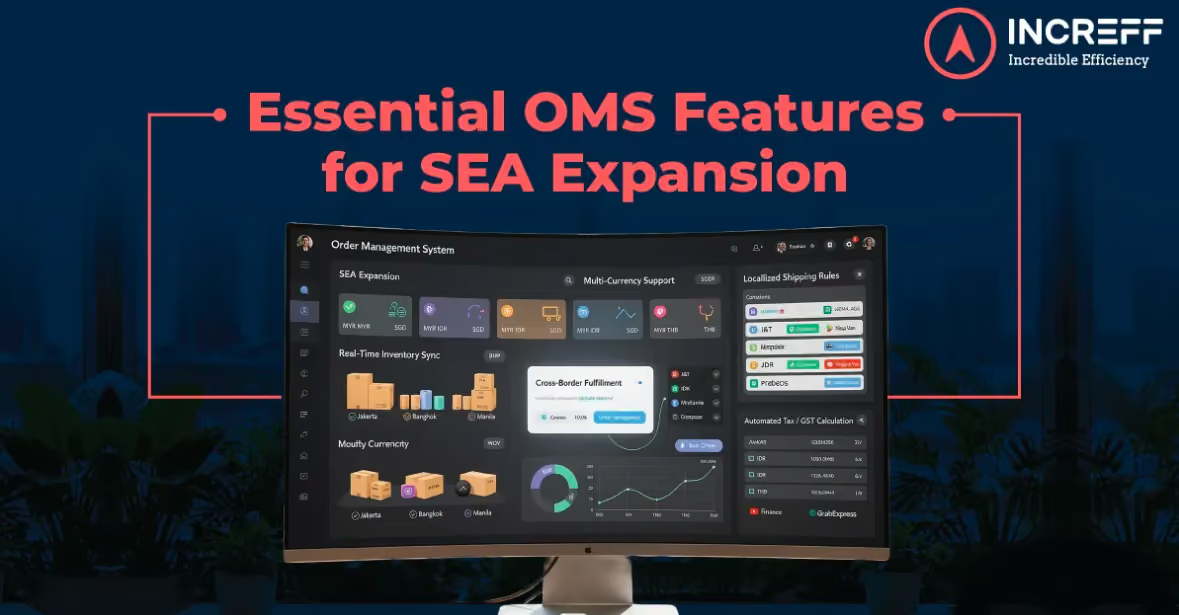





If you manage operations for a growing retail or ecommerce brand in Southeast Asia, this probably sounds familiar: one sales channel sells products that are already out of stock, inventory numbers don’t match across platforms, and your team spends hours fixing issues through spreadsheets and scattered systems.
According to Google's e-Conomy SEA report, Southeast Asia's ecommerce market is on track to surpass $186 billion by 2025, growing at a CAGR of over 16%. Yet research flags that only 22% of logistics and retail players in the region are satisfied with their current order visibility and fulfillment infrastructure.
That gap between order volume and order management capability is exactly where an order management system becomes the difference between scaling efficiently and hemorrhaging margin on every peak sales event.
Key Takeaways
- Southeast Asia's ecommerce complexity (multi-marketplace, multi-carrier, multi-currency) makes a purpose-built OMS non-negotiable for brands operating at scale.
- Real-time inventory visibility across all channels is the foundational capability; everything else breaks without it.
- Intelligent order routing cuts fulfillment costs and delivery times simultaneously.
- An OMS that supports omnichannel fulfillment BOPIS, ship-from-store, endless aisle directly drives revenue that would otherwise be lost.
- Returns management automation reduces reverse logistics costs and protects customer lifetime value.
- The right order management system integrates with your WMS, ERP, and last-mile logistics partners without heavy custom development.
What Core Features Should an Order Management System Include?
Real-Time Inventory Visibility
Every feature of an OMS depends on accurate, real-time inventory data. Without it, you're routing orders blind.
- Unified stock view across all warehouses, stores, and fulfillment centers on one dashboard
- Automatic inventory reservation the moment an order is placed across every channel simultaneously
- Low-stock alerts before you hit a stockout, not after a customer complaint
- Cross-channel sync so the same SKU on Shopee, Lazada, and your website reflects the same live stock number
This eliminates the most common SEA operational nightmare: a product selling out on one channel while still showing "available" on three others.
Intelligent Order Routing
Smart order routing evaluates every available fulfillment source warehouse, dark store, retail location and assigns the order based on proximity, stock availability, carrier SLA, and cost.
- Routes orders to the nearest fulfillment node to minimize last-mile cost and delivery time
- Handles multi-location inventory especially critical for brands with regional distribution across Indonesia, Thailand, Vietnam, and the Philippines
- Scales without degradation during 9.9, 11.11, and 12.12 peak events, when order spikes can hit 10x normal volume
Omnichannel Fulfillment Support
Customers in SEA expect a smooth shopping experience across every platform and store. Your omnichannel fulfillment capability needs to match that behavior.
Key fulfillment modes an OMS must support:
- BOPIS (Buy Online, Pick Up In-Store) — lets customers pick up online orders from the nearest store
- BORIS (Buy Online, Return In-Store) — critical for building post-purchase trust in physical retail markets
- Ship-from-Store — turns retail locations into fulfillment nodes, reducing delivery windows and warehouse pressure
- Endless Aisle — allows store staff to fulfill from central inventory when local stock is exhausted, preventing lost sales
Returns and Reverse Logistics Management
The NRF estimated total retail returns globally would reach $850 billion in 2025. In SEA, where cash-on-delivery orders carry higher return rates and consumers expect frictionless post-purchase experiences, poor returns management directly destroys margin.
A strong OMS should:
- Automate return label generation and refund processing
- Update inventory the moment a returned item is restocked and inspected
- Provide customers with real-time return status notifications
- Flag return fraud patterns based on order history
Analytics, Reporting, and Exception Handling
An order management system that can't surface actionable data isn't managing orders, it's just recording them.
- Real-time fulfillment dashboards with channel-level and SKU-level performance
- Exception flagging (e.g., order stuck in "ready for fulfillment" for over 8 hours triggers an alert)
- Demand forecasting to anticipate volume ahead of flash sales
- Carrier performance analytics to optimize logistics partner allocation by region
- ations vary by country and need to be automated within the order processing workflow
How Should You Choose the Right OMS for Multi-Channel Ecommerce?
When evaluating an ecommerce order management system for SEA operations, assess vendors against these criteria:
- Integration depth, not just breadth — does the Shopee or Lazada integration actually sync in real time, or does it lag by hours?
- Implementation timeline — enterprise implementations in SEA should go live in 4–8 weeks; be skeptical of anything that promises less than 2 weeks for complex multi-warehouse, multi-brand setups
- Scalability under peak load — the OMS must handle 10x order spikes without degradation
- WMS and ERP connectivity — a standalone OMS that doesn't connect cleanly with your warehouse management~ system creates new data silos
- Local support availability — timezone-aligned support matters when fulfillment issues emerge during a live campaign
How Does Increff's Platform Solve the Order and Fulfillment Visibility Problem?
Most order fulfillment problems aren't really OMS problems. They're visibility problems, operations teams finding out inventory is in the wrong place only after the order has already failed.
Increff's Order Management System targets that gap directly.
Rather than routing orders against stale inventory snapshots, Increff works off live stock positions across every warehouse, store, and fulfillment node. Orders are assigned to the location that minimizes cost and delivery time, not just the one that happens to have capacity. Omnichannel fulfillment capabilities ship-from-store, BOPIS, BORIS, endless aisle turn retail stores into active fulfillment nodes instead of inventory dead zones. The WMS integration keeps warehouse operations synchronized with order flow in real time, so fulfillment capacity never becomes the bottleneck during an 11.11 spike. The difference between a brand that absorbs peak demand cleanly and one that oversells, delays, and refunds is almost always how much visibility the operations team had before the problem compounded.
Request a demo.
Frequently Asked Questions
Q: How long does OMS implementation typically take for a mid-size SEA brand?
A: For a mid-size brand with 2–4 integrations and one to two fulfillment centers, a realistic implementation timeline is 4–8 weeks. Complex multi-brand, multi-warehouse setups with custom workflows may require 8–12 weeks. Be cautious of vendors promising live deployment in under two weeks for anything beyond a simple single-channel setup.
Q: What's the ROI case for investing in an OMS for ecommerce?
A: The ROI comes from multiple vectors: reduced overselling (protecting revenue), lower fulfillment costs through smarter routing, reduced manual labor in order processing, faster returns processing (recovering inventory faster), and fewer customer service escalations tied to order status confusion. Analysis of brands in Malaysia and Singapore has shown average annual operational savings of over $40,000 primarily through labor and error-reduction gains and that's before accounting for the revenue upside from improved stock availability.
Q: How does an OMS integrate with a WMS and ERP?
A: Modern OMS platforms connect to WMS and ERP systems via API integrations. When evaluating vendors, verify that the integration is bidirectional (orders flow in, fulfillment status flows back), real-time (not batch-synced), and tested on your specific WMS stack before go-live.
Q: What integrations matter most for SEA omnichannel operations?
A: Prioritize integrations that affect order flow and delivery promises: (1) marketplaces like Shopee/Lazada/TikTok Shop, (2) last-mile carriers/3PLs for label creation + tracking updates, (3) WMS for fulfillment execution, (4) payments/COD confirmation flows, and (5) customer communication tools (WhatsApp/SMS/email) for proactive order and returns updates. Depth matters more than a long checklist—ensure the integrations are real-time, stable under peak load, and support exceptions (partial fulfillments, split shipments, failed pickups).
Q: What security, compliance, and audit capabilities should an OMS have for multi-country SEA operations?
A: Look for enterprise-grade controls that reduce risk as your team and order volume grow: role-based access control (by country, brand, warehouse, and function), approval workflows for high-risk actions (cancellations, address changes, refunds), and a complete audit trail of who changed what and when (orders, inventory allocations, routing rules). For regulated environments, ensure data encryption, configurable data retention, and support for PII controls (masking customer data for warehouse/call center roles). These safeguards prevent “silent” operational leakage—like unauthorized refunds, inventory adjustments, or rule changes—especially during peak events.