





If you're a Supply Chain Director at a retail brand, there's a good chance your last planning cycle was built on a forecast and a demand plan that tried to compensate for that uncertainty with extra safety stock.
According to McKinsey, AI-enabled forecasting can reduce supply chain forecasting errors by 20 to 50%., reduce lost sales and product unavailability by up to 65%, and lower warehousing costs by 5–10%. Yet a 2023 industry study found that inventory distortion, the combined weight of overstocks and stockouts, cost retailers $1.77 trillion globally. That gap between what was predicted and what was actually planned for is precisely where that loss originates.
Key Takeaways
- Demand forecasting predicts what customers will want and how much it is a data-driven output, not a strategy.
- Demand planning takes that forecast and turns it into an operational response across stock, procurement, and distribution.
- Silos between sales, finance, and operations are the single biggest threat to forecast accuracy.
- An integrated inventory management system that connects both processes in real time separates resilient supply chains from reactive ones.
- AI-driven demand forecasting tools can reduce forecast errors by 20–50% and lower warehousing costs by 5–10%, per McKinsey.
What Is Demand Forecasting?
Demand forecasting is the process of predicting future goods and materials demand to help businesses stay as profitable as possible. At its best, it combines two types of inputs:
- Qualitative inputs — drawn from market research, competitor activity, social trends, news signals, and direct customer feedback. These are especially valuable for new product launches or disruptive demand shifts where historical data doesn't yet exist.
- Quantitative inputs — typically internal: historical sales data, peak shopping periods, web and search analytics, point-of-sale data. These form the statistical backbone of most forecasting models.
Modern demand forecasting tools apply machine learning to process both simultaneously analyzing 20 to 40 variables at once, from promotional calendars to regional demand signals, in ways that spreadsheet-based models cannot.
What Are the Main Demand Forecasting Techniques and Methods?
Supply chain practitioners typically work across three levels. Applying the right demand forecasting techniques and methods at each level is what determines how actionable the output actually is:
- Macro-level forecasting examines broad economic conditions, external disruptions, and global market forces. It keeps businesses aware of regional risks, currency shifts, or geopolitical events that could affect demand.
- Micro-level forecasting drills into a specific product, SKU cluster, region, or customer segment. It is especially attuned to sudden or unexpected demand spikes and is the level where most stock management decisions are made.
- Long-term forecasting looks beyond 12 months and informs strategic decisions expansion, capacity investment, new market entry, or supplier partnerships. It is macro or micro in nature, but extended in horizon.
Most supply chains run all three in parallel, feeding different planning processes.
What Is Demand Planning and How Does It Differ from Forecasting?
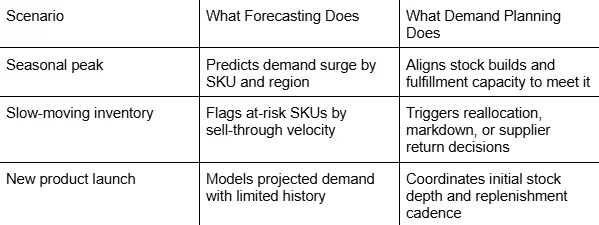
Demand planning takes the forecast and asks: "How will our business actually meet that demand?" It is broader, more cross-functional, and more consequential because this is where inventory decisions get made. Where forecasting is primarily an analytical exercise, demand planning coordinates action across current stock positions, supplier capacity, procurement constraints, financial targets, and consensus inputs from sales, marketing, and finance.
A forecast tells you that demand for a given SKU will rise 30% next quarter. Demand planning determines whether you can actually meet, what's in the warehouse, what's on order, and what the budget allows. Without the planning layer, the forecast is just a number on a slide.
Why Are Silos the Biggest Threat to Demand Forecasting Accuracy?
Demand forecasting framework makes a point that often gets overlooked in planning in supply chain management: silos are the enemy of accurate demand forecasting. For a forecast to be reliable, sales, marketing, finance, and operations all need to be connected in real time, continuously contributing data and insights.
In practice, this breaks down predictably: sales inflates forecasts with pipeline assumptions that never convert; finance cuts plans to meet OTB targets without seeing where demand is strongest; operations replenishes from lagged inventory reports, not live stock positions.
When these functions operate in disconnected systems, the demand plan that gets executed reflects nobody's reality. Integrated demand forecasting tools combined with a shared real-time view across all functions are the antidote to this fragmentation.
What Role Does Seasonality and Market Complexity Play in Modern Forecasting?
Seasonality and shifting customer expectations are two of the most challenging variables for demand forecasters today and both directly affect retail inventory optimization and management at scale.
Seasonality is no longer just about Christmas or summer. Anything that changes customer behavior, a weather event, a viral trend, a competitor promotion creates demand spikes that traditional annual models miss. Demand forecasting tools need to detect these signals at the micro level and respond in near real time.
Customer expectations have also fundamentally changed the inventory challenge. Where planners once managed stock at a handful of distribution centers, they now maintain accurate buffers across hundreds of smaller fulfillment locations, each with its own demand profile.
Gartner predicts 70% of large organizations will adopt AI-based supply chain planning and optimization software by 2030, precisely because static historical models can no longer keep up.
How Does Increff Turn Forecasting Into Execution-Ready Planning?
Most demand planning failures aren't forecast failures. The signal existed; the system just couldn't act on it fast enough, at the right granularity, across the right locations. The gap isn't in the data. It's in the distance between the forecast and what actually happens to stock on the ground.
Real-time inventory visibility gives merchants accurate, door-level stock positions across every channel, so planning decisions are based on what inventory is actually doing, not what a report from last week suggested. Demand-led allocation and replenishment moves the right SKUs to the right locations based on actual sales velocity, not last season's template reducing the regional overstock that creates markdown pressure before it builds. Assortment intelligence through Merchandise Financial Planning aligns buy depth to each store's real demand, so OTB dollars aren't locked into sizes and colors that won't move in that location. Early sell-through alerts via Co-Pilot flag at-risk SKUs weeks before they hit critical thresholds giving merchants time to act with a small, early correction instead of a large, late clearance cut. And Planning & Buying closes the loop so what gets ordered is grounded in live demand signals, not historical averages that no longer reflect how customers are buying.
The result is better inventory turns, healthier GMROI, and planning in supply chain management that's synchronized with what's actually happening across the supply chain, not just what a model predicted three months ago.
Conclusion
Demand forecasting and demand planning are distinct disciplines that most supply chains treat as one. The methods you use to forecast determine how accurate your signal is. But planning in supply chain management determines whether your teams can act on that signal translating it into stock decisions, purchase orders, and replenishment triggers before the opportunity or the problem compounds. For retail inventory optimization and management especially, the cost of conflating them shows up every season in excess markdowns, lost full-price revenue, and working capital tied up in the wrong inventory. Getting both right connected in real time is what separates a supply chain that responds to demand from one that's always catching up to it.
Request a demo.
Frequently Asked Questions
Q: What is the simplest way to explain the difference between demand forecasting and demand planning?
A: Forecasting answers "what will customers want and how much?" Planning answers "how will we make sure we can meet that?" Forecasting is the input; planning is the response. Both are necessary, but they serve different functions in the supply chain.
Q: Do demand forecasting tools use AI and machine learning?
A: Yes. Modern demand forecasting tools use AI and machine learning to analyze sales history, seasonality, promotions, and external signals like weather or trends. ML models continuously learn from new data, improving accuracy over time and outperforming traditional statistical methods, especially for fashion and short-lifecycle products.
Q: What are the most common demand forecasting techniques used in retail?
A: The most common demand forecasting techniques in retail are time-series analysis, moving averages, exponential smoothing, regression models, and machine learning–based forecasting. Retailers often combine quantitative methods with qualitative inputs like buyer judgment and market trends to handle seasonality, promotions, and new product launches.
Q: How much do demand forecasting tools cost?
A: Demand forecasting tools typically cost between $500 and $10,000+ per month, depending on data volume, SKU count, and AI capabilities. Entry-level tools start low for small brands, while enterprise platforms with ML, multi-channel inputs, and integrations are priced based on usage or annual contracts.
Q: What are common causes of a low fill rate, and how can we reduce them with process changes or automation?
A: Common causes: bad forecasts, wrong safety stock, late/partial supplier deliveries, poor allocation, inaccurate inventory, slow replenishment cycles. Fixes: automated replenishment, dynamic safety stock, exception-based alerts, cycle counting/RFID, tighter supplier OTIF tracking, and allocation rules tied to demand + priority tiers.